

National probation service has a history of apathy, obfuscation of truth, lack of accountability and an unwillingness to learn from its failings.
One of the easiest ways to see this is in the way complaints about NPS services are handled. This is a three stage process.
The initial stage is communication with a person’s probation officer, who will attempt to settle the issue informally. The next step is what is known as a stage one escalation. This is where a formal response is received and the matter investigated by a local office. In this case this is Yorkshire and The Humber Regional Hub which can be found based at West Offices, Station Rise, York.
If issues are still unresolved following this matter moves to a stage two escalation. At this stage, the complaint is examined by a panel made up of people who work for National Probation Service and the results reported back to the complainant.
This procedure for dealing with complaints is outlined in a document in public circulation. This is Probation Service Instruction (PI) 51/2014.
Here is a link to that document:
https://www.gov.uk/government/publications/handling-complaints-pi-512014
I mentioned earlier that NPS has a tendency towards unaccountability, and willingness to learn from its failings.
One of the of the most pernicious aspects of this organisation is the degree to which it will attempt to protect probation officers, and their supervisory staff from the effect of their own misconduct.
Pauline Forbes Williams works for National Probation Service based in York. Her job title is Head of Complaints Team for NPS Yorkshire and the Humber.
She is effectively the first line of defence for NPS when a stage one complaint is raised. The purpose of her intervention very often is seen in early-stage attempts to get a complaint dismissed without any form of examination and more often on questionable grounds.
It would appear from evidence obtained that the means of her doing this include misrepresenting Probation Service Instructions on handling complaints. For example, she may say that a complaint is time barred from being examined when in fact, no such time bar exists. She may say that a complaint is has already been dealt with in other matter when in fact this is not the case.
All of these are ways and means by which NPS – often with knowing and deliberate dishonesty – seeks to evade proper examination of complaints brought to it.
As a consequence lessons regarding poor service are never learned and the service fails to improve.
It appears NPS don’t like complaints much and this relates back to the matter of lack of accountability and willingness to learn from failings. It may also be the case that NPS is aware that the service provided is in many ways wholly inadequate to the point being on the verge of collapse.
Consequently, there is a massive incentive on the part of NPS to minimise, trivialise, diffuse and fragment any complaints put to it and to do so via any means at its disposal. Even if it means the methods for discontinuance of a complaint are contrary to the duty of care and PI 54/2014 instructions for handling complaints.
Or contrary to the truth, as in this matter.
This brings us back to Paulette Forbes-Williams.
A complainant who we will call Mr X for the purpose of this article made a complaint which was dealt with at stage two. The complainant requested details of the appeal panel, and who sat upon it.
This is not an unreasonable request for information!
The fact that the information was not provided by NPS at the conclusion of the second stage of the complaint response suggests that they were seeking to hide details of who was sat upon the appeal panel, possibly, because there was some conflict of interest or prior knowledge of Mr X by one of the persons sat on the panel that may have prejudiced their opinion and the way they approached the complaint.
The response of Paulette Forbes-Williams is seen below.
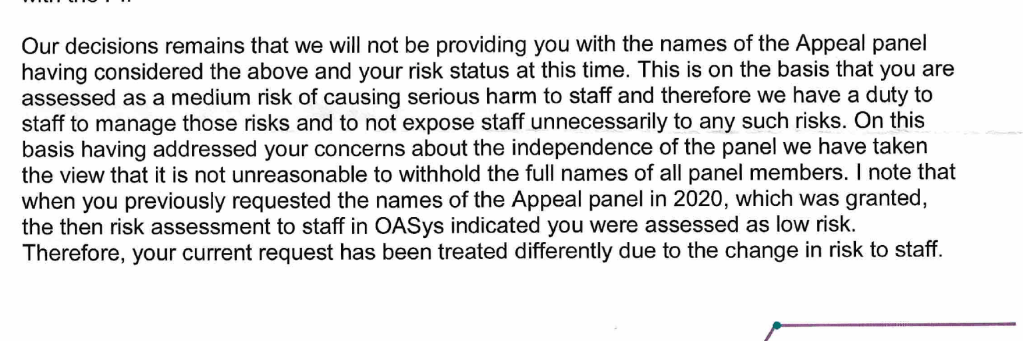
So in short the reasons Mr X was not provided with a copy of the names of the appeal panel – according to Forbes-Williams – was because Mr X posed a medium risk to staff.
This is clearly wrong because Mr X obtained a copy of information from National Probation Service around a month prior to the letter seen above from Paulette Forbes-Williams.
Two extracts from this are seen below.

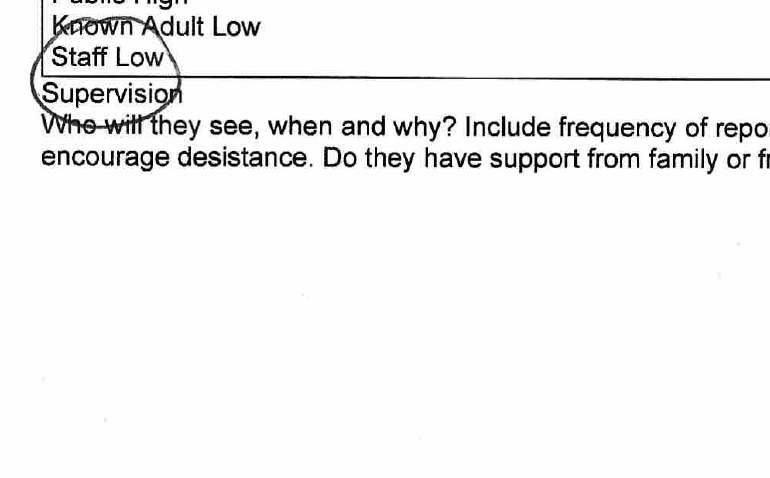
These clearly state that Mr X was not in fact a risk to NPS personnel as stated by Forbes-Williams. That he was classified in fact as a low-risk offender. That the risk presented to probation staff was low and a risk presented to the public was low.
Therefore, in her grounds for refusal to provide the information requested, Forbes-Williams wholly misrepresented the situation in order to deny access to the information.
It’s reasonable to imagine that prior to issuing this complaint response Paulette Forbes-Williams would have checked the records of Mr X and the level of risk he supposing presented before making such broad comments as appear in the letter.
Or maybe not!
When the facts were put to Forbes-Williams from NPS’ own documents this response was received:
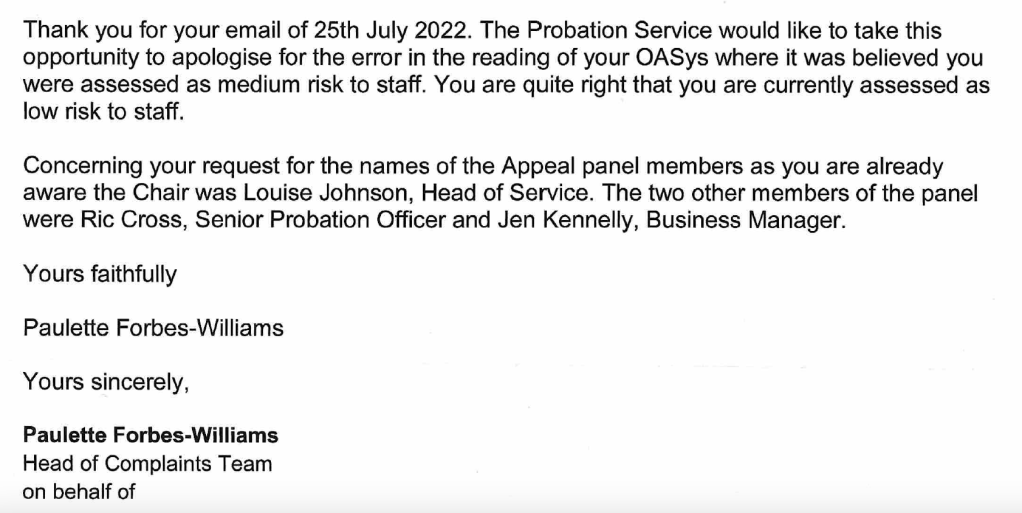
As stated there are clear grounds for why NPS might have sought to withhold information on the composition of the appeal panel from Mr X and it would appear on past form based on evidence seen that Forbes-Williams will utilise any means to avoid either progressing a complaint or providing information.
In any case, it is beholden upon someone whose job title is Head of Complaints to be able to provide the correct information in complaint responses and data access requests and not to act in bad faith to unfairly disadvantage Mr X in the pursuit of information he has requested.
Some hope of that here!
Given Paulette Forbes-Williams, history of malfeasance, misfeasance, and purposeful misconduct in public office in relation to complaint handling I favour, the explanation that the data was knowingly & deliberately withheld forming a breach of Section 77 of The Freedom of Information Act as well as misconduct in public office on the part of Forbes-Williams. S.77 of FOI makes it a criminal offence for a person to do anything with the intention of preventing the disclosure of information pursuant to an FOI request. You can read more about this Act here:
https://www.legislation.gov.uk/ukpga/2000/36/section/77
All quite predictable so far. You’ll recall the opening lines of this article discussed apathy, obfuscation of truth & lack of accountability.
Here’s where these factors come into play in relation to this matter.

Paulette Forbes-Williams’ supervisor for the purpose of such matters as this is Lynda Marginson CBE. She is the Regional Director for the Probation Service in Yorkshire and the Humber. You can find her on Twitter @lyndamarginson where she relentlessly bangs the drum that all is good in the world of NPS.
The matter of Forbes-Williams misconduct in relation to this and other matters was put to Lynda Marginson. The response as seen below.
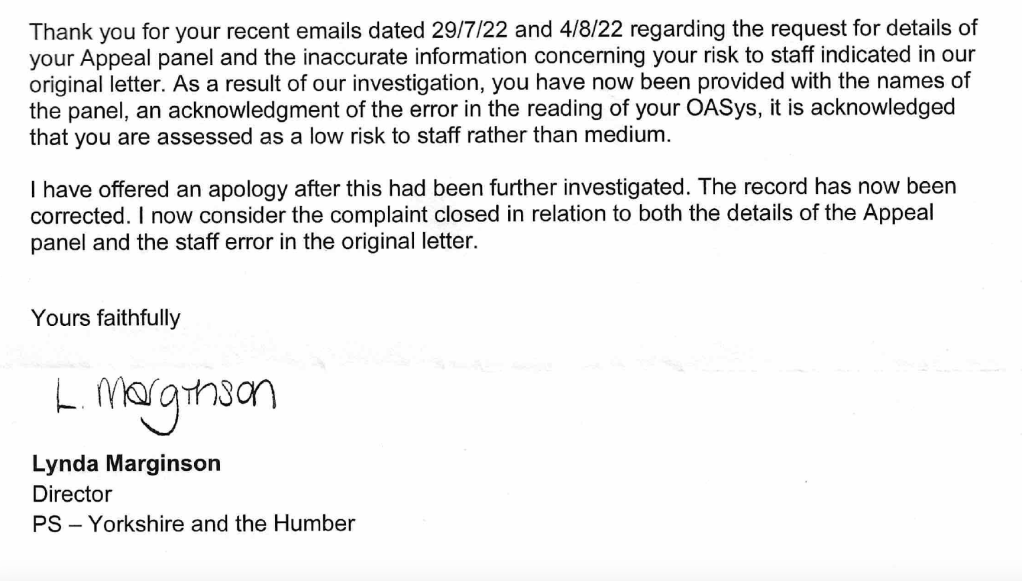
Bland assurances that a proper investigation was carried out fall somewhat short of the Probation Service Instructions for how a complaint should be actioned. You will recall that PI 54/2014 for dealing with complaints specify a three stage process. Mr X wrote back to state:
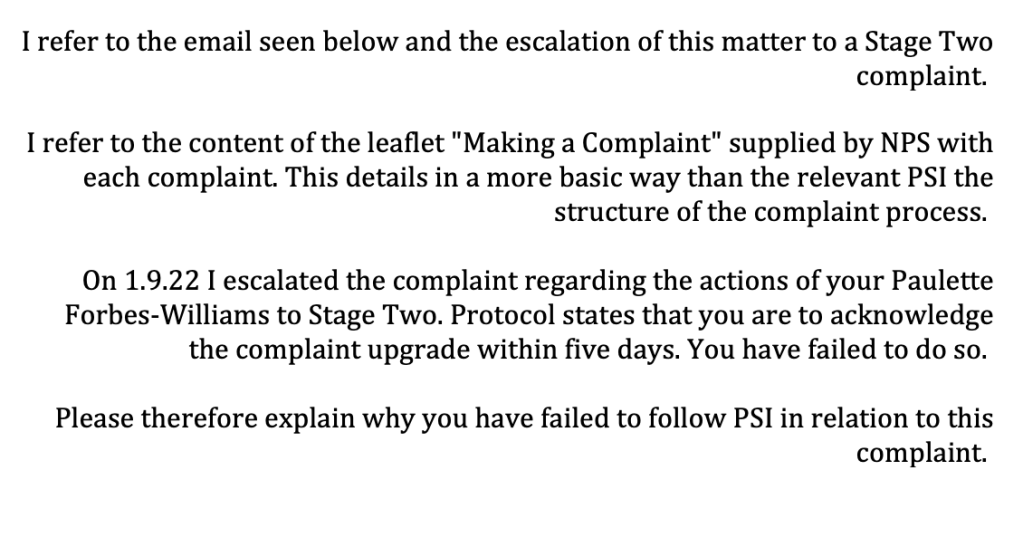
…and expressed concerns regarding the rigor of the investigation into Forbes-Williams for what clearly amounts to misconduct to try to retain data. A stage one complaint is supposed to provide some explanation of the means by which a matter has been investigated. In this case it looks likely that with a senior member of NPS being caught out the proper procedure and process has been skipped.
What Marginson has sought to do is to stop the matter proceeding on to being a stage two complaint response by herself deciding that there is no further aspect of this complaint that needs to be examined. You can see for yourself, the paucity of a response given by Marginson and the lack of rigor by which the matter was investigated.
It is clear that the process by which investigations are conducted into complaints about NPS is designed to block any reasonable investigation into a complaint made by such as Mr X by any means possible. Paulette Forbes-Williams being the first stage gatekeeper in that.
However when she is found out for misconduct don’t count on the likes of Lynda Marginson offering appropriate oversight: organisations such as NPS need people like Forbes-Williams to limit, restrict and deny legitimate and reasonable complaints by all means possible. This means someone like Forbes-Williams – because they are prepared to bend the rules to protect NPS – must themselves be protected by their immediate superiors when they do so.
 Legal Babble