Daylight Robbery! How Police Evade Accountability on Data Access Requests

In a November 2020 report The Information Commissioner (or ICO) wrote the forward to a report and stated:

โ€œIt is my hope that police forces, and other organisations, will read this report, understand their current position and identify actions they can take to improve or maintain good performance. We will continue to work with the police to support their compliance with information rights laws.โ€

Some hope of that!

When the Commissioner wrote of โ€œtheir current positionโ€ she was using soft-soap language for what would have been more accurately described as clear flouting of the law and institutional efforts to evade disclosure of information.

The full report can be read at https://ico.org.uk/media/action-weve-taken/reports/2618591/timeliness-of-responses-to-information-access-requests.pdf
A copy of the title page of the report.

Letโ€™s take a look at West Yorkshire Police as being a recent example of this failure to comply with both the law on data access requests, ICO guidance and their general obligations to maintain good relations with the public.

The Office of The Police and Crime Commissioner for West Yorkshire has for some months now been aware of suboptimal handling of data access requests by West Yorkshire Police. They have noted an increasing number of complaints from members of the public about poor service and inadequate provision of data by Information Access departments at that force.

A Professional Standards Department investigation into a complaint brought by a member of the public that subject access requests made had been delivered late, were missing data and had been purposefully frustrated by police was mishandled by Professional Standards Department. The Office of The Police and Crime Commissioner for West Yorkshire (the PCC) found that the investigation had been substandard in several areas.

As per usual for a police Professional Standards Department the conclusion to the investigation ran along the lines of โ€œWe have investigated ourselves and found nothing wrongโ€. This outcome is usually achieved by PSD adjusting the frame of reference to the complaint to disregard all that inconvenient evidence that proves the complaint is correct. This indeed appears to have been done in this instance.

Accordingly PCC wrote in their examination of the complaint handled by PSD:

โ€œThe decision I have reached is that the outcome of the complaint was not reasonable and proportionate… [that a proper complaint investigation involved] Full consideration of the Information Management Departmentโ€™s handling of [the complainants] requests over the last year, including all the ones he brought to the complaint handlerโ€™s attention and the involvement of the ICO in those requestsโ€

Which is as I stated: police complaints department ignoring evidence which proves the force has misconducted itself.

PCC wants a re-examination of major aspects of the complaint and also wants to see:

โ€œFull consideration of the wider context concerning the timeliness of replies to Subject Access requests by West Yorkshire Police, including the engagement with the ICO. This should take into account the findings and recommendations from the ICOโ€™s report from November 2020 โ€œTimeliness of Responses to Information Access Requests by Police Forces in England, Wales and Northern Irelandโ€

…in other words the report I referenced above.

This is to say the least mildly inconvenient for police. An examination of the timelines for a dip-sample of data access requests made (but not fulfilled on time) is one of the easiest ways to see that police have broken the law in relation to these requests.

But of course if West Yorkshire Police were to investigate themselves and report to PCC the errors made in supplying data requested by members of the public then it would be impossible to hide the scale of information deliberately hidden.

So the response of Rene Prime, Reviewing Officer at Professional Standards Department to PCC states:

โ€œUnfortunately, I do not agree with the actions you propose should be taken to resolve the complaint. I agree that full consideration should be given to [the complainantโ€™s] contact and requests to Information Management over the last year and the issues that have arisen around those requests, however I do not consider that it is appropriate to consider the wider context of perceived issues within the Information Management Team.โ€

Which is as slippery a way as can be found to avoid PCC discovering the full extent of West Yorkshire Policeโ€™s efforts to evade the production of data requested by members of the public. This reply also in effect โ€œcuffs offโ€ (to use a West Yorkshire Police term) the recommendations of PCC which have been made in the light of the many other individual complaints from members of the public regarding failed data access requests.

The standard approach to data access requests made by police forces is not compatible with legislation allowing the public access to data.

Secretive, evasive and mendacious: police hate requests for information from the public.

Instead they seek to frustrate access requests, deny even the production of non-contentious materials and in most cases seek to delay the production of data beyond time limits in law so that the requester will be liable to forget all about the request and go away. At all stages the intention is to frustrate, vex and delay. This is often because the police operational mindset is focused towards evading any form of insight into their working practices or accountability. Ergo the more the public get to know about police methods and actions by data access requests the less the freedom for police to do more or less as they wish. An informed public is aware of the abuses of power and the bending of the law that the police perform daily.

The above correspondence gives you something of an insight into the attempts police make to avoid production of data which would make them accountable. This time last year the police complaints process was subtly changed to make the local PCC engage more with appeals into poorly handled complaints. It will be interesting in the light of the above to see if West Yorkshire Policeโ€™s PCC has the guts to challenge ongoing breaches of the law over data access requests to West Yorkshire Police.


Top Tips for Aspiring Criminals

Have you ever seen a magician who happens to be very capable at making watches, wallets and suchlike vanish from your pocket or wrist? Itโ€™s quite a sight when someone that capable manages to remove something from your person without you being aware of it.

A friend of mine works for a local police force. Every so often he updates me on all the recent criminal activity theyโ€™ve not been able to stop. Generally itโ€™s quite a lot: theyโ€™re forever behind the curve and not in front of it.

But like with the magician who can remove your watch or wallet in a stage show once you know whatโ€™s happening itโ€™s easier to not let it happen to you. So hereโ€™s a couple of tips which might help you to protect yourself.

There are two big recent growth areas of crime. The first of these is the theft of high powered vehicles. Audiโ€™s seem to be targeted especially at present and are then broken down for parts: Audi spares being especially expensive.

A nice new Audi.
Probably wonโ€™t be there for long!

One village with only about 140 homes was recently targeted. Each night over seven nights two homes were burgled and car keys removed. These days this sometimes comes with an assault on the homeowner if the burglar is disturbed. In the olden days such a thief would make off in fear when an upstairs light came on.

The second growth area is the wedding robbery. This again takes place by stealth. At a busy wedding the criminal (often a young woman between 18-30 years old who no-one would otherwise suspect) invites herself. When everyone is dancing around at the end of the night jewels, gold and expensive watches are removed from wrists, necks etc. and often looked after by elderly relatives who are not dancing themselves. This is when the sneak thief strikes & distraction techniques seem to be used. The gangs concerned in this type of robbery seem especially to be targeting Asian weddings.


The Rise of the Liars

Has someone ever asked you “Does my bum look big in this?”. Did you feel inclined to answer honestly or fib a little to offer some comfort and solace while still being truthful?

The simple fact is that lots of people lie on an almost daily basis. The majority of these are “white lies” which are popularly thought to do no harm, but despite this have a habit of coming back and affecting us in all sorts of ways.

However we used to expect more from people in public positions. The popular myth of the lying politician has of course been around for generations. But often this was more a matter of an MP having been caught out when circumstances rapidly change, or they were simply poor communicators, as opposed to them directly seeking to deceive. Once being caught out as a liar would end a political career either via resignation or sacking. Not any more.

I have dealt with public bodies for the best part of thirty years now and I have detected a drop in standards from state-run organisations which roughly parallels the drop in standards in public life generally.

Sorry to ruin your day by reminding you of these mendacious b******* (pt. 1)

Here’s my theory.

When Tony Blair’s New Labour came to power in 1997 and Blair walked into Downing Street for the first time there appeared to be – to the casual observer – a public demonstration of joy as people lined Downing Street cheering and waving flags. Hooray for the new dawn for Britain!

Except that this wasn’t the case. Those people were all Labour Party activists and not members of the public. But we were supposed to think these were happy Londoners expressing gratitude. Thus the New Labour Goverment of 1997 – 2010 started its term in office with a cynical little deception.

And so it continued. The rise of political spin and outright deception marred any beneficial policies New Labour brought. The 1997 cohort of MPโ€™s still present in opposition continue to practice the same spin and evasion when caught out not doing their jobs that theyโ€™ve practiced for years. For more details of the long term effects of this spin and deception ask the average Iraqi citizen.

Some time past mistakes made by organisations such as HMCTS in handling claims were few and far between. Staff were trained, diligent and in a job more or less for life. When a mistake was made an apology was issued and a correction made quickly. Thus mistakes were learning experiences which made staff better employees and future errors less likely. However from 1997 onwards I remember I detected there was a shift: mistakes became something to be covered up like guilty family secrets. Court Managers became adept at avoiding addressing the key aspects of a complaint (“we have investigated ourselves and found nothing wrong”) in order to avoid blame.

This is entirely parallel to the New Labour age of spin and public relations managment style Government. Anyone remember “A good day to bury bad news”? That one was a big hit back in 2001.

Arguably in the last few years the efforts made to avoid admitting clear errors have mutated into something far more corrosive. Such as Court Managers and Area Directors now deny – in the face of clear documentary evidence – that an error in a claim has occured at all.

The rise of political lying has been very well documented in the last few years and started in ernest with Tory Chancellor George Osborne and Michael Gove who clearly sought to decieve and deployed mendacity as a deliberate political weapon. It seems we now have a Government who are happy to issue untruths on a daily basis secure in the knowledge that the world moves on so fast that by the time their comments have been fact-checked and the truth known that the public will largely have swallowed the lie.

So it is now with public bodies. In many cases the organisation – and I speak of such as MoJ and HMCTS etc. – as I have the majority experience of these two – are so chaotically run that more and more daily errors occur and it is impossible to catch all of these and correct them. For example case files are returned to storage incomplete and disordered as staff run around a a blind panic with no clear idea what they are tasked with.

Sorry to ruin your day by reminding you of these mendacious b******* (pt. 2)

The end result of all this is clear. Any trust remaining in public institutions vanishes. No learning from an error occurs and so it is repeated.

Management cannot address every error as it occurs and so they outright deny such a problem has happened, even when it is clear the whole system is close to collapse. The rise of political lying gives them an example to follow and once again sets the tone for how those employed by the state act. It’s Nelson putting the telescope to his eyepatch and saying “I see no ships”.

The Biggest Sensitive Personal Data Loss in NHS History.

Currently the scandal around COVID-19 and the supply of contracts for PPE to friends of Conservative Party MPโ€™s and Tory party donors hangs over Britain like an unpleasant smell.

But there’s a similar NHS procurement scandal with a somewhat longer history. This shows that – if anything – lessons are never learned which it comes to NHS outsourcing. The fast and cheap route is often the chosen path and this leads to incalculable consequences for individual patients.

TPP – or The Phoenix Partnership as they are otherwise styled – are a company based in Horsforth, Leeds and provide computer systems and software for GP’s surgeries in the British NHS.

Their website claims that their systems assist in:

increasing efficiency, driving innovation and empowering patients.

…all of which is the usual marketing hot air.

The standard package sold to surgeries is an error-riddled piece of software called SystmOne. This is used by about a third of GP practices in England and holds the records of million of patients.

The present incarnation of this software was introduced in 2012 The Information Commissioner’s Office, the public body concerned with protection of individuals data, has long had concerns about the quality of the software and its ability to protect the sensitive personal data of patients.

A series of coding errors on SystmOne caused – from 2017 onwards – an incredibly significant and serious data loss.

Pictured is TPP founder Frank Hester with former PM David Cameron. Hester has been a part of trade missions led by Cameron and former MP Kenneth Clarke. Hester himself was awarded an OBE – tellingly at about the same time his company was managing to loose the sensitive personal data of some 140,000 people. Tellingly following the revelation of the scandal he has not seen fit to hand this OBE back.

TPP’s parent company made ยฃ9.1m operating profit on ยฃ48.5m sales in 2015-16. This was concurrent with the data error discussed in this article and the company has more than ยฃ56.2m net assets making it easily worth ยฃ100m. That the company cannot summon the resources to then produce software which enables GPโ€™s surgeries to keep patient data confidential is quite astonishing.

There have been concerns with the security of data from TPP software even before the knowledge of 140,000 patientโ€™s records being shared became public.

Here’s an extract from an article from Digital Health, dated May 2017. This is around a year before TPP saw fit to inform NHS Digital of the poor quality of its product and the consequences of this. The full article can be seen at www.digitalhealth.net/2017/03/hester-hits-back-over-tpp-data-security-concerns

It states:

“…it comes as the BMA wades into the increasingly murky debate over who controls access to the GP records of millions of patients.โ€

โ€œThe doctorโ€™s trade union is now calling on the thousands of GPs using TPPโ€™s SystmOne electronic record to โ€œurgently consider any action they need to takeโ€, including switching off the systemโ€™s โ€œenhanced data sharing functionโ€.
โ€œIt has become clear that if patient records are being shared through TPPโ€ฆ GPs are unable to specify which other organisations can have access to their patientsโ€™ recordsโ€

โ€œSome media have reported [www.telegraph.co.uk/news/2017/03/17/security-breach-fears-26-million-nhs-patients/] that it allowed patient records to be viewed by โ€œthousands of strangersโ€ not involved in their care. TPP has disputed these claims, stating that patients records cannot be accessed without their permission, except in emergencies.

Around 12 months later the errors caused by TPP failing to construct their software correctly led to some 140,000 persons having their personal medical data shared without their consent. This amounted to the biggest data loss in NHS history.

Not that it takes a coding error alone for SystmOne to share your data. If you do not explicitly opt out of having your data shared then the software will enable potentially thousands of third parties to be able to access your patient records.

Often this means that such data is shared with American organisations who pay the NHS for bulk healthcare data. In short then unless you explicitly tell your surgery not to share your data then SystmOne will automatically monetise your data to share with third parties for which the NHS will be paid. It takes an enquiry with NHS Digital to discover exactly who has had access to your data. No doubt your surgery and the NHS overall would rather you didn’t know about the monetisation of your sensitive personal data.

No wonder that in the 2017 article in Digital Health we can see Hester fighting tooth and nail to prevent any restrictions on TPP products being able to share patient data with third parties!


Now to focus back on the issue of the major data loss.

In respect of the 140,000 persons whose data was share against their express wishes the following was said in The House of Commons on 2 July 2018 by the Parliamentary Under-Secretary of State for Health who issued a statement to Parliament in which she said:

โ€œNHS Digital recently identified a supplier defect in the processing of historical patient objections to the sharing of their confidential health data. An error occurred when 150,000 Type 2 objections set between March 2015 and June 2018 in GP practices running TPPโ€™s system were not sent to NHS Digital. As a result, these objections were not upheld by NHS Digital in its data disseminations between April 2016, when the NHS Digital process for enabling them to be upheld was introduced, and 26 June 2018. This means that data for these patients has been used in clinical audit and research that helps drive improvements in outcomes for patients.โ€

โ€œSince being informed of the error by TPP, NHS Digital acted swiftly and it has now been rectified. NHS Digital made the Department of Health and Social Care aware of the error on 28 June. NHS Digital manages the contract for GP Systems of Choice on behalf of the Department of Health and Social Care.โ€

She went on to say…

โ€œTPP has apologised unreservedly for its role in this matter and has committed to work with NHS Digital so that errors of this nature do not occur again. This will ensure that patientsโ€™ wishes on how their data is used are always respected and acted upon.โ€

โ€œNHS Digital will write to all TPP GP practices today to make sure that they are aware of the issue and can provide reassurance to any affected patients. NHS Digital will also write to every affected patient. Patients need to take no action and their objections are now being upheld.โ€

โ€œThere is not, and has never been, any risk to patient care as a result of this error. NHS Digital has made the Information Commissionerโ€™s Office and the National Data Guardian for Health and Care aware.โ€

The full text of the statement can be found at:

www.parliament.uk/business/publications/written-questions-answers-statements/written-statement/Commons/2018-07-02/HCWS813

On discover of this – the largest data loss in NHS history – The Information Commissioner’s Office immediately sprang into action. And as expected did nothing. This is par for the course for ICO.

At present it is not known what the commercial relationship between TPP and NHS Digital may comprise. Therefore it cannot be said if one has indemnified the other from the consequences of data losses. This may be why ICO fails to act.

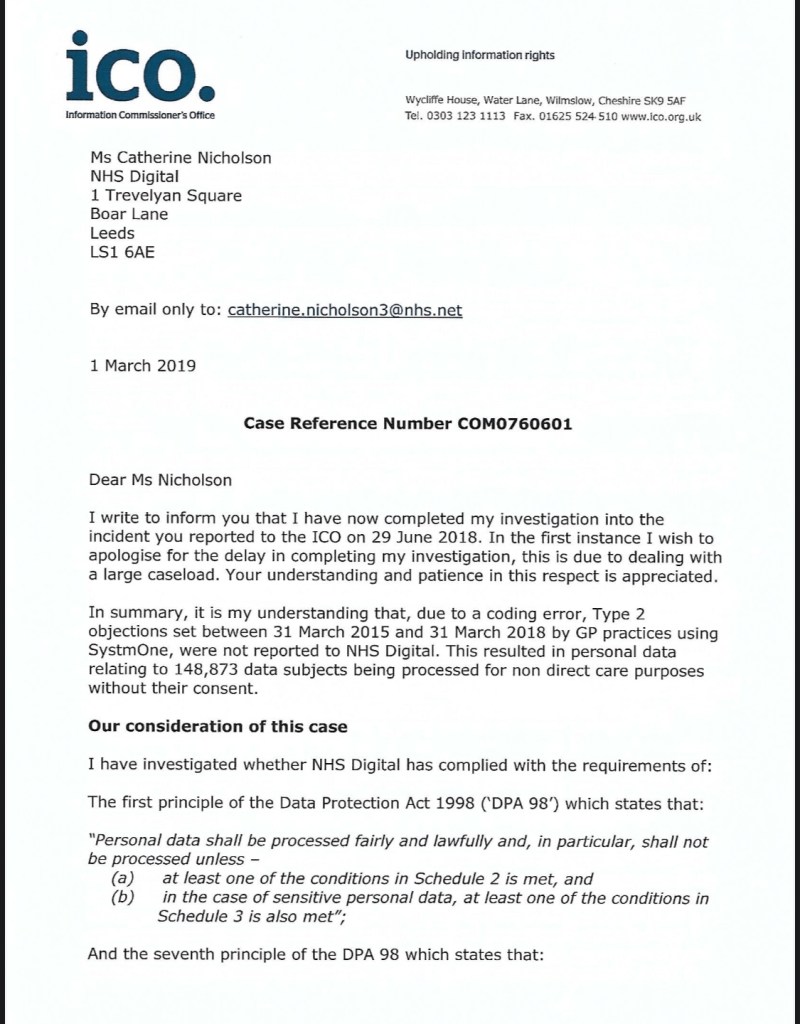
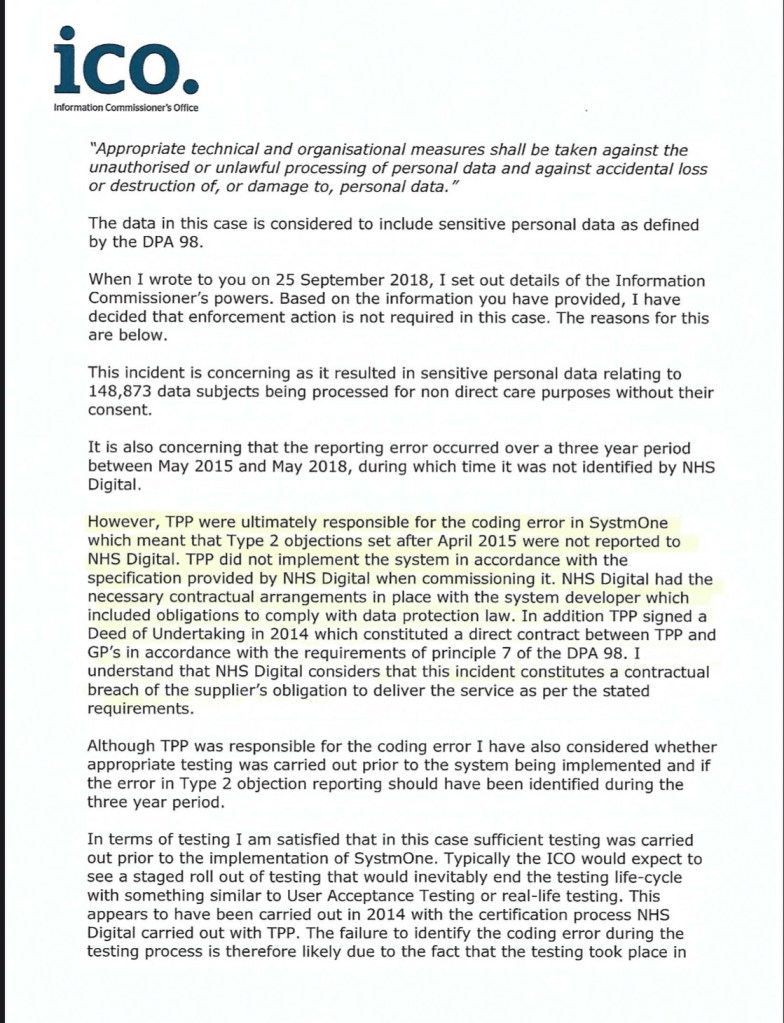
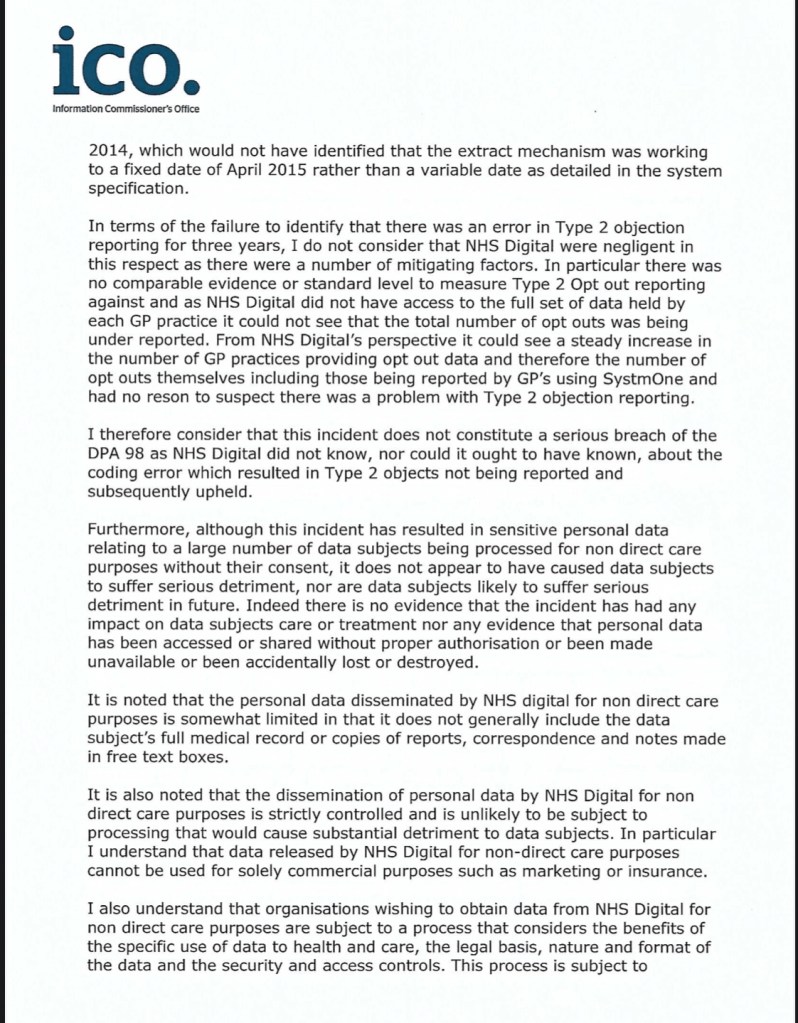
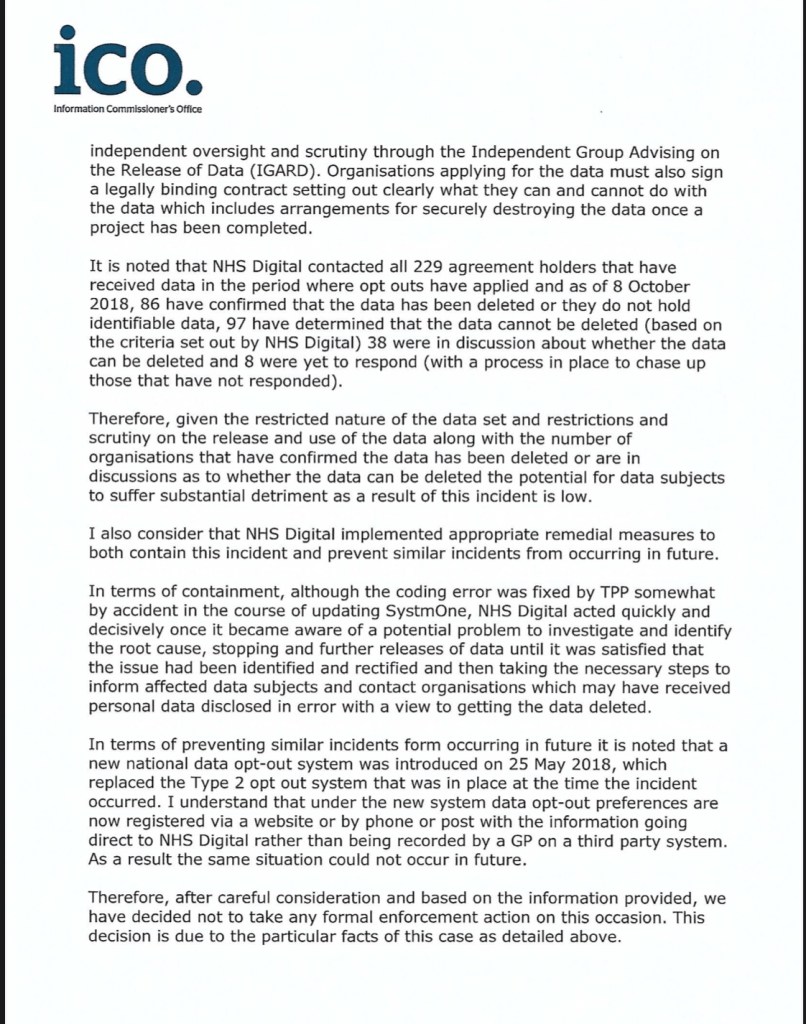
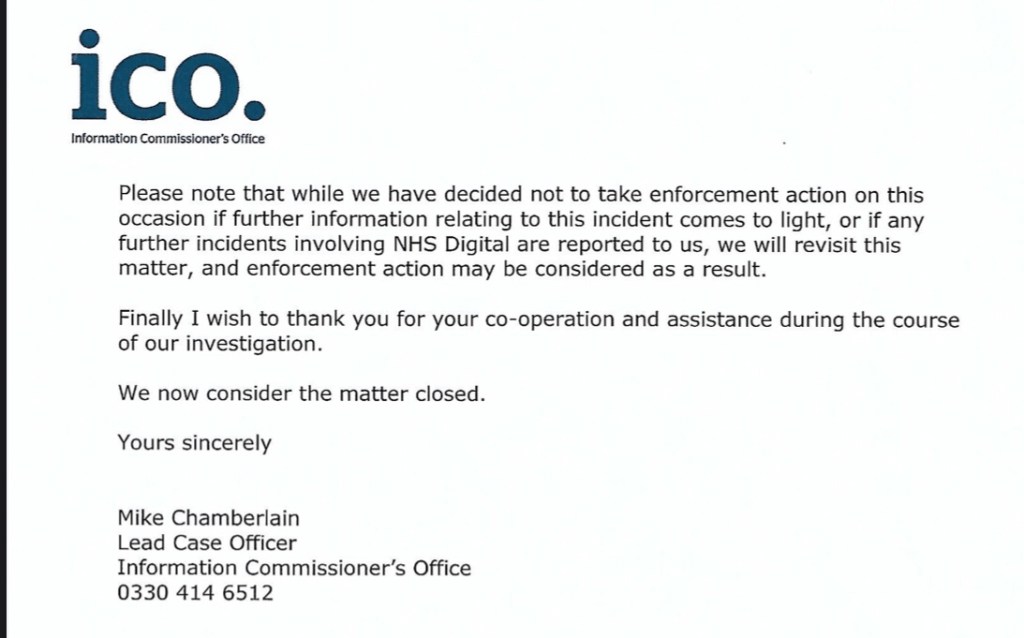
Look at the extracts below from a letter sent from ICO to NHS Digital. As far as Iโ€™m aware this is the first publication of this document in any media:

All of tale of failure is par for the course in modern Britain.

Shoddy companies such as TPP gain contracts for services to the public sector but produce shoddy work. When errors happen it’s a “learning experience” for all concerned rather than one in which heads roll. Supervisory organisations such as ICO fail to act as appropriate. And the gravy train keeps on running!

The case of Julian Assange & Press Freedom

I write in relation to the Julian Assange extradition attempt by the US government. This has received a ruling today which has stated that Assange cannot be extradited to America on the basis of mental health concerns.

It is widely considered that the case against Assange has been cooked up as revenge against Wikileaks publication of atrocities by the US military in the Middle East. That such was designed to frighten any journalist in the future from exposure of similar state backed horrors.

As this post will detail The Ministry of Justice in the UK is quite prepared to commit abuse of process to also persecute those who publish material which exposes its wrongdoing and incompetence.

Assange in transit in a prison van from Belmarsh high security prison where he has been held.

The ruling in the case is that extradition cannot take place as America cannot guarantee the safety of Assange in a US prison in the light of his apparent suicidal ideations. These thoughts probably stem from his continued persecution for many years over Wikileaks publication of video footage of atrocities committed by the US military against civilians.

The points made regarding the safety of the US prison system of course apply equally – if not more so – to British prisons. Belmarsh was the choice of prison for Assange on the basis of the additional security given to inmates there.

The other thing that struck me about the judgment is that the extradition to America was refused not on grounds which assert and re-enforce the freedom of the press or the ability of such as Wikileaks to publish material which challenges authority but on the grounds of safety for the defendant.

The decision was made by a District Judge. Anyone familiar enough with the British legal system will likely be aware that the judge has chosen an anaemic third way in order to dismiss the case for extradition. No wonder the decision is likely to be appealed! Rather than outright confrontation of the prosecution case which was designed both as an act of revenge against Assange and a threat to any future journalists exposing official misconduct the judge chose a way which avoids these prosecution arguments being confronted and carefully debunked.

If a decision was made to extradite on the basis of the case put on behalf of the prosecution then the risk to press freedom in future would have been grave. As it is the case has been a warning shot to anyone thinking of publishing contentious material regarding state backed misconduct.

The judge has accepted the proposition advanced by Assangeโ€™s legal team that an American prison is not sufficiently safe for someone with suicidal thoughts.

Were he still alive Jeffrey Epstein would also likely agree that an American prison is an insufficiently safe environment for people who have – like Assange – embarrassed or risk embarrassing those who hold the levers of power in America.


We donโ€™t have to look to a high-profile case such as this to see official misuse of power in an act of revenge against those who publish material which would embarrass authority, as our own Minisry of Justice in Britain are quite prepared to carry out misconduct in public office in this way.

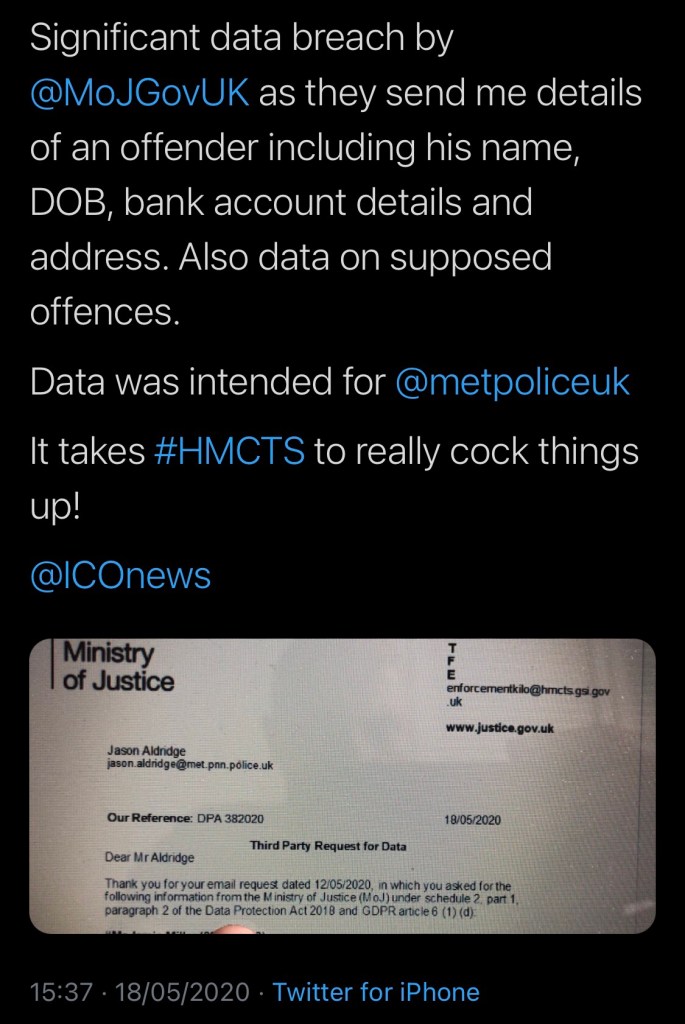
In May this year I was sent material in error by MoJ. This was a letter intended for the Metropolitan Police in relation to Proceeds of Crime Act proceedings against an individual in the Kent area.

The data sent to me in error constituted a considerable Data Protection Act breach and covered the name, address, date of birth and bank details of the individual and other compromising data. Such data in the wrong hands could have resulted in considerable fraud committed against the data subject by the misuse of his personal details. I informed both The Information Commissionerโ€™s Office and the data subject about this.

I also posted – with no small amount of schadenfreude – the tweet seen below. No aspect of the content of this tweet breached revealed data on the data subject and thus was not actionable. It simply and quite rightly embarrassed MoJ as an organisation which is incompetent in the handling of personal data.

Despite the fact that MoJ were wholly in the wrong over this entire matter they decided to go on the offensive and instructed West Yorkshire Police to arrest me in relation to offences under The Data Protection Act.

Police, having seen no evidence of any offence committed in civil or criminal law, nevertheless took the word of MoJ as gospel and in so doing broke the law themselves not least by committing a wrongful arrest.

I was arrested and held in custody at the police station. It was relegated much later in an email chain from the Head of Security at MoJ that the purpose of this was โ€œto give him a shockโ€. Iโ€™d embarrassed MoJ in public with the tweet and reported the data breech to ICO. Consequently MoJ wished to revenge itself and were prepared to commit misconduct in public office to do so.

Of course the other thing the emails between MoJ and West Yorkshire Police also reveal is the sudden loss of interest in the matter when I was arrested – the arrest being the short, sharp shock MoJ was aiming for. An internal investigation by police also admits there were no grounds for arrest and no offence had been committed.

The point of my explaining all this shabby behaviour and breach of duty of care from two shifty little organisations is clear. Just as Assange has been intimidated and subject to abuse of process because of what he published so have I.

Such actions from organisations such as MoJ and West Yorkshire Police serve to wholly undermine public confidence in the organisations themselves and damage their own reputation. Further it exposes the organisations as being comprised of the inept, the incompetent and the petty-minded.

If MoJ or West Yorkshire Police would like a right of reply to the content of this article then I am happy to publish any point of view they may give. I may equally produce further evidence in response which confirms the facts already stated above!

ICO Address Police Breaches of the Law on GDPR

Police forces are notoriously bad at responding to subject access requests (those are requests for your own personal data) as well as requests for data overall from the force, especially if the request for access is made by the public.

The Information Commissionerโ€™s Office has recently published a report (link seen below) outlining just what an absolute catastrophe police responses to these requests are.

Click to access timeliness-of-responses-to-information-access-requests.pdf

As ever with such a report the real eye-opener are the recommendations made by ICO. In this instance these are nine points which show how UK police forces are failing to deal with data access requests in anything like an efficient and professional way. Often this is because the purpose of data access legislation clashes with policeโ€™s wish to keep information regarding errors in procedure and process wholly secret.

Title page of ICOโ€™s report.

This report will cause consternation in particular at failing Humberside Police, a force subject to many eye-watering fines from ICO in the past for failures to comply with the law on data access by the public. The recommendations ICO suggest will likely be impossible for the force to implement.

West Yorkshire Police – as expected one of the forces most likely to break the law to try to avoid the production of data – said at a meeting convened by their Police and Crime Commissioner recently that they would be looking at increasing the staffing in the Information Management Department in the next year (budget permitting) to cope with the demands made upon it. โ€œLooking atโ€ and โ€œbudget permittingโ€ is another way of saying that nothing will be done to address the problem.


A Christmas Card from Humberside Police!

Iโ€™ve written on here many times before about how Humberside Police are particularly useless, even in a hotly contested field of local forces.

However even I fell off my chair at the sheer incompetence of the subject access response provided by their Information Compliance department this week.

A subject access request provided by the force amounts to a nonfeasance as the response:

1. Fails to provide the data requested.

2. Is issued outside the legal time limit for a response to be provided.

3. Repeats back the same information put in the original request.

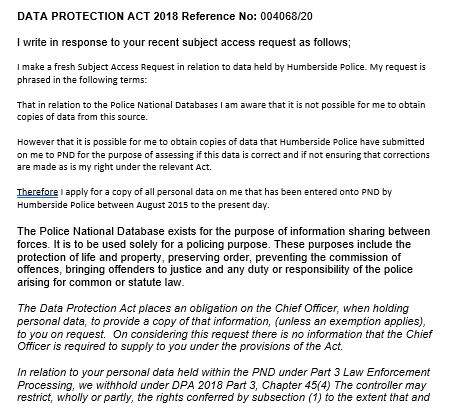
Hereโ€™s the letter in full. I have redacted the header.

The key sentences are in the fourth and fifth paragraphs seen above. These are reproduced from the original request. Data cannot be obtained from the Police National Computer – however data that has been entered into the PNC by a local force can be obtained from the same regional police force. Hence the request to Humberside Police.

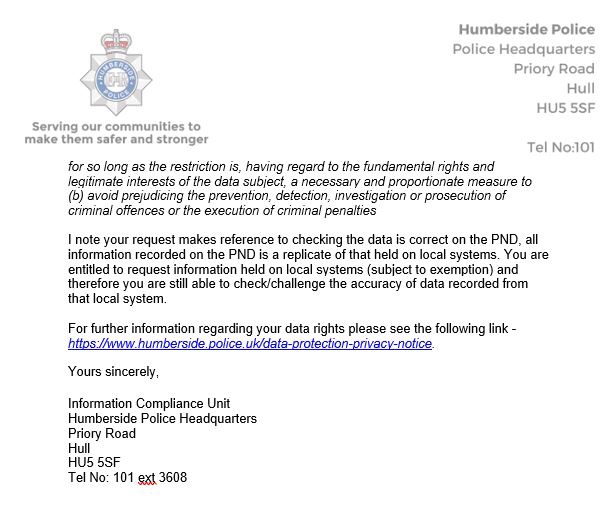
The substantive reply is seen below:

Here we focus on the second paragraph. It essentially repeats the data I put to police in the first instance.

Consequently the force has failed to react correctly to the subject access request in every conceivable aspect.

This suggests that the intention is to continue frustrate any further request made for the data using the rights conferred in italics in the letter to do so as the response to any further requests that might be made.

The Information Commissionerโ€™s Office has been informed.


The Mendacity of HMCTS

This post details the extent to which HMCTS will seek to lie and mislead in order to avoid admitting a clear service level error made by court staff, particularly when such an error is serious enough to amount to a breach of a personโ€™s right of access to justice or human rights.

Below is a copy of an email sent earlier today to Customer Investigations at HMCTS. They are the final stage of appeal in the event that court staff make serious errors in the handling of civil claims. 

It follows two separate instances of the Court Manager at Leeds Combined Court, Joanne Town, seeking to deliberately mislead in her replies to a complaint. The original complaint was that court staff failed to notify me of a hearing taking place into two claims โ€“ they only informed me of a third taking place on the same date in November.

Joanne Town states that these two claims were not heard on the relevant date. All available evidence including an Order from the hearing proves her wrong but she maintains her position twice over.

This behaviour and the original error of the court failing to inform me of dates for two claims to be heard represents sufficiently shocking behaviour that I share the email I have sent to Customer Investigations in its entirety below. 

The email beginsโ€ฆ 


I refer to the issue below as a formal complaint to Customer Investigations. 

On 11.11.20 a hearing took place at Leeds Combined Court in [REDACTED]. I was unable to attend this hearing. Also in the same hearing two other claims were heard. These being [REDACTED] & [REDACTED]. I was not notified that these claims were to be heard on that date at the same time as [REDACTED]. A formal complaint was therefore made to Leeds Combined Court. It is a fundamental aspect of access to justice that a Claimant should be able to attend hearings in relation to claims he has brought. Indeed CPR enshrines such rights. Article 6 of The Human Rights Act states the right to be a fair and public trial or hearing at which I am allowed representation if a public authority is making a decision that has a impact upon my civil rights or obligations. The failure to notify in respect of two claims in which I was Claimant taking place on 11.11.20 thus activates my Article 6 rights. By failure to inform of hearings taking place on 11.11.20 HMCTS has breached my Article 6 rights. 

Firstly as can be seen from the email below no communication was received as sent on 7.12.20 by Leeds Combined Court. A copy of a letter dated 7.12.20 has been sent to me by email today in relation to my query regarding a level two response. 

The onus of the complaint to Customer Investigations is as follows: 

The response provided on 23.11.20 and that dated 7.12.20 both state: 

The court did not receive any applications or fees on [REDACTED] & [REDACTED] to set aside, vary or discharge the order of Mr. Justice Lavender dated 27th February 2020 and as such these cases were not listed on the 11th November 2020 these files were not forwarded to the Judge

Further that the position as outlined above is the same argument outlined by the Court in its defence in the 23.11.20 email. There has therefore been no review of the appeal to the first stage complaint response. It would additionally appear that no further investigations into the matter have taken place by Leeds. A simple check of the Order of 11.11.20 would have shown Joanne Town that the statements she has made are wholly factually wrong. 

I attach further a copy of an Order made on 11.11.20 in the matters of [REDACTED], [REDACTED] & [REDACTED]. This clearly shows that the matters of G00LS437 & [REDACTED] WERE heard on 11.11.20. I attach also a Notice of Hearing in respect of the 11.11.20 which is the only Notice of Hearing received in relation to any proceedings on this date. 
I was therefore not informed of the hearing of two other claims on 11.11.20. 

As a consequence of this both the email seen in the attached Word document from Joanne Town of November and the PDF of 7.12.20 also attached have deliberately and purposefully set out to misrepresent the facts, mislead and are a clear breach of the duty of care of the Court Manager to act with good faith in relation to service users. 
When you have a Court Manager who is prepared to mislead in such a way but is so easily caught out I would suggest that itโ€™s pretty much the beginning of the end for HMCTS as an organisation. If you are incapable of honesty and integrity in your dealings with the public then any confidence in the organisation will vanish. The errors seen in the original complaint are compounded by the mendacity of the Court. 

I have additionally noted that Joanne Town has acted to respond to both the first and second stage of the complaints and as such there has been no actual second-stage review of the issues raised: the PDF of 7.12.20 simply repeats the response put in the original of 23.11.20. 

Consequently I appeal the second stage response on the basis that both that and the first stage response are wholly mendacious and fail to accept that a serious service level failure amounting to a breach of my Article 6 rights has occurred. The situation is no different to that of [REDACTED] in which the same Court Manager was aware that no action was taken in a claim for over a year but failed to respond to complaints in respect of that service level failure. 

As a consequence of the error by court staff I have had to make an application in respect of [REDACTED] & [REDACTED] which has also cost me money. 

In respect of this matter I seek a financial settlement appropriate to the breach of my rights by Leeds Combined Court in failing to notify of the hearings into [REDACTED] & [REDACTED] and the mendacious response of Court Manager Joanne Town. I have also lost time and amenity chasing this matter and have been vexed and harassed by the behaviour of the Court in respect of the original failure and the mendacious responses provided. I seek compensation in relation to these matters also. 

The behaviour of the Court Manager is sufficiently shocking that I believe others should be aware of this and as such the content of communications in this matter thus far โ€“ including this email โ€“ will be published online. 

I await your urgent response.


Letter ends.

Greater Manchester Police in Special Measures

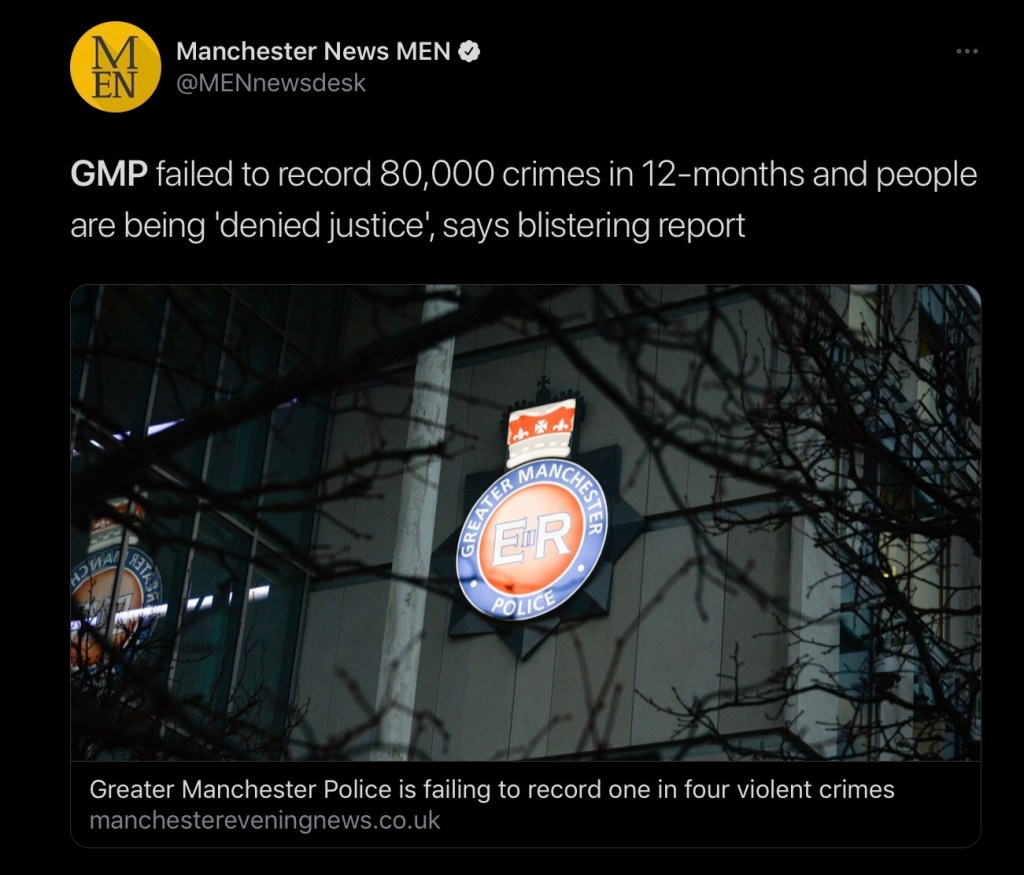
Flurry of activity at GMP in the last few days starting with this considerable shocker:

Overall GMP has been known to be a failing organisation for some time but no active intervention to stop the fall in service standards has been made by GMP itself, The Home Office or HM Inspectorate of Constabulary.

On Wednesday the Chief Constable, reckoned to be amongst the worst in a very competitive field, resigned citing โ€œlong term health issuesโ€. None of these issues had been apparent or seemed to prevent him discharging his duties prior to Tuesdayโ€™s news regarding non-recording of crimes.

On Thursday the force was placed into special measures following Home Office intervention.

Thatโ€™s a triple whammy of connected events.

Most interesting from my perspective is how GMP denied any failings in regards to service standards until the scandalous failure to record crimes became public. Like every British police force at present the effort made to hide errors and failures is tremendous. The mantra of the modern Chief Constable is that the professional reputation of the force must be maintained at all costs.

How many other forces will end up in special measures by the end of 2021? Iโ€™m willing to take bets on at least two.

Crime Recording Standards, Werewolves & Other Inexplicable Phenomena

This blog post is best avoided being read on a full moon for reasons which will shortly become obvious.

In a meeting due to take place tomorrow, Friday 18th December the Ethics, Integrity and Complaints Committee of Leicestershire Police will discuss the reasons why the number of supposed rapes recorded by police are high while the number of prosecutions for the offence are low.

Current Labour Party leader Sir Kier Starmer is known to be one of the individuals behind the mantra of โ€œwe believe the victimโ€, a post-Saville call-to-arms which led to a turnaround in modern policing resulting in the prosecution of thousands of men for supposed historic sexual offences. Many of these men were geriatric and due to the passage of time since the supposed offences their accusers unable to produce physical evidence of wrongdoing. In the post-Saville climate however one personโ€™s word against another remains sufficient to enable a wrongful conviction; particularly over something as emotive as a sexual offence allegation.

Some fifteen years ago the proportion of wrongfully convicted men in gaol was around one in twenty. The figures are likely presently significantly higher.

Yet an accusation of rape remains one of the problematic offences for police to investigate. The number of offences compared to the number of convictions carries a massive disparity. The Leicestershire Police report to be discussed tomorrow helps explain why.

You can read the leaked report into the matter below. It gives an insight into the level of lunacy currently practiced in the British Police overall.

The file is at http://www.leics.pcc.police.uk/DOCUMENT-LIBRARY/Transparency/Meetings/Ethics-Integrity-and-Complaint-Committee/2020/18th-December-2020/Item-8-Recording-of-Rape-Offences.pdf

Click to access Item-8-Recording-of-Rape-Offences.pdf

In short the statistics for such offences given to the public are wrong. Police have known they are wrong for some time and that they provide a wholly distorted and prejudicial view of the true extent of rape offences. The report explains why this is so.

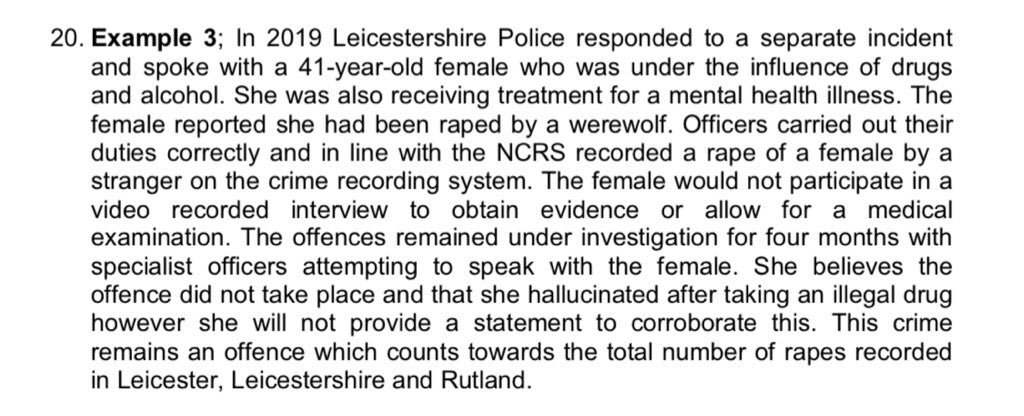
The most memorable part of the report concerns a complaint by a woman of assault by a werewolf. An actual werewolf. Not just a hairy bloke. The matter took some four months to investigate at a cost of goodness knows what to the taxpayer.

๐Ÿบ – ๐ŸŒ•

The matter of supposed rape by a supernatural being is still recorded as an offence.

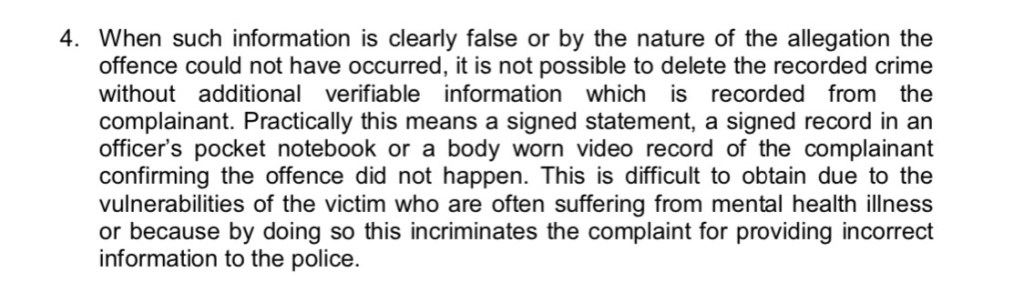
More serious is the extract below:

In short when a false claim of rape has occurred police do not obtain a retraction (failure to do so keeping the non-offence as a recorded offence) and police do not appear to seek to obtain a retraction as it would leave the complainant open to prosecution for wasting police time. This stops false accusers and compensation-seekers from being prosecuted and would enable them to โ€œhave another goโ€ at a later date. The lucrative gravy-train of false allegations thus rolls on and everyone on the criminal justice system benefits. Except the poor bloody defendant of course.

If enough false accusers were to be prosecuted the well of complaints that the British police have been supping from since โ€œWe believe the victimโ€ was introduced would shortly run dry.

This approach however is too common-sense. It would however solve the problem of false statistics and keep innocent men out of gaol.


Design a site like this with WordPress.com
Get started