A superb example of how the civil courts in the UK operate.
Laurel & Hardy-ish levels of incompetence from staff at Leeds Combined Court.
A hearing was set for last week and the appropriate Notice of Hearing was sent out for that case.
However what the merry pranksters at civil section failed to point out was that there were two other pending civil cases to be heard by the same High Court Judge at the same hearing on the same day.
No Notice of Hearing document was sent out in relation to these other two cases. Equally no Order in relation to them was made ahead of the hearing. In short no notification of these two other claims being in play that day at all.
Therefore there could be no case preparation for these other two claims as I was blithely unaware that these were due to go ahead in the same hearing as a claim that I was notified about.
This is pretty much par for the course with HMCTS these days: an organisation in which the right hand doesn’t know what the left hand is doing.
The consequence of this overall for court users is delay, confusion and ultimately injustice.
The consequence for your poor bloody correspondent is of course more time, effort and expense spent correcting the errors made by court staff.
Twist ending to the tale: an application in respect of this matter was sent to the court just a few moments ago with an inquiry as to what the fee would be to file this. The answer was returned almost immediately.
However a complaint about the poor standard of service in the failure to notify me of two cases to be heard hasn’t been answered at all.
Conclusion: HMCTS is more interested in taking your money to correct service level errors they’ve made than they are in responding to legitimate and justified complaints.
The purpose of the site is to publish conviction information on sex offenders based in the UK. The site copies and pastes data verbatim from local newspaper articles. Court report sections from the local press are then republished nationally via this site.
There is an associated Facebook page with the same name and operated by the same people. The content is identical. When a post is made on the main site it is replicated on the Facebook page.
Not that these people actually catch sex offenders, you understand. The name is a misdirection. They do however reproduce articles from the local press detailing the convictions of people who have. It is assumed that in reproducing this data they do not have an appropriate licence to reprint copyrighted materials (the copyright of course being invested in the newspaper publisher).
The site owners of Predator Catchers UK go to a great deal of trouble to avoid detection themselves. I can however reveal that the operators of the site are:
Richard Robinson & Sarah Elizabeth McClarence of 47 Truro Avenue, Sandall, Doncaster, South Yorkshire. DN ——
Why should this matter? There are three principal reasons:
1. The site hampers the rehabilitation of offenders
By offering a lasting home to newspaper reports which would otherwise be forgotten, or eventually buried in the online archive of the newspaper itself such sites as Predator Catchers UK actively work against the reforming efforts of the probation system. If the details of a person’s past offence are accessible for all to see then the associated problems of the conviction will remain for the offender. There can be no rehabilitation or moving on… Employment, personal circumstances and life chances remain limited and restricted. In this situation there is little incentive for an offender to change.
We generally accept the “paid their debt to society” element of criminal justice and the redemptive effects of such xxxx
2. The site exposes offenders and their families to the risk of vigilante attacks and violence
Again the issue here is with the accessibility of the data. Details of any past offending are permanently on display on the site. Sex offenders are more at risk of attack by “have a go heroes” by the nature of their offence. It also inclines prior offenders to be targeted for entrapment or by compensation-seekers for false allegations. This presents a threat to the liberty of the former offender and to the integrity of the criminal justice system (CJS).
Examples
3. Given the number of wrongful convictions presently before The Court of Appeal Criminal Division (CACD) the likelihood is that up to a third of the convictions presented on Predator Catchers UK are wrongful convictions.
Examples
4. The site reproduces any factual or legal errors reported in the original newspaper articles.
Neither Richard Robinson nor Sarah McClarence are present for the trial or sentencing of any of the sex offenders they list on Predator Catchers UK. They do not have access to the case papers or evidence. Thus factual errors in the original newspaper reports are reproduced on their site. This means they are also unaware of which cases they feature are sent to appeal and do not list these on their site either.
5. The associated Facebook page for Predator Catchers UK facilities online abuse.
While there’s no ability to make comments on the Predator Catchers UK site itself the associated Facebook page is different. This contains the same content cut and pasted from the main site but allows Fakebook – sorry Facebook – users to post comments regarding the persons whose details are posted on the main site. Some of these posts are the standard pile-ons that Twitter users will of course be familiar with. Some threaten violence in quite chilling terms. There’s a further concern here: that people who themselves claim to be victims can post indiscreet details that potentially prejudice any appeal proceedings.
Some further thoughts…
It’s curious how people who are quite happy to expose others and their families to a risk of attack and reprisals are unwilling themselves to be names publicly.
Richard Robinson and Sarah McClarence purposefully hid their identities behind a series of shell email accounts and further failed to inform their site host of their true identities. The critical mistake came when Robinson used McClarence’s mobile number with their email provider Verizon (Yahoo!) which allowed their details to be located on public databases in relation to case regarding large scale copyright theft.
Their deliberate efforts made towards anonymity show that they were fully aware of the potential risk to themselves from people featured on their site being disgruntled enough to take action against it, or indeed the relatives and friends of such people.
It has been the observation of this writer for some time that people to engage in the dubious tactic of attempting to catch predatory sex offenders are often persons who themselves cannot be said to have lived entirely satisfactory lives. That the frisson of righteousness that charges these people is unlikely to make up for the relatively low socio-economic status that bedevils them.
There are sufficient of these groups around the UK and the standard entrapment techniques they use are well enough established. The entrapment aspect is itself a grey area legally. Often the final “sting” involves the person subject to the entrapment attending at a particular address as arranged over such as internet messaging, the intent being that they would attend to commit further offending. The campaign group usually arrive mob-handed – for this is the perigee of their hobby – to witness the chance to physically restrain and verbally abuse the entrapped person while they await the presence of police.
I am honesty surprised that in relation to this activity no-one has yet been killed. The fury of the mob is of course well-documented. The self-aggrandising righteousness of people who set themselves up as the protectors of others will lead them to commit offences themselves in the pursuit of their activities. They are themselves of course at equal risk of violent assault from the person they are attempting to capture. Given that any sex offenders are by their nature suffering from mental illness (hence the offending in the first place…) this is a substantial risk.
A further risk comes from the infiltration of such groups by covert police surveillance: if the group is prepared to step over the line into direct illegality then they will naturally be a focus for covert surveillance.
Ultimately it comes down to the kind of society we wish to live in. The baseless Qanon conspiracy theories being promoted in the USA at the moment xxx Sex offenders and so-called predator catcher groups are
Presently the East Yorkshire city of Kingston Upon Hull has the highest COVID-19 rates of infection in the UK. The virus appears to be running rampant in the city causing a significant numbers of deaths.
The Guardian has quoted local Hull resident Gavin Storey in an article published this week. The original article can be found at:
It states that Storey thinks it suits the ruling class have let the virus run riot through deprived communities like his. He says:
“It seems like they are trying to get rid of us. That way when it’s over they won’t have to spend so much money around here. Let the kids go to school, spread it to their parents and then let them all die. Most of the people in the country who are on benefits will be dead.”
Twitter users react to Mr. Storey’s comments in the article.
This all got me thinking about the initial wave of the pandemic to hit the UK in spring 2020.
According to information passed over to me in a conversation in spring 2020 from one of Leeds’ top criminal defence solicitors West Yorkshire Police were arresting and pulling suspects in for questioning with an urgency and speed which was quite at odds with the nature of a lethal pandemic and the requirement for people to self isolate.
Those arrested were not given masks and at that point before the end of the first lockdown self-sourced PPE was not commonly owned like today. The overall idea at that point was to protect by keeping your distance from others which makes the arrests carried out seem even more bizarre. Command Teams must have been aware of the risk of police stations as focal points for the spread of the virus. Frontline officers were of course given PPE but of dubious effectiveness which had been sold to the force, desperate to be seen to protect officers, as a “job lot”.
This is also unusual behaviour for a force which remains in financial dire straights considering the potential costs of increasing the pace in ongoing investigations.
Indeed I was told that at that time even people who had been released under investigation for a long period and who had no notification of progress on potential charges were being re-arrested and brought in for interview.
UK police tend to be toxic at the best of times.
In the same way as Mr. Storey thinks schools are being used to spread COVID-19 in deprived communities the sudden urge of West Yorkshire Police to pull in suspects for interview in the initial wave of a lethal pandemic seems… unsettling.
Were these actions part of a deliberate policy to assist the virus to spread in deprived communities?
Is this too outlandish an idea? Then consider also that in spring 2020 the elderly and frail were discharged from hospitals into care homes without adequate screening to ensure they were not infecting others.
The initial Government policy on the virus was to let it run through the population. This was the planning in the early stages of the UK’s response until SAGE, the Government’s scientific advisory group, suggested this strategy would lead to potential UK deaths of up to 250,000. This initial discredited strategy meant excess deaths through the initial lockdown coming too late. It is known that former Government advisor Dominic Cummings is a eugenicist who employed another advisor for a short period in February 2020 before that person’s past writings in eugenics were made public leading to their dismissal.
In every one of multiple other respects the UK’s response to the pandemic was lethargically slow and inept. This situation continues to this day.
The idea then that there has been purpose in the UK’s handling of COVID-19 has some merit. That the initial plan to allow the virus to rip through the population is still in play but not stated openly as a matter of State policy.
It is likely then that people with either criminal records or suspected of committing a criminal offence have been considered in the same light as the fail and elderly: a potential burden to society and something best gotten rid of. That the virus provides (to the State) a convenient ability to do just this.
I know of one clear instance of West Yorkshire Police officers attending at a suspect’s home without masks or PPE in May despite being aware of a vulnerable person being present at the home. Breaking subject access request laws the Right of Access Department at West Yorkshire Police have failed to release body worn video footage of this incident showing officers attending without PPE.
The theory that West Yorkshire Police were actively pulling in suspects in an attempt to spread Coronavirus around is just a theory.
But it’s a theory that does seem to fit into the overall approach of the authorities towards the virus from the inept Test and Trace system to Eat Out to Help Out. All of these have assisted the virus to move through the poorer sections of the population to the point where we’ve ow reached the second point of national lockdown within one year.
In South Korea there have so far been less than 600 deaths from COVID-19. Britain has (at a low estimate) 60,000 to date.
HMCTS has a number of ways of obtaining money from court users. Some of these amount to sharp practice and although within the Civil Procedure Rules can also be said to amount to an abuse of process.
Yesterday I discussed how difficult it is to obtain a refund from HMCTS (with an example!). Today I look at one of the ways they increase costs for parties.
Here’s one of the ways this happens.
An application in a civil claim was cancelled with a few days notice.
This is because the High Court Judge set to hear the case, The Hon. Mr Nicholas Lavender, decided to scuttle back to London before Yorkshire and the North East Circuit (for which he is senior civil judge) was put into tier three COVID restrictions. In the event this was pointless as a few days later the Government decided to lockdown the whole of England. However this caused significant disruption to civil listings at Leeds Combined Court this week. Great to see a judge who takes his leadership responsibilities so seriously.
The hearing was rescheduled with eight days notice to the parties. Which was insufficient notice for the Claimant. The Claimant informed the court of this and the grounds for being unable to attend the short-notice rescheduled hearing. Either these grounds were not out before the judge or else were ignored.
One facet of The Hon. Nicholas Lavender’s handling of cases can be seen on a website in which it’s complained that he seeks to drive up costs for litigants. Particularly ones whose cases he finds tiresome. I suppose he has to find some amusement in the job. This site can be found at https://www.bentjudgenicholaslavender.site/index.php/contact/ [viewed February 2020]. Some of the content of the site this writer is unable to verify: in respect of his seeking to drive up costs for parties however I am able to comment.
So consequently the grounds on which the Claimant couldn’t make the rescheduled hearing were ignored and an Order made by the judge regarding the rescheduled date. As per usual the route to challenge such an Order lies in the completion of an N244 form and the payment of a fee. Indeed this is the only route to do so when an Order has been made by the judge.
Now here’s where things get funky. In addition to driving up costs for parties he dislikes Nicholas Lavender likes to take his time on dealing with applications made. Sometimes this can be up to four months when HMCTS service standards say fourteen days should be the turnaround time for such.
So the court ignored the grounds for the Claimant not being able to attend the rescheduled date in order to make an application which would then cost the Claimant £55 to overturn. There is of course no guarantee that the application to vacate the rescheduled date would be heard before the due date of the hearing (especially not with this judge!) but hey… let’s take a punt on the idea of making some more money out of a service user.
This sort of thing represents clear sharp practice but is a common enough activity within HMCTS.
Two blog entries on two separate days about how HMCTS deals with services users money.
Tomorrow is the more complex blog entry which deals with some of the underhand ways civil courts like to part you from your cash. Stay tuned!
Today is a simpler tale of how awkward they are when you try to get it back.
An artists impression of the inside of the Fees Office at The Royal Courts of Justice.
In April this year a fee was paid to Queen’s Bench Division at The Royal Courts of Justice.
Due to the pandemic QBD was largely out of action for some time, or at least the office to deal with the application was.
By July it was clear that the grounds and reasons for making the application had passed. The time which had gone without any staff present to man the appropriate office at QBD rendered the application pointless.
So the fees were requested to be returned.
“No problem!”, say QBD.
And the appropriate notification was supposed to have been sent to Fees Office. Lead time on return was reckoned to be six weeks maximum.
Four months later I’m still waiting.
Not that the fee paid was large or exorbitant. Which makes the continued retention of it even more baffling.
But what really boils my blood is that of several emails sent to both QBD and Fees Office at RCJ can you guess how many have received a response?
Go on! Have a wild guess!
That’s right. None. Over a period of some four months now Fees Office & QBD has failed totally to respond to several emails chasing this matter.
This is of course very HMCTS.
Nor have emails to The Court Manager at QBD about the lack of response received a reply. This is even more HMCTS!
Just today an email response to a separate matter has been issued by HMCTS. That took a blindingly quick two months without any explanation of why so much time had elapsed.
In separate proceedings last week the DJ complained that the case file was in very poor condition. A prior hearing in the same matter had to be abandoned on the basis that the file had been lost.
All of the above and the general woeful experiences to be had with HMCTS suggest the organisation – visibly tottering for some time – is now actually on the verge of collapsing or has actually done so. Staff largely unable to cope pre-COVID-19 appear now to be hopelessly overwhelmed by the day to day administration of cases.
Customer Relations at HMCTS dealing with another complaint with customary sensitivity and respect.
The recent death of Peter Sutcliffe (a man dubbed in the media as The Yorkshire Ripper) presents a practical public-relations problem for West Yorkshire Police. It again raises the spectre of how Sutcliffe was able to kill so many people for such a sustained period. The answers make uncomfortable truths for that force.
Sutcliffe in 1974
West Yorkshire Police’s failure to catch Sutcliffe in what was one of the UK’s biggest manhunts plays a significant part in their present international reputation as a force beset by incompetence and corruption. It is a reputation with considerable justification.
Sutcliffe was not blessed with high intelligence enabling him to evade capture. Nor was he the popular fiction version of a serial killer: a creature of almost animal cunning and divine luck. Granted he was aided considerably in his activities by the relative infancy of forensics in the late 70’s. But this does not tell the whole story.
For the most part the reason Sutcliffe was able to carry on killing was down to long-identified administrative and operational failures on the part of the police. He is known to have been interviewed several times by officers in the course of their investigations but each time was discounted for further investigation. Other operational errors are known to have included an excess of paperwork generated in the course of the investigation. Detectives were hindered rather than helped by the weight of data generated and the primitive storage of such.
I would argue another failing contributed to the deaths of thirteen women. This is that police officers both at the time and now have a particular mindset which pre-disposes them towards both a closed minded approach to investigations and a form of “tunnel vision”. This comprises some of the issues I’ll discuss below.
Personal characteristics
To start with it’s popularly said that a Yorkshireman is a particular sort of stout character. Gruff, uncommunicative and 100% convinced he’s right in the face of all opposing evidence. Bluff and stiff-necked. The Harry Enfield comedy version of a Yorkshireman isn’t far from the mark. You know as well as I do the popular stereotype. For some reason beyond my capacity to fathom West Yorkshire Police provides a home to people very much of this mindset: there is a poisonous organisational culture which incubates some undesirable personality characteristics.
“Ah’ll say what ah bloody well like!”
Consider the absolute certainty with which the senior officer in the Sutcliffe investigation, George Oldfield, was sure the killer was the voice on the Weirside Jack hoax tape is a tragic example of this unwillingness to admit to error once a set path has been taken. In the police both of the 70’s and today face-saving is also a strong motivating force. Especially so when consistent underperformance or failure are likely to result in downgrade to civilian worker status.
A former Australian Director of Public Prosecutions Nicholas Cowdry produced a book called “Getting Justice Wrong” in which he argued that tunnel-vision on the part of officers (…he must have done something even if we can’t get him on what we’ve arrested him for!) plays a significant part in police failures. Tie this into the inability to admit to errors being make and you’ve an already toxic mix.
The “right” sort of victim
Sutcliffe’s first few murders were women largely at the margins of society. It is only with his killing of Jane Macdonald, a shop worker, in 1977 that the investigation increased in speed and urgency. This was partly in response to media pressure. But police then and now categorise crimes reported to them in an internal value system based partly on the perceived “worth” of the victim in society (socio-economic status etc). Sutcliffe attacked a young woman outside of Bradford in 1974 who sustained horrific injuries but police handling of the complaint and their investigations were at best suboptimal. The same occurred later when he attacked a lady who was a member of the BAME community in Leeds. Her complaints were “cuffed off” (to use the current parlance of West Yorkshire Police) rather than investigated. it is likely because of her background and low educational attainment that she was not considered a significant enough figure for her complaint to be deemed “worth” investigation.
Presented without comment. BBC News report on the day Sutcliffe’s death was announced.
The “right” sort of crime
Easy to solve crime is preferred. Especially if it’s hitting targets or addressing an issue of public concern. More complex investigations are likely to be shunned on the basis of the time, expenditure and difficulty of prosecuting successfully. Then and now police have one eye on the crime statistics and are more likely to address issues of public concern based on recent media exposure of such crimes. There’s a reason The Serious Fraud Office are so notoriously unsuccessful despite The City of London being rampant with financial corruption. In the matter of the Sutcliffe investigation it is arguably only when he began to operate outside of the red light areas from 1978 onwards that the police ramped up efforts due to increased public concern. This public concern increased again from 1980 onwards.
Conclusions
Ultimately Sutcliffe was caught by sheer luck and the most basic of police work.
He was picked up by uniformed constables from South Yorkshire Police in a situation in which he was likely preparing to kill again. Having disposed of his weapons behind a toilet cistern under the pretext of needing to urinate it is the quick-thinking of a South Yorkshire PC which led to the discovery of the weapons and the eventual confession of Sutcliffe that he was the killer.
The hugely expensive and lengthy investigation by West Yorkshire Police had been an excruciating waste of time and money. Arguably by tying itself in knots by a combination of weak administration and blinkered mindset the investigation had allowed Sutcliffe to carry on killing.
Serial killers are thankfully exceptionally rare and unusual. The advances in forensic technology and other policing methods in the forty nine years since he was caught render another Yorkshire Ripper type of killer thankfully even less likely.
However a weak spot remains in the mindset and attitude of police officers as I have discussed. Then and now significant barriers exist in investigations due to habits it’s almost impossible for police officers to break. This is partly fostered by an inherited organisational culture and thus will remain with us for some time yet.
Brief post for today. Well a brief post by the standards of this blog!
In yesterday’s blog post one of the themes touched upon was how The Ministry of Justice had sent data in error to a third party. This was a serious breach of the data subject’s rights and potentially quite dangerous to the data subject as MoJ shared the subject’s name, address, date of birth and financial details.
The post discussed the attempts The Ministry of Justice made to get back at the accidental recipient of this data which included a false complaint to police to ensure he was arrested, although fully aware police would not be able to bring charges as no offence had taken place.
Elizabeth Denham, UK Information Commissioner
The Information Commissioner’s Office (ICO) is a quasi-Governmental organisation reliant on public funding. Their stated aim is to enforce data access rights of people in the UK and also to adjudicate on data protection issues: in other words to monitor that your personal data held by companies and Government organisations is kept safe.
So we can naturally expect ICO to fully comply with data protection legislation and be extra specially careful with their own handling of other people’s data.
Can’t we?
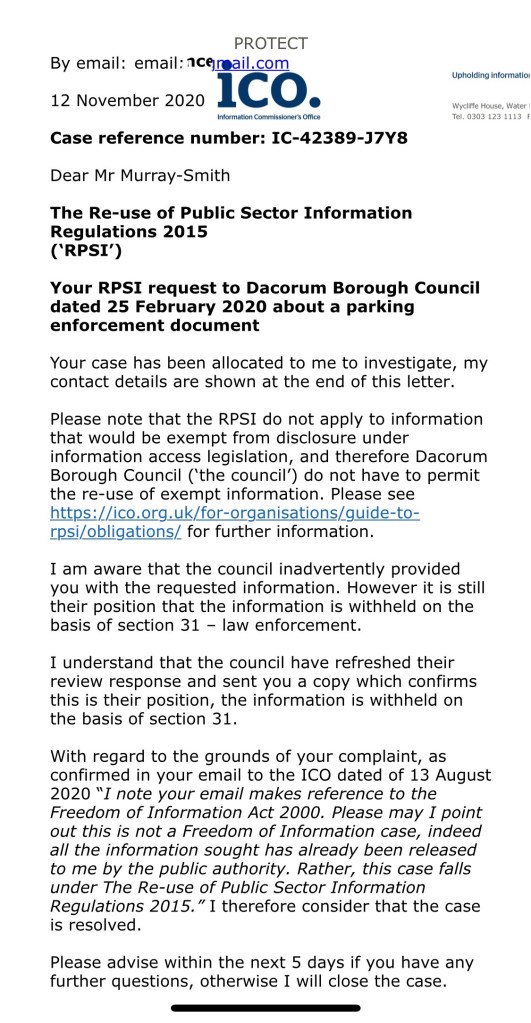
In a delicious piece of timing just after I’d written yesterday’s blog post about The Ministry of Justice emailing data to the wrong person ICO go and do the same by sending a letter in error to me which was intended for a third party, just like the error MoJ made!
I have of course deleted the email address of the intended recipient of this letter.
It seems that Dacorum Borough Council also suffers from the problem of email incontinence as they appear to have sent the intended recipient of the ICO letter some information despite claiming an apparent exemption over the data sent!
The ICO letter states:
I am aware that the council inadvertently provided you with the requested information.
Significantly the letter also states the grounds for the council attempting to withhold this data (but clearly not managing to) were under section 31 – that is a claimed exemption from disclosure as the data is related to law enforcement.
One might hope the ICO takes appropriate action against itself for this data breach.
In all honesty I wouldn’t hold my breath.
ICO’s present logo. Strange use of lower case letters and an inappropriate full stop.
Like many of the UK’s regulatory bodies such as The Parliamentary and Health Service Ombudsman or The Local Government Ombudsman the ICO has selective blindness in relation to even large scale and ongoing breaches of GDPR and The Data Protection Act.
Ultimately the best most complainants can hope for is a letter from the ICO informing them that their complaint has been upheld and that ICO will keep a record of the data protection concerns logged regarding the data controller complained of. This does not of course produce the data that has been requested! Occasionally ICO will assist by instructing the data controller to supply data if it is being clearly withheld. However if the data controller is sufficiently obstreperous there exists enough “trapdoors” in the relevant legislation that a (often misapplied) exemption will be used to avoid supply of the data.
The efforts organisations used to evade production of data include the mishandling of applications such as considering a subject access request for personal data as if it were a Data Protection Act request and so rejecting it without giving sufficient grounds to the requester. A further trick is to label everything as the personal data of a third party and thus exempt from disclosure: on this basis large scale parts of any data disclosed can be redacted (meaning blanked out).
In these circumstances ICO becomes like a turtle placed on its back: it spins around to no real effect.
Let’s look at the wider picture. A key thing to recall about most of the non-departmental public bodies supposed to supervise how the law or organisations work in Britain is that they rarely do. These supervisory bodies often exist instead to confirm the decisions made by the lower organisation or as a way to diffuse complaints safely and without litigation. Having said this ICO is better than most and does occasionally pursue misconducting organisations through the courts. But due to the pressure of time and resources they also habitually pursue only those organisations who have committed a blatant breach of the law which has been made public, or who would be less likely to defend themselves in court and thus drive up ICO’s expenses. The majority of the fines issued in successful judgments are not paid.
One example of this willingness to turn a blind eye on the part of ICO: a 2017 significant data breach by the NHS involving some 50,000 patients medical records – the largest loss of data in NHS history – was not prosecuted by ICO. This is a matter I will comment on in detail in a blog another day.
The West Yorkshire Police and Crime Commissioner is Mark Burns-Williamson, a largely gaff-prone failed politician. Heaven knows there’s sufficient data out there in the public domain to show that by any stretch of the imagination the man is unsuited to any role requiring public trust.
My favourite one details how he sent an inadvisable letter in a “love triangle” which would ordinarily have rendered him open to criminal prosecution. This was however covered up by West Yorkshire Police’s (then) DCI Simon Bottomley leading to the eternal gratitude of Burns-Williamson to the force he is supposed to scrutinise.
It also appears his office is prepared to manipulate and ignore facts to protect the very organisation it should be holding to scrutiny.
This blog entry tells the story of one such incident.
Burns-Williamson demonstrates the degree to which he hold the local force to scrutiny.
In May 2020 The Ministry of Justice’s Data Access Office sent data to a person (who we will call the recipient) in error.
This data was information on a third party who lived in the London area. This amounted to a serious data breach as the disclosure included the subjects name, address, date of birth and bank account details etc. as well as other disclosures regarding a series Proceeds of Crime Act proceedings against the data subject.
The recipient of the data informed The Information Commissioner’s Office and The Ministry of Justice as well as the data subject whose information had been disclosed. He also posted regarding this on Twitter but did not reveal any confidential information in so doing.
Data Access at MoJ requested the recipient remove the mocking tweet. The recipient of the data refused citing his freedom of expression under The Human Rights Act and that no offence in civil or criminal law had been committed by the tweet.
Three days later the recipient of the data was arrested at his home by West Yorkshire Police on the basis that he had breached The Data Protection Act. The allegation being that he had shared the confidential data sent to him in error on Twitter.
This was palpably untrue as an examination of the tweet would have confirmed. However police did not examine the tweet for themselves but took it “on trust” from MoJ that a supposed offence had taken place. Of course it hadn’t but MoJ were burning with indignation that a serious data security error had been made public and to their official regulator on data matters the ICO.
Police were aware that no offence had occurred.
The bar for arrest for any offence is set very high as recent cases such as Rachid v. The Chief Constable of West Yorkshire Police (2020) show. Instead police took it on trust from The Ministry of Justice that an offence had occurred in a situation in which the Security Manager for MoJ’s correspondence (seen by this blogger) reveals his desire to give the recipient “a nasty shock”.
The recipient’s home was entered by police on his arrest. In the middle of the Spring 2020 pandemic a vulnerable family member who was shielding was subject to interaction with police who did not wear PPE or take any form of precautions regarding introducing COVID-19 infection into the home. Electronic devices were removed and the home was ransacked in the search. The officer leading this was PC Alan Jackson. Police actions amount to trespass to property (since there were no reasonable grounds for arrest) alongside trespass to goods and wrongful arrest.
The home of the recipient of data was raided by police without PPE in the middle of the spring pandemic.
Predictably no charges were brought. Emails seen between the Officer in Charge (OIC) and The Ministry of Justice reveal MoJ immediately loose interest when the recipient was arrested which fits in with the prior email claiming MoJ wanted to give him a nasty shock. No further action resulted to the recipient from either Police or MoJ.
A complaint was duly made by the recipient to West Yorkshire Police Professional Standards Department (PSD). Their internal investigation under The Police Reform Act 2002 confirmed – but only internally to the police – that the arrest was wrongful on the basis that WYP had not seen or been provided by MoJ with any indication that a criminal offence had taken place. Other aspects of the complaint made were ignored by PSD and not investigated.
An organisation such as West Yorkshire Police which has an international reputation for both corruption and incompetence needs to be able to head off complaints and minimise them early on. The investigation concluded in a document called an Assessment and Progress Log that there had indeed been no reasonable grounds for arrest, therefore logically the arrest was unlawful. This document was an internal document not for public or complainant’s consumption.
Police of course cannot admit that they have erred to the complainant. It opens the door for civil action for wrongful arrest and payment of compensation. It also amount to loss of professional reputation.
Thus the results of the PSD investigation which were presented to the complainant in August 2020 were totally at odds with the actual true findings of the investigation. The official line was that nothing untoward had occurred and that the arrest was legitimate: the unseen internal report stated quite the opposite. A copy of this report has since been obtained from WYP and examined.
If you find that the above shocks you then I would respectfully point out you may have little experience of the police complaints process and the extent to which it seeks to hide the conduct of misconducting and underperforming officers.
The complainant found some 21 issues with the PSD investigation response which were either suboptimal or evaded examination of the facts. Of course if you’re prepared to commit mendacity on such a scale as a police complaints office then it’s best to keep any communication simple. The response provided by PSD’s Vicky Silver was clearly exceptionally evasive and the errors in it were manifest.
Police Professional Standards Departments go to any length to dismiss valid complaints.
The complaint was progressed as an appeal to The Office of The Police and Crime Commissioner for West Yorkshire, this being a body with supposed oversight of the local force. Karen Gray at PCC was tasked with the examination of the appeal.
It is a basic element of any investigation that the investigator should have access to all of the data available to be able to reach a reasoned conclusion. This is common sense. In the course of the PCC’s investigation they either failed to obtain copies of documents such as the PSD Assessment and Progress Log or else were provided with a copy of the relevant data but chose to ignore it in favour of a rubber-stamped approval of the earlier PSD investigation.
Thus the office of West Yorkshire Police and Crime Commissioner have shown themselves to be either as throughly dishonest or professionally incompetent as the police force they are supposed to supervise. Further they are prepared to support the local force in their dishonesty.
A further complaint was made regarding the failure of the PCC to obtain all relevant data meaning that the Karen Gray investigation was fundamentally flawed. This was responded to more recently by PCC’s Jane Owen who has stated that Karen Gray could not have been aware of the Assessment and Progress Log on the basis that it was produced after the conclusion of the original PCC review.
However the document in question from PSD is dated 5.6.20.
Therefore it was produced BEFORE the complaint was referred to PCC by around two months. The response that it was not available in the original PSD investigation is therefore an outright lie.
It is of course inconceivable that an investigation properly conducted would not have requested a copy of, assessed and examined the PSD Assessment and Progress Log which was in existence by this point and therefore PSD’s position that Karen Gray had access to all of the required documentation to enable correct conclusions is not only incorrect but also deliberately misleading.
The essence of the complaint to PSD regarding wrongful arrest etc. was proven – as that office was well aware – by 5.6.20.
All subsequent efforts of PSD and the office of the PCC for West Yorkshire have sought to bury the facts under an increasing mound of guff and nonsense.
PSD chose to issue a response completely opposite to the facts they had themselves established and The Office of The Police and Crime Commissioner has assisted them in this cover-up and continues to do so.
In a desperate final attempt to avoid further scrutiny Jane Owen writes:
I have concluded that you have used the Office of the Police and Crime Commissioner’s complaints process to try and change the outcome of your complaint… and the subsequent review undertaken by this office but – in line with the statutory guidance that has been issued that sets out how reviews have to be handled – you do not have a further right of review
Is it any wonder that both West Yorkshire Police and The Office of the Police and Crime Commissioner have such a poor reputation both locally and nationally?
Certainly both are prepared to bend the truth into impossible angles to avoid any admission of error or loss of professional reputation. Perversely this ends up in a situation as described above in which loss of face and reputation end up occurring both from the original issue and the labyrinthine efforts made to conceal it.
In Doncaster in early January 2020 a child died. His name was Keigan O’Brien.
Doncaster overall has an appalling reputation as a place in which children can grow up safely and free from fear of harm. Several incidents in recent years have put the city’s child protection measures into the national spotlight. At one point the relevant responsibilities would have rested with the local authority.
Doncaster Council offices, Waterdale
However Doncaster Children’s Services Trust (DCST) is an offshoot organisation set up by Doncaster Council. This follows a series of disastrous child protection failures from Doncaster Council (itself a noticeably underperforming local authority) and the establishment of DCST was clearly to place some element of distance between the Council and child protection services in the city. A useful tactic for the senior organisation avoiding blame and bad publicity. But the service provided by DCST is still the same appallingly poor standard as when matters were under the Council’s jurisdiction.
Tellingly the most recent OFSTED reports that DSCT show on their own site end in 2018.
The head of DCST is Jim Foy, the improbably titled LADO or Local Authority Designated Officer. The title is of course a hangover from the days when the service was an in-house Council run operation.
On the occasions this correspondent has encountered him Jim Foy seems a man hopelessly disengaged with the job he has to do and the overall impression is of a man who is the cause of chaos in his employment which others run then around correcting. This is bad enough in any post but in one with the responsibilities of LADO the consequences of failure are catastrophic to service users, their families and the local community.
And so it proved when Jim Foy – in the course of his duties – recorded data on a person who had engaged in a new relationship with a clerical support worker in a Doncaster area school. Not only did he record the data wrongly but he also recorded a matter which was not an offence in British criminal law. He failed to spot either of these errors. He then used this incorrect data to confront the clerical support worker and used it to try to force her out of her employment. When later faced with clear evidence that he had recorded the data incorrectly Jim Foy refused to amend or correct the error. Instead only after matters were investigated by the UK’s data regulator, The Information Commissioner’s Office, which found against DCST was the data reluctantly corrected.
The DPA 1998 states at 10(1) that a data controller is required to cease processing of personal data on ground that process of that data likely to cause damage / distress and is unwarranted.
Principal 4 also states that data held on an individual should be both accurate and kept up to date.
The error caused by DCST is twofold then: the recording of incorrect data in the first instance and the failure to correct it in the second. It is assumed that Jim Foy is sufficiently aware of these regulations and how they impact on his responsibilities although the persistent failure to correct the error when notified suggests otherwise.
In a civil case at Doncaster Civil Justice Centre North this week the defence of DCST to the claim of breach of the relevant legislation was not accepted by the judge who saw through the (admittedly very weak) set of arguments defence barrister presented.
The wider issue in this matter is that if DCST is recording data on people wrongly then how can they hope to build a genuine picture of the potential threats to children in their area? The consistent failure of DCST to protect children in the Doncaster region is evidence of where these kinds of systemic failure leads.
There is a cost to the public purse of this. So far there have been five hearings in this claim settled this week at a figure of around £1,000.00 costs to DCST each time they have sent counsel and instructed solicitor. Conservative estimates therefore put the costs to then local taxpayer of defence of a matter which was doomed to fail in any event (including pre-trial preparation etc) at around £9,000.00. This is over the matter of a simple piece of data recorded wrongly from one telephone call.
Nor is this the worst part of this matter.
In a December 2019 hearing and – presumably desperate to gain some form of hold on the Claimant and tactical advantage in the case via obtaining information on him – Jim Foy overheard a conversation at court in the case which resulted in him making enquiries regarding the Claimant’s children which by any examination breach the Claimant’s Article 8 right to privacy. These enquiries were made not only to the databases that DCST would use as a matter of course but also to local police forces.
Jim Foy was running around gathering this data with questionable legality and no operational remit to do so at the same time Keigan O’Brien was being placed in peril by the actions of his parents.
All this of course could only happen in DCST where actual child protection concerns come second to maintaining underperforming staff in post and ensuring the continuation of the organisation.
Recorder Ben Nolan QC, a part-time, fee-paid judge on the North East Circuit posted an inadvisable tweet in the late evening of 18th June, 2020:
The relevant Twitter account has now been deleted.
Like the account of HHJ Sarah Greenan, a Family Court judge sitting at Leeds and who has been subject of a prior blog post regarding judicial misuse of Twitter.
Ben Nolan QC is assumed to have sufficient seniority as a judge to be aware of the judicial conduct rules and how these relate to the expression of opinions on social media and elsewhere.
However let’s count the issues with the tweet above, shall we?
Inappropriate uses of expletives
Political opinions expressed regarding the Government
Poor diction – an issue which has been said to appear in Ben Nolan’s judgments
“fetid Primark store” expresses social prejudice against the people you’d likely find in Primark if not the store itself.
A complaint was made to the reliably ineffective Judicial Conduct and Investigations Office which supposedly enforces judicial conduct guidelines. The complaint was made in the terms mentioned above. JCIO can usually be relied upon to evade proper action on complaints about judges via a series of “trapdoors” built into the regulations which allow such cuffing off of legitimate complaints.
However – again unusually for JCIO – the issue made it as far as Nominated Judge (NI) stage. In this matter the NI being The Right Honourable Lady Justice Carr. In a complaint outcome letter dated 21st August, 2020 the JCIO stated that the Nominated Judge (NJ) concluded that:
“I do not consider that the posting of the tweet amounted to judicial misconduct. The tweet was not sent from a judicial account. The details of the account did not identify its holder as a judge. Nor did the contents of the tweet identify in any way that the author was a judge. In short, the tweet contained a private expression of opinion, albeit in offensive language, on the part of the Judge in circumstances that did not implicate him as a judicial office holder. In these circumstances, it did not risk bringing the judiciary into disrepute”
The NJ also considered that:
“the tweet did not reflect any social prejudice on the part of the Judge. Rather it reflected what the Judge had seen in the newspapers and on television”.
You might of course wonder about the common sense of a judge who bases his opinions on things he has seen on television or read in a newspaper!
Recorder Ben Nolan QC
The Nominated Judge went on to say:
“Accordingly, the complaint has been dismissed under Rule 41 (b) of the Judicial Conduct (Judicial and other office holders) Rules 2014.”
Regardless of the NI’s findings the rules regarding judicial conduct apply if the judge is identified / self-identified as such or not. Otherwise there is little point having the rules! As such the findings of Lady Justice Carr are at best unsustainable.
The findings of the Nominated Judge have been appealed on these grounds:
The outcome letter states:
The tweet was not sent from a judicial account. The details of the account did not identify its holder as a judge.
However the March 2020 Guide to Judicial Conduct states:
Judges should be aware; however, that participation in public debate on any topic may entail the risk of undermining public perception in the impartiality of the judiciary whether or not a judge’s comments would lead to recusal from a particular case. This risk arises in part because the judge will not have control over the terms of the debate or the interpretation given to his or her comments.
The risk of expressing views that will give rise to issues of bias or pre-judgment in future cases before the judge is a particular factor to be considered. This risk will seldom arise from what a judge has said in other cases, but will arise if a judge has taken part publicly in a political or controversial discussion.For these reasons, judges must always be circumspect before accepting any invitation, or taking any step, to engage in public debate. Consultation with their relevant leadership before doing so will almost always be desirable.Where a judge decides to participate in public debate, he or she should be careful to ensure that the occasion does not create a public perception of partiality towards a particular organisation (including a set of chambers or firm of solicitors), group or cause or to a lack of even handedness. Care should also be taken therefore, about the place at which and the occasion on which a judge speaks. Participation in public protests and demonstrations may well involve substantial risks of this kind and, further, be inconsistent with the dignity of judicial office.
This is stated in the context of post on social media or to newspapers etc.
There is no requirement in the Conduct Regulations that a judge is able to state anything he or she wishes provided he is not identified as a judge. Which of course makes a nonsense of the Nominated Judge’s application of the rules. In fact it rather shows that the NI has misapplied the rules to avoid making a judgment against Recorder Ben Nolan QC.
In fact the rules apply to judiciary regardless of if they are commenting from a personal perspective, or as a judicial office holder. Different rules of course apply to such as The Secret Barrister who is believed to be a member of counsel but is not identified directly as such.
There is no mention made in the Conduct regulations that the judge is able to publicise his own views regardless of if he mentions his judicial office or not. The rules apply equally to someone identifying themselves as a judge or not.
The response of The Rt. Hon. Lady Justice Carr hinges on the basis that the judge was not identified on his Twitter account as a judge. This is the basis for her dismissal of the complaint. This is not relevant to the complaint and in this matter has been seized upon as grounds to dismiss the complaint erroneously and contrary to the relevant rules.
One might wonder about the reliability of the investigation given the deeply odd findings made.
Anyone working on the North East Circuit (presumably the majority of Ben Nolan’s Twitter followers) are able to identify the Twitter account holder as a judge and the majority of the persons following the account will also have been aware that he was a fee paid judge from either media or professional connections. That the account holder was a member of the judiciary is something clear and obvious from the account itself.
Recorder Ben Nolan QC described as “a heavyweight in criminal practice”.
The basis on which the complaint has been dismissed is therefore spurious and erroneous.
In respect of the comments regarding Primark clothing stores the findings of the Nominated Judge stretched credulity even further. For good or ill that store seems to be one ripe for mockery as a place where people without much money tend to shop. The NI claimed:
“the tweet did not reflect any social prejudice on the part of the Judge. Rather it reflected what the Judge had seen in the newspapers and on television”.
This is problematic in a number of areas. Firstly why would Ben Nolan QC comment on something that he has picked up from second-hand experience? Is also his comment not reflective of social prejudice on the part of the source material in newspapers papers or on television in which he has seen such comments? Regardless of if a prejudice has been obtained from TV or newspapers the expressing of the same ideation by a person – particularly a person intelligent enough to recognise them as being prejudice – is effectively them expressing the same prejudice.
I would say that the tweet regarding Primark does express social prejudice on the part of a judge and that this is an exceptionally concerning matter.
The complaint outcome has been appealed. The outcome of the appeal is awaited.
It has been intimated in a separate civil case that Ben Nolan will shortly no longer be undertaking judicial work.





























 Legal Babble