
How South Yorkshire Police Evade Investigating Crimes & Evade Accountability

On Tuesday 22nd of September 2020 I alerted South Yorkshire Police to a crime taking place in their area.

This followed the original reporting of this matter via an online form for just such a purpose. The online form had not received a response some considerable time after being completed, so the appropriate phone call was made.

This call was to the non-emergency number and it took the duration of a trip from Leeds to Bridlington on the East Yorkshire coast for the police to pick up the call, so around one and a half hours.

Finally managing to speak with an officer he disputed that the incident being reported was a crime. In fact I was advised to call South Yorkshire Police in relation to this matter by two other agencies that I had already reported the crime to: they considered the seriousness of the matter sufficient to warrant police attention. The officer spoken to was a PC PC Marc Horsbrough.

In the call Horsbroughโ€™s behaviour and attitude was lazy, gave the impression he couldnโ€™t care less and was reluctant to record the crime even when the relevant legislation was pointed out to him. More seriously he later he called me back and the content of that call amounted to unwarranted personal attack on me and a flat refusal to record a crime.

I should point out at this stage that the crime has now been recorded and the suspect interviewed: further developments are awaited. This took place only after the completion of a futher online form, not via the non-emergency phone service to South Yorkshire Police.

A formal complaint was made to South Yorkshire Police Complaints and Discipline Team:

  1. A complaint of a crime was made. This was done via the online form. That the response from the online form took longer than the 72 hours it states online for any action to be taken in respect of the referral of a crime.   
  2. That the online form had still not been processed some 7 days later.   
  3. That from comments made by Complaints and Dicipline in their email of 2.10.20 it would appear that this online referral has been lost.    
  4. That a series of phone calls were made by me on Tuesday 22.9.20 and Wednesday 23.9.20 to SYP to establish what was happening in relation to the online referral.   
  5. That these calls were either cut off when transferred to the appropriate department or else rang out for an exceptionally long period.   
  6. That on eventually speaking to an officer he stated that he had no copy of the online form in front of him but proceeded to dismiss the referral to SYP as being not something that police would deal with. This is incorrect. CPS guidance has been quoted that clearly shows the activity being reported is a criminal offence. The officer was Marc Horsbrough. working in either the Comms dept or Crime Recording around 12:45 – 1.30pm on 23.9.20.    
  7. That the same officer rang me back several minutes later.  
  8. That his comments on the call back amount to harassment and intimidation. His manner during this second call was offensive, uncivil and harassing.    
  9. That the officer concerned did this solely for the purpose of causing harassment, vexation and distress. On the second call he refused to give his name or service number when asked which is usually indicative of an officer misconducting himself.   

    That overall the standard of conduct in relation to this matter is sufficient to cause loss of reputation for the force. 
      

The complaint was given the reference number CO/665/20.

Calls to and from police stations are recorded on a system called Airwave. When South Yorkshire Police later claimed that they could not trace the officer involved they were simply being disingenuous: the record of all calls will have enabled an easy trace of officer identity and indeed the identity of the officer has been found out by other enquiries.

From 5th of November 2020 to 13th of March 2020 no communication from police was received in relation to this complaint. They additionally failed to respond to emails requesting a progress update. The Police Reform Act 2002 states that police should keep complainants updated every twenty eight days with a progress update on the complaint.

So I wrote to The Independent Office for Police Complaints (IOPC). I have addressed the issue in prior blog entries that IOPC is very significantly staffed by former police officers, and provided the results of a data access request showing this, and so they cannot in any way claim to be “independent”. IOPC wrote back on 23rd of March to state:

“Upon receipt of your correspondence, we contacted the Complaints and Dicipline [sic]Team Department (PSD) of South Yorkshire Police to ascertain the status of your complaint. The PSD have advised that your complaint has been recorded under their reference CO/665/20, and that the investigation of the matter is still live. They stated that they have asked the case handler of your complaint to make contact with you.”

Around a month later still no response from South Yorkshire Police. IOPC cannot investigate a complaint when it is still with the relevant force, meaning that they cannot step in on this matter and compel South Yorkshire Police to act.
So I again wrote to IOPC who stated:

“I have contacted the PSD and asked them to make contact with you and provide an update.”

I then wrote to police a few more times to chase an update on the basis that they had failed to comply with the instructions of their professional regulator. On 15th of June, some three months after IOPC originally made contact with South Yorkshire Police on this matter the following came from George Henson at their Complaints and Discipline Team:

“I can confirm the receipt of your email and I have passed it onto the case handler of your complaint referenced above.”

…which tells me nothing about the progress of the complaint. This was the last communication received from South Yorkshire Police in relation to this matter.

A recent update to The Police Reform Act 2002 states that police are only obligated to inform a complainant when something has taken place in relation to the complaint investigation. As there has been no such update the clear conclusion is that there has been no proper investigation of this matter. We are now over one year elapsed from the complaint being made.

Likely this is because the Airwave system on which calls to and from police stations are recorded retains data for a set period. The failure to investigate this complaint is probably down to South Yorkshire Police attempting to “run down the clock” towards the deletion of this data which will show clear misconduct on the part of one of their officers. This will enable their Complaints and Discipline Team to then dismiss the complaint on the basis of lack of evidence.

The original crime was referred to an Inspector Stephen Fennell and has been investigated, albeit at a very slow pace.

The exceptionally poor service received before this investigation took place suggests anyone living in South Yorkshire who has a crime to report should really not bother. The delays and wasted time attempting to contact police on their non-emergency number and their lethargic attitude which attempts to actively put people off referring a crime are bad enough. However in my case the officer, because I had quoted the relevant section of law at him, took umbrage. His fragile police ego had been dented and his response was to abuse me on a call back and refuse to record the crime. The actions of South Yorkshire Police since have all been directed towards evasion of responsibility for the actions of this officer in a way which breaches their duty of care and obligations to investigate complaints under the relevant law.
Daylight Robbery! How Police Evade Accountability on Data Access Requests

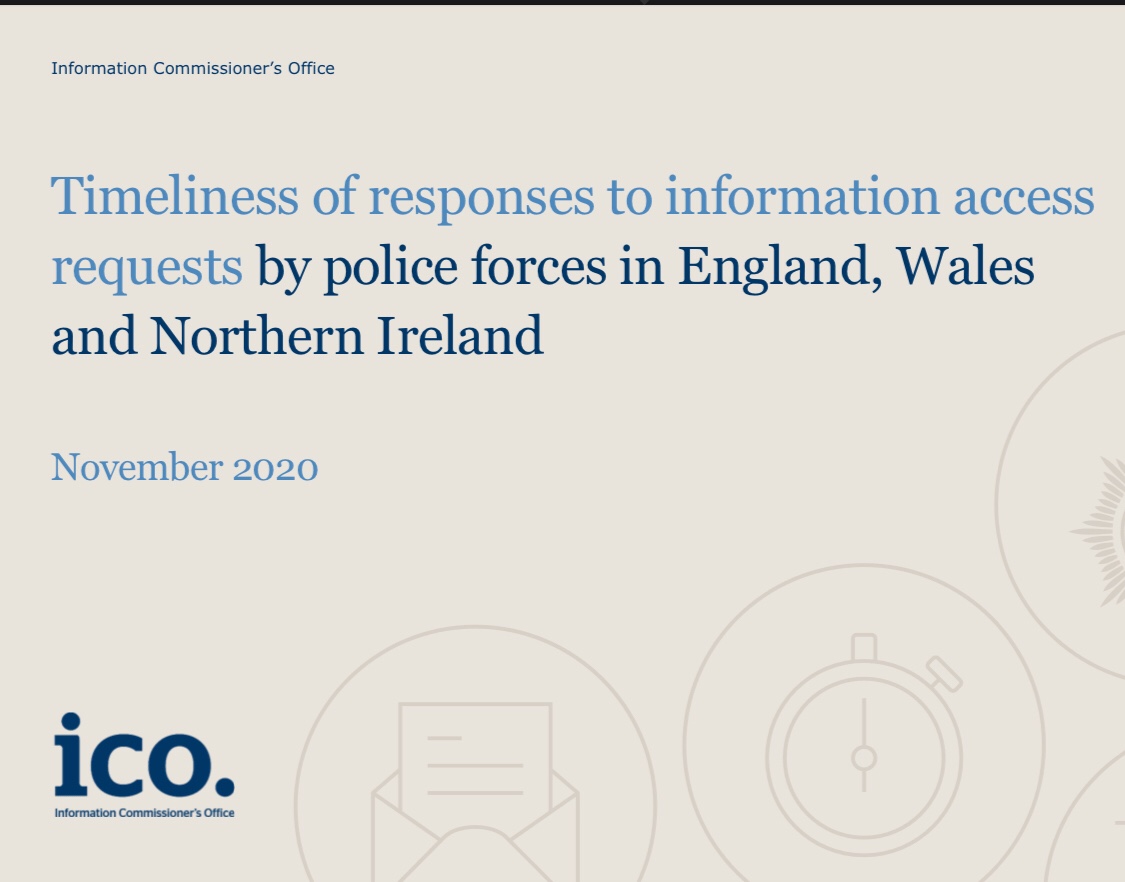
In a November 2020 report The Information Commissioner (or ICO) wrote the forward to a report and stated:

โ€œIt is my hope that police forces, and other organisations, will read this report, understand their current position and identify actions they can take to improve or maintain good performance. We will continue to work with the police to support their compliance with information rights laws.โ€

Some hope of that!

When the Commissioner wrote of โ€œtheir current positionโ€ she was using soft-soap language for what would have been more accurately described as clear flouting of the law and institutional efforts to evade disclosure of information.

The full report can be read at https://ico.org.uk/media/action-weve-taken/reports/2618591/timeliness-of-responses-to-information-access-requests.pdf

A copy of the title page of the report.

Letโ€™s take a look at West Yorkshire Police as being a recent example of this failure to comply with both the law on data access requests, ICO guidance and their general obligations to maintain good relations with the public.

The Office of The Police and Crime Commissioner for West Yorkshire has for some months now been aware of suboptimal handling of data access requests by West Yorkshire Police. They have noted an increasing number of complaints from members of the public about poor service and inadequate provision of data by Information Access departments at that force.

A Professional Standards Department investigation into a complaint brought by a member of the public that subject access requests made had been delivered late, were missing data and had been purposefully frustrated by police was mishandled by Professional Standards Department. The Office of The Police and Crime Commissioner for West Yorkshire (the PCC) found that the investigation had been substandard in several areas.

As per usual for a police Professional Standards Department the conclusion to the investigation ran along the lines of โ€œWe have investigated ourselves and found nothing wrongโ€. This outcome is usually achieved by PSD adjusting the frame of reference to the complaint to disregard all that inconvenient evidence that proves the complaint is correct. This indeed appears to have been done in this instance.

Accordingly PCC wrote in their examination of the complaint handled by PSD:

โ€œThe decision I have reached is that the outcome of the complaint was not reasonable and proportionate… [that a proper complaint investigation involved] Full consideration of the Information Management Departmentโ€™s handling of [the complainants] requests over the last year, including all the ones he brought to the complaint handlerโ€™s attention and the involvement of the ICO in those requestsโ€

Which is as I stated: police complaints department ignoring evidence which proves the force has misconducted itself.

PCC wants a re-examination of major aspects of the complaint and also wants to see:

โ€œFull consideration of the wider context concerning the timeliness of replies to Subject Access requests by West Yorkshire Police, including the engagement with the ICO. This should take into account the findings and recommendations from the ICOโ€™s report from November 2020 โ€œTimeliness of Responses to Information Access Requests by Police Forces in England, Wales and Northern Irelandโ€

…in other words the report I referenced above.

This is to say the least mildly inconvenient for police. An examination of the timelines for a dip-sample of data access requests made (but not fulfilled on time) is one of the easiest ways to see that police have broken the law in relation to these requests.

But of course if West Yorkshire Police were to investigate themselves and report to PCC the errors made in supplying data requested by members of the public then it would be impossible to hide the scale of information deliberately hidden.

So the response of Rene Prime, Reviewing Officer at Professional Standards Department to PCC states:

โ€œUnfortunately, I do not agree with the actions you propose should be taken to resolve the complaint. I agree that full consideration should be given to [the complainantโ€™s] contact and requests to Information Management over the last year and the issues that have arisen around those requests, however I do not consider that it is appropriate to consider the wider context of perceived issues within the Information Management Team.โ€

Which is as slippery a way as can be found to avoid PCC discovering the full extent of West Yorkshire Policeโ€™s efforts to evade the production of data requested by members of the public. This reply also in effect โ€œcuffs offโ€ (to use a West Yorkshire Police term) the recommendations of PCC which have been made in the light of the many other individual complaints from members of the public regarding failed data access requests.

The standard approach to data access requests made by police forces is not compatible with legislation allowing the public access to data.

Secretive, evasive and mendacious: police hate requests for information from the public.

Instead they seek to frustrate access requests, deny even the production of non-contentious materials and in most cases seek to delay the production of data beyond time limits in law so that the requester will be liable to forget all about the request and go away. At all stages the intention is to frustrate, vex and delay. This is often because the police operational mindset is focused towards evading any form of insight into their working practices or accountability. Ergo the more the public get to know about police methods and actions by data access requests the less the freedom for police to do more or less as they wish. An informed public is aware of the abuses of power and the bending of the law that the police perform daily.

The above correspondence gives you something of an insight into the attempts police make to avoid production of data which would make them accountable. This time last year the police complaints process was subtly changed to make the local PCC engage more with appeals into poorly handled complaints. It will be interesting in the light of the above to see if West Yorkshire Policeโ€™s PCC has the guts to challenge ongoing breaches of the law over data access requests to West Yorkshire Police.

โ€œAccessing Police Systems for an Improper Purposeโ€

Humberside Police are one of those forces that you wonder how they get away with it.

Largely hidden away from the rest of the country on the edges of East Yorkshire they have a reputation every bit as unwholesome as other local forces.

One reason they do seem to get away with it is both geographical distance from the rest of the UK and of course lack of proper oversight. Their perennially ineffective Police and Crime Commissioner Keith Hunter recently showed the level of consideration he has for the local pubic by manhandling a visitor asking perfectly reasonable questions out of his office. As a former officer himself old habits die hard.


The PCCโ€™s behaviour is of course equal to the contempt for the public shown by the force itself in such matters as inadequate custody suites which – on the basis of the last inspection reports I read – were shockingly poor, particularly in regards to the welfare of young people held in custody.

But while holding the public largely in contempt officers can expect lavish prize ceremonies at The Humber Bridge Country Park Hotel, a venue synonymous with chicken in a basket style meals and budget wedding ceremonies. These police awards stem from the days the force were in a Chief Constable-less mess which almost ended up with them being put into special measures. Handing out cut glass awards helped to boost the morale of the troops, albeit on a temporary basis. Clearly no gongs were forthcoming from any other source at that time and so the force decided to award gongs to themselves.


The days in which the force almost ended up in special measures still hang heavily over Humberside Police. The epithet โ€œWhere we do what we wantโ€ has seldom applied more to a UK force in modern times, Met Police excepted. Overall in those days and to a lesser extent now Humberside officers still tend to do what they want.

The consequence to all of this is that quite a number of officers from Humberside Police end up before their Professional Standards Department and such hearings now appear to be increasing in frequency. This suggests an increasing breakdown in internal discipline and operational effectiveness that needs to be addressed urgently.

Of course PSD generally tend to go for the low hanging fruit which means the officers most likely to be prosecuted are PCโ€™s caught slacking off, pulling a sickie or whose face doesnโ€™t appear to fit around the station. Occasionally officers are thrown to the wolves just so PSD can appear to be exercising some form of oversight. The more serious miscreants and offenders further up the slippery ladder are ignored. In the modern police force assistance over cover-ups are rewarded with promotion and rocking the boat by sacking someone who knows โ€œwhere the bodies are buriedโ€, metaphorically speaking of course, has the potential to bring the whole house of cards tumbling down.

So this recent case seen directly below reminded me of a well-publicised matter from a few years back – which is still a shocker – which I will discuss in a short while.

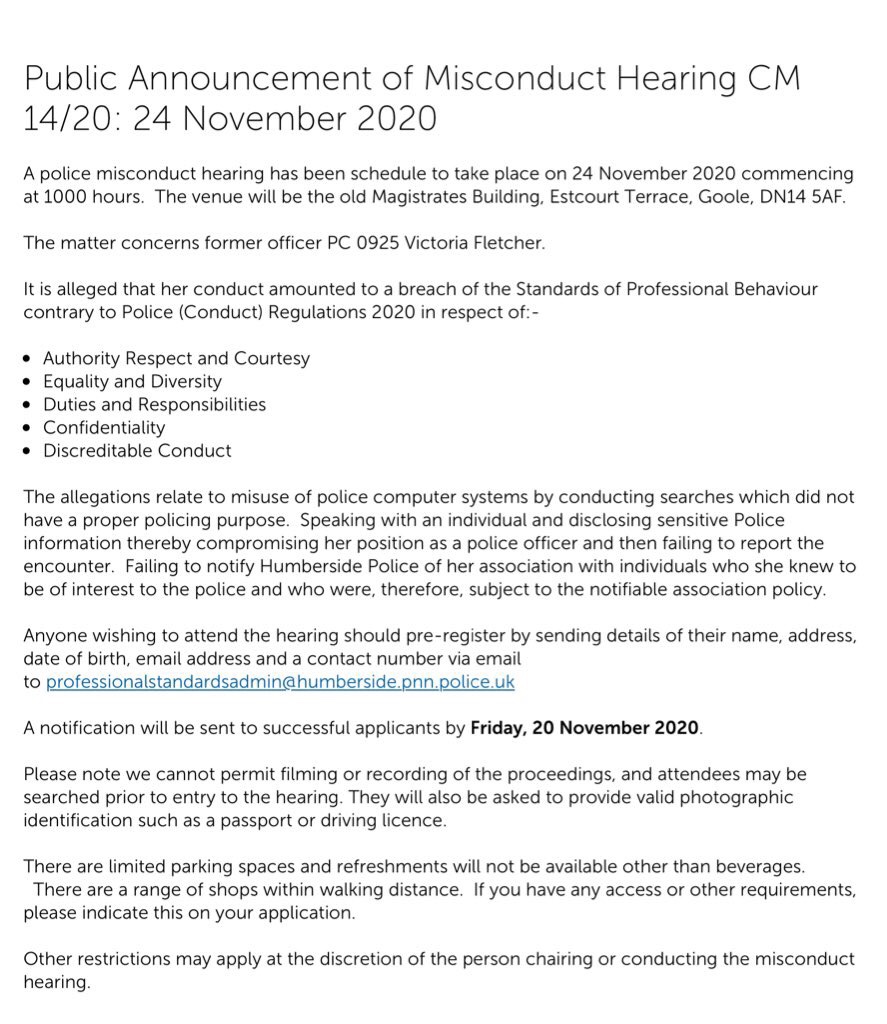
Busted!

As you can see the basic charge is that this PC has been passing confidential police information on to criminals. Guaranteed this data will have been specifically requested by Ronnie and Reggie, will be of considerable use to said criminals and there will have been a payment involved somewhere down the line. Thatโ€™s the way these things work.

Police databases include something called the PND or Police National Database. This is a huge wealth of half-truth, rumour and suspicion which will have entries on just about any person who has come into contact with the police for any purpose. Unlike the Police National Computer which must be accurate (containing as it does details of convictions, cautions etc.) the PND can contain outright unsupported rumours, slurs and spite.

Do please bear in mind you have no right of access to whatever falsehoods might be stored on the PND about you: although you can make a request for all the data uploaded by an individual force about you to PND. You then have a legal right of correction of the same.

Which brings us back round to Humberside Police.

As weโ€™ve already seen thereโ€™s a tendency in the force to dip into and out of police systems for officerโ€™s own benefit. Any access to PNC or PND is logged however so anyone doing so is easy to locate. Officers dipping into databases for their own curiosity or benefit tend to forget this.

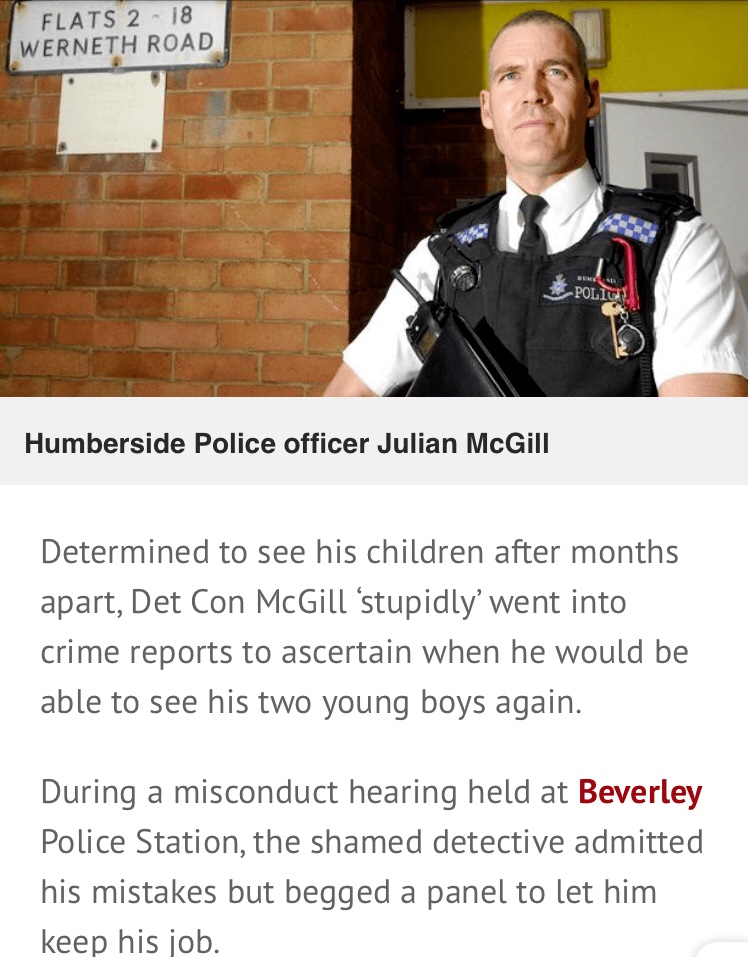
Which brings us to DC Julian McGill.

Busted! Again.

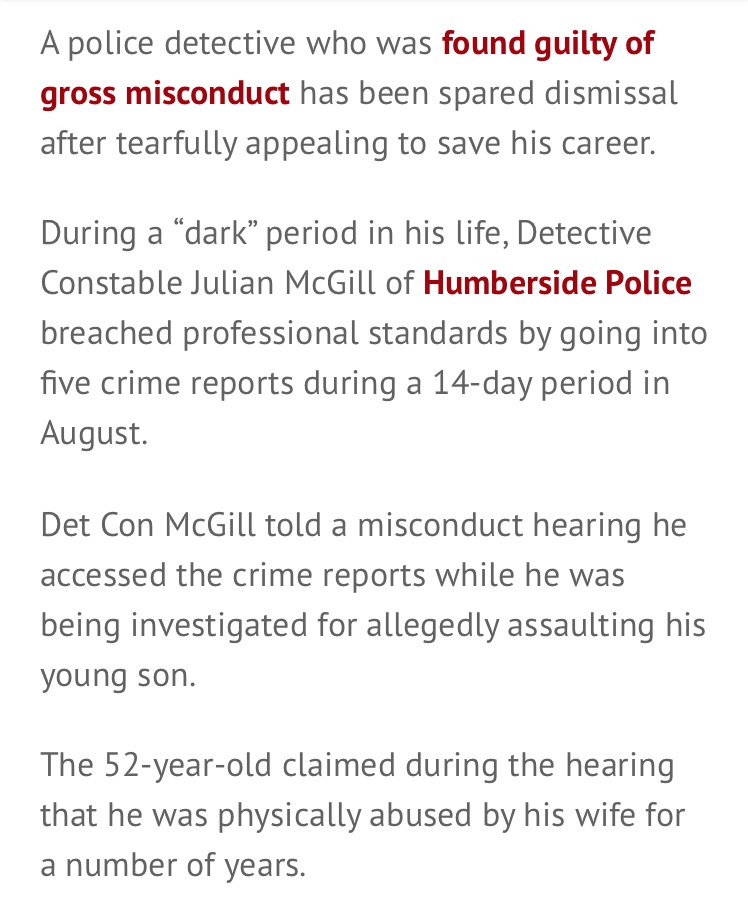
The report above isnโ€™t the full story as thereโ€™s been several instances of computer misuse from this officer over the years. This resulted in a final written warning and the hearing described below in which his career was on the line:

Believable? You decide!

McGill at the time was serving as part of the local Police Federation. A fact that will have of course been unlikely to influence the position of the misconduct panel in any way! Generally gross misconduct results in only one outcome and since the offending act was admitted (he could hardly deny it given his access was logged) the decision of the panel was very much at odds with the seriousness of the offence.

However this all ties into my original premise that Humberside Police – situated away from prying eyes – seek to do what they like. Accessing police databases for their own use is simply one part of this and the brushing aside of an instance of gross misconduct is a further example.


โ€œCuffingโ€ or โ€œShonkingโ€ at South Yorkshire Police.

In modern police parlance โ€œcuffing offโ€ a job means to look for a way to avoid dealing with a complaint about a crime made by a member of the public. Shonking means the same thing. South Yorkshire Police is very much focused on internal award ceremonies for its staff and members of the public calling to report criminal offences gets in the way of this. Most inconvenient.

So hereโ€™s the story. I had an offence to report on the basis of information that came my way. Having researched the offence and charging guidelines for the same as well as collated sufficient documents to show who was responsible and how I completed the South Yorkshire Police online form. This is their preferred way of contacting you. And so I waited for contact back. And waited. And waited.

Eventually a series of phone calls were made on one afternoon to South Yorkshire Police via 101. The poor handling of the initial report from the webform data and subsequent poor handling of all subsequent contacts are described below.

Basically the webform was ignored. Phone calls to check on the progress of the report of a crime were also consistently mishandled.


From the 1980โ€™s to the present day SYP is mired in scandal.

The basic issues are as follows:

1. A complaint of a crime was made. This was done via the online form for such. That the response from the online form took longer than the 72 hours the website states for any action to be taken in respect of the referral of a crime.

2. That the online form had still not been processed some 7 days later.

This amount to the first effort to โ€œshonkโ€ the job.

3. That from comments made by Professional Standards Dept. at SYP in a later email to me it would appear that this online referral has been โ€œlostโ€.

4. Following the lack of response to the webform a series of phone calls were made by me on the Tuesday and Wednesday to SYP to establish what was happening in relation to the online referral.

5. That these calls were either cut off when transferred to the appropriate department or else rang out for an exceptionally long period. The time it took to get through to someone was the time of my journey that day from West Yorkshire to Bridlington on the East Yorkshire coast. Some one hour and fifteen minutes.

6. That on eventually speaking to an officer he stated that he had no copy of the online form in front of him but proceeded to dismiss the referral of a crime being committed on the basis that this incident was not a crime and therefore not something that police would deal with.

This is incorrect. I quoted CPS guidance and sentencing guidelines that clearly show the activity reported was a criminal offence.

Most police officers have a very poor working knowledge of the law and are often the worst people to decide if an offence falls into their jurisdiction or not. Or if an offence has been committed in law. Without sight of evidence etc. the officer was additionally on very shaky ground.

7. That the same officer rang me back several minutes later. He had performed a search on my name after our initial conversation and my refuting his comments that the matter complained of was not an offence in law.

8. That his call back to me amounted to harassment and intimidation. His manner during this second call was offensive, uncivil and harassing. Having tried to โ€œcuff / shonk the job offโ€ only to be confronted by a member of the public who knew the law put his fragile and delicate nose out of joint.

Most police officers have exceptionally fragile egos and cannot bear not to have the last word on something. As sites such as the exceptional. ://crimebodge.com show (especially I would recommend their YouTube channel) this can often lead to violence and assault from the officer if a member of the public stands their ground.

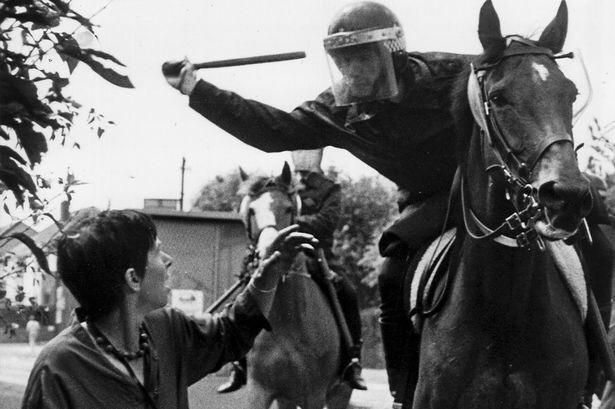
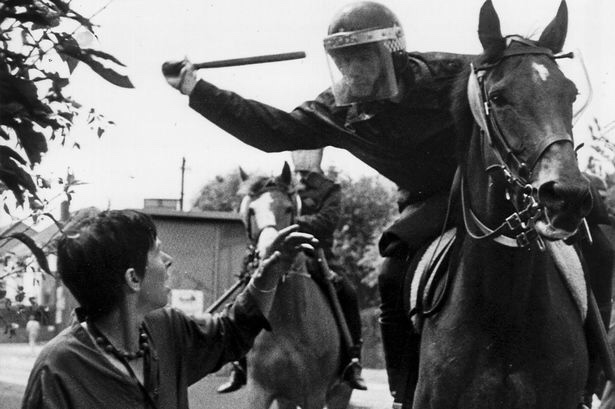
9. That the officer concerned did this solely for the purpose of causing harassment, vexation and distress. On the second call he refused to give his name or service number when asked which is usually indicative of an officer misconducting himself. South Yorkshire Police have plenty of form for this. Ask the miners who were at The Battle of Orgreave: SYP removed their epaulets displaying service numbers so they couldnโ€™t be subject of individual complaints.

South Yorkshire Police are internationally famous for violence and criminal negligence.

That overall the standard of conduct in relation to this matter was sufficient to cause loss of professional reputation, such as it is, for the force. Overall the behaviour described above gave the impression of South Yorkshire Police as being inept, incompetent and evasive.

Later that day is I rang again. This time to make a formal complaint. The College of Policing Code of Ethics has a series of guidelines which had each been breached in the policeโ€™s handling of this matter. Not least of these are those related to courtesy and respect. https://www.college.police.uk/What-we-do/Ethics/Documents/Code_of_Ethics.pdf

I was told I would be called back in a few days. However again there was no response.

This matter relates to the following issues in the College of Policing Code of Ethics:

1. Authority, respect and courtesy.

2. Duties and responsibilities.

3. Conduct.

I emailed Professional Standards Department at South Yorkshire Police a few weeks later. The response was initially in terms of my complaint call of a few weeks earlier and stated:

Unfortunately, we are unsure as to who the officer was who spoke with you…

This suggests that the admin systems at South Yorkshire Police are not robust enough or else that theyโ€™ve already tried to evade examination of the complaint in the same way as they avoided examination of the original report of a crime. The comment is also vague: do they mean the misconducting officer I spoke to at around around lunchtime or the one spoken to to enter the complaint at 18:30 on the same day?

But it gets worse:

In relation to the online complaint form this does not a appear to have been received by us.

So an additional copy was attached to the response. Neither the original web form reporting a criminal offence nor the complaint form sent by email were received by the force. How many others have been similarly missed by them?

By this point some three weeks had elapsed since this complaint form was sent in to Professional Standards Department and their sobriquet was looking further and further misapplied. The South Yorkshire Police webform auto-generates a copy of the complaint for the public so it is unlikely that a copy was not sent to PSD. The comments they made about not receiving a copy are likely bunkum.

They stated:

If you would like to reply to this email with your initial complaint, we will pass it for assessment and ask our assessors to look into it asap.

So this created a further issue to the complaint: that failure to record the initial complaint call made around 18.30hrs in the evening to SYP via 101 amounts to a further breach of duty. A copy of this call will have been recorded on the Airwave system, which records all incoming and outgoing calls from police stations.

The failure to properly action the issues raised by phone in the evening call amounts to an effort to evade dealing with the complaint from an early stage. The โ€œlossโ€ of the follow up complaint form to PSD is a further effort in this direction.

Matters have now been before Professional Standards Department at South Yorkshire Police for two months without visible progress.

The whole fiasco makes SYP look doubly incompetent in their behaviour in failing to action the original webform, then โ€œcuffing offโ€ the job on the phone.

Then they fail to record and action the complaint made from 18:30hrs on the same day and further claim a follow up communication on the complaint was โ€œlostโ€.

Heaven help people who actually live in South Yorkshire when it comes to reporting crime or making a complaint to SYP. Because the forceโ€™s systems are clearly set up to avoid having to deal with either.


West Yorkshire Police: COVID-19 Super-Spreaders?

Presently the East Yorkshire city of Kingston Upon Hull has the highest COVID-19 rates of infection in the UK. The virus appears to be running rampant in the city causing a significant numbers of deaths.

The Guardian has quoted local Hull resident Gavin Storey in an article published this week. The original article can be found at:

https://www.theguardian.com/world/2020/nov/18/gypsyville-hull-most-deprived-and-covid-infected-suburbs-in-england

It states that Storey thinks it suits the ruling class have let the virus run riot through deprived communities like his. He says:

โ€œIt seems like they are trying to get rid of us. That way when itโ€™s over they wonโ€™t have to spend so much money around here. Let the kids go to school, spread it to their parents and then let them all die. Most of the people in the country who are on benefits will be dead.โ€

Twitter users react to Mr. Storeyโ€™s comments in the article.

This all got me thinking about the initial wave of the pandemic to hit the UK in spring 2020.

According to information passed over to me in a conversation in spring 2020 from one of Leedsโ€™ top criminal defence solicitors West Yorkshire Police were arresting and pulling suspects in for questioning with an urgency and speed which was quite at odds with the nature of a lethal pandemic and the requirement for people to self isolate.

Those arrested were not given masks and at that point before the end of the first lockdown self-sourced PPE was not commonly owned like today. The overall idea at that point was to protect by keeping your distance from others which makes the arrests carried out seem even more bizarre. Command Teams must have been aware of the risk of police stations as focal points for the spread of the virus. Frontline officers were of course given PPE but of dubious effectiveness which had been sold to the force, desperate to be seen to protect officers, as a โ€œjob lotโ€.

This is also unusual behaviour for a force which remains in financial dire straights considering the potential costs of increasing the pace in ongoing investigations.

Indeed I was told that at that time even people who had been released under investigation for a long period and who had no notification of progress on potential charges were being re-arrested and brought in for interview.

UK police tend to be toxic at the best of times.

In the same way as Mr. Storey thinks schools are being used to spread COVID-19 in deprived communities the sudden urge of West Yorkshire Police to pull in suspects for interview in the initial wave of a lethal pandemic seems… unsettling.


Were these actions part of a deliberate policy to assist the virus to spread in deprived communities?

Is this too outlandish an idea? Then consider also that in spring 2020 the elderly and frail were discharged from hospitals into care homes without adequate screening to ensure they were not infecting others.

The initial Government policy on the virus was to let it run through the population. This was the planning in the early stages of the UKโ€™s response until SAGE, the Governmentโ€™s scientific advisory group, suggested this strategy would lead to potential UK deaths of up to 250,000. This initial discredited strategy meant excess deaths through the initial lockdown coming too late. It is known that former Government advisor Dominic Cummings is a eugenicist who employed another advisor for a short period in February 2020 before that personโ€™s past writings in eugenics were made public leading to their dismissal.

In every one of multiple other respects the UKโ€™s response to the pandemic was lethargically slow and inept. This situation continues to this day.

The idea then that there has been purpose in the UKโ€™s handling of COVID-19 has some merit. That the initial plan to allow the virus to rip through the population is still in play but not stated openly as a matter of State policy.

It is likely then that people with either criminal records or suspected of committing a criminal offence have been considered in the same light as the fail and elderly: a potential burden to society and something best gotten rid of. That the virus provides (to the State) a convenient ability to do just this.

I know of one clear instance of West Yorkshire Police officers attending at a suspectโ€™s home without masks or PPE in May despite being aware of a vulnerable person being present at the home. Breaking subject access request laws the Right of Access Department at West Yorkshire Police have failed to release body worn video footage of this incident showing officers attending without PPE.

The theory that West Yorkshire Police were actively pulling in suspects in an attempt to spread Coronavirus around is just a theory.

But itโ€™s a theory that does seem to fit into the overall approach of the authorities towards the virus from the inept Test and Trace system to Eat Out to Help Out. All of these have assisted the virus to move through the poorer sections of the population to the point where weโ€™ve ow reached the second point of national lockdown within one year.


In South Korea there have so far been less than 600 deaths from COVID-19. Britain has (at a low estimate) 60,000 to date.

Malfeasance at the Office of West Yorkshire Police and Crime Commissioner

The West Yorkshire Police and Crime Commissioner is Mark Burns-Williamson, a largely gaff-prone failed politician. Heaven knows thereโ€™s sufficient data out there in the public domain to show that by any stretch of the imagination the man is unsuited to any role requiring public trust.

My favourite one details how he sent an inadvisable letter in a โ€œlove triangleโ€ which would ordinarily have rendered him open to criminal prosecution. This was however covered up by West Yorkshire Policeโ€™s (then) DCI Simon Bottomley leading to the eternal gratitude of Burns-Williamson to the force he is supposed to scrutinise.

It also appears his office is prepared to manipulate and ignore facts to protect the very organisation it should be holding to scrutiny.

This blog entry tells the story of one such incident.

Burns-Williamson demonstrates the degree to which he hold the local force to scrutiny.

In May 2020 The Ministry of Justiceโ€™s Data Access Office sent data to a person (who we will call the recipient) in error.

This data was information on a third party who lived in the London area. This amounted to a serious data breach as the disclosure included the subjects name, address, date of birth and bank account details etc. as well as other disclosures regarding a series Proceeds of Crime Act proceedings against the data subject.

The recipient of the data informed The Information Commissionerโ€™s Office and The Ministry of Justice as well as the data subject whose information had been disclosed. He also posted regarding this on Twitter but did not reveal any confidential information in so doing.

Data Access at MoJ requested the recipient remove the mocking tweet. The recipient of the data refused citing his freedom of expression under The Human Rights Act and that no offence in civil or criminal law had been committed by the tweet.

Three days later the recipient of the data was arrested at his home by West Yorkshire Police on the basis that he had breached The Data Protection Act. The allegation being that he had shared the confidential data sent to him in error on Twitter.

This was palpably untrue as an examination of the tweet would have confirmed. However police did not examine the tweet for themselves but took it โ€œon trustโ€ from MoJ that a supposed offence had taken place. Of course it hadnโ€™t but MoJ were burning with indignation that a serious data security error had been made public and to their official regulator on data matters the ICO.

Police were aware that no offence had occurred.

The bar for arrest for any offence is set very high as recent cases such as Rachid v. The Chief Constable of West Yorkshire Police (2020) show. Instead police took it on trust from The Ministry of Justice that an offence had occurred in a situation in which the Security Manager for MoJโ€™s correspondence (seen by this blogger) reveals his desire to give the recipient โ€œa nasty shockโ€.

The recipientโ€™s home was entered by police on his arrest. In the middle of the Spring 2020 pandemic a vulnerable family member who was shielding was subject to interaction with police who did not wear PPE or take any form of precautions regarding introducing COVID-19 infection into the home. Electronic devices were removed and the home was ransacked in the search. The officer leading this was PC Alan Jackson. Police actions amount to trespass to property (since there were no reasonable grounds for arrest) alongside trespass to goods and wrongful arrest.

The home of the recipient of data was raided by police without PPE in the middle of the spring pandemic.

Predictably no charges were brought. Emails seen between the Officer in Charge (OIC) and The Ministry of Justice reveal MoJ immediately loose interest when the recipient was arrested which fits in with the prior email claiming MoJ wanted to give him a nasty shock. No further action resulted to the recipient from either Police or MoJ.


A complaint was duly made by the recipient to West Yorkshire Police Professional Standards Department (PSD). Their internal investigation under The Police Reform Act 2002 confirmed – but only internally to the police – that the arrest was wrongful on the basis that WYP had not seen or been provided by MoJ with any indication that a criminal offence had taken place. Other aspects of the complaint made were ignored by PSD and not investigated.

An organisation such as West Yorkshire Police which has an international reputation for both corruption and incompetence needs to be able to head off complaints and minimise them early on. The investigation concluded in a document called an Assessment and Progress Log that there had indeed been no reasonable grounds for arrest, therefore logically the arrest was unlawful. This document was an internal document not for public or complainantโ€™s consumption.

Police of course cannot admit that they have erred to the complainant. It opens the door for civil action for wrongful arrest and payment of compensation. It also amount to loss of professional reputation.

Thus the results of the PSD investigation which were presented to the complainant in August 2020 were totally at odds with the actual true findings of the investigation. The official line was that nothing untoward had occurred and that the arrest was legitimate: the unseen internal report stated quite the opposite. A copy of this report has since been obtained from WYP and examined.


If you find that the above shocks you then I would respectfully point out you may have little experience of the police complaints process and the extent to which it seeks to hide the conduct of misconducting and underperforming officers.


The complainant found some 21 issues with the PSD investigation response which were either suboptimal or evaded examination of the facts. Of course if youโ€™re prepared to commit mendacity on such a scale as a police complaints office then itโ€™s best to keep any communication simple. The response provided by PSDโ€™s Vicky Silver was clearly exceptionally evasive and the errors in it were manifest.

Police Professional Standards Departments go to any length to dismiss valid complaints.

The complaint was progressed as an appeal to The Office of The Police and Crime Commissioner for West Yorkshire, this being a body with supposed oversight of the local force. Karen Gray at PCC was tasked with the examination of the appeal.


It is a basic element of any investigation that the investigator should have access to all of the data available to be able to reach a reasoned conclusion. This is common sense. In the course of the PCCโ€™s investigation they either failed to obtain copies of documents such as the PSD Assessment and Progress Log or else were provided with a copy of the relevant data but chose to ignore it in favour of a rubber-stamped approval of the earlier PSD investigation.

Thus the office of West Yorkshire Police and Crime Commissioner have shown themselves to be either as throughly dishonest or professionally incompetent as the police force they are supposed to supervise. Further they are prepared to support the local force in their dishonesty.

A further complaint was made regarding the failure of the PCC to obtain all relevant data meaning that the Karen Gray investigation was fundamentally flawed. This was responded to more recently by PCCโ€™s Jane Owen who has stated that Karen Gray could not have been aware of the Assessment and Progress Log on the basis that it was produced after the conclusion of the original PCC review.

However the document in question from PSD is dated 5.6.20.

Therefore it was produced BEFORE the complaint was referred to PCC by around two months. The response that it was not available in the original PSD investigation is therefore an outright lie.

It is of course inconceivable that an investigation properly conducted would not have requested a copy of, assessed and examined the PSD Assessment and Progress Log which was in existence by this point and therefore PSDโ€™s position that Karen Gray had access to all of the required documentation to enable correct conclusions is not only incorrect but also deliberately misleading.

The essence of the complaint to PSD regarding wrongful arrest etc. was proven – as that office was well aware – by 5.6.20.

All subsequent efforts of PSD and the office of the PCC for West Yorkshire have sought to bury the facts under an increasing mound of guff and nonsense.

PSD chose to issue a response completely opposite to the facts they had themselves established and The Office of The Police and Crime Commissioner has assisted them in this cover-up and continues to do so.

In a desperate final attempt to avoid further scrutiny Jane Owen writes:

I have concluded that you have used the Office of the Police and Crime Commissionerโ€™s complaints process to try and change the outcome of your complaint… and the subsequent review undertaken by this office but โ€“ in line with the statutory guidance that has been issued that sets out how reviews have to be handled – you do not have a further right of review


Is it any wonder that both West Yorkshire Police and The Office of the Police and Crime Commissioner have such a poor reputation both locally and nationally?

Certainly both are prepared to bend the truth into impossible angles to avoid any admission of error or loss of professional reputation. Perversely this ends up in a situation as described above in which loss of face and reputation end up occurring both from the original issue and the labyrinthine efforts made to conceal it.


Design a site like this with WordPress.com
Get started