
An Easter Miracle!

Only around one in ten complaints made to the police of poor conduct, breach of the College of Policing Code of Ethics etc. are found in favour of the person whoโ€™s complained.

This is because poor, ineffectual and incompetent investigations into complaints are par for the course from police forces. The more misconduct thatโ€™s happening in a force the greater the urgency to suppress public admittance of this by mishandling complaints.

The mantra is โ€œWe investigated ourselves and found nothing wrongโ€. Every police force does this.

As a police force West Yorkshire Police has more to hide than most. Theyโ€™ve an international reputation for corruption and incompetence but also an obsession with maintaining a public image. Consequently obtaining agreement from them about their low standards of policing requires more of an effort than with most other forces.

In this instance however they were banged to rights.

A transcript of a online live chat with an officer left them with no wriggle room. This is proof of why all your interactions with the police should always be recordedโ€ฆ because the first instinct of most police officers when caught out is to lie.

The report made concerned a crime committed in the breach of s.92 of The Care Act 2014 (as amended). Wakefield Council had knowingly as a care provider created false information on a person receiving care in their area. This is a criminal offence under the Act.

Iโ€™ll write more on this in a blog entry one day soon.

Note also the length of the replies given. When police are trying to hide something in a complaint response they avoid discussing the subject, fail to speak to relevant people and avoid issues theyโ€™d find uncomfortable to discuss. Here, as I said, a transcript of the chat means they canโ€™t avoid making a finding against themselves.

It should be noted that police have still failed to investigate this offence reported. So despite an unusual degree of honesty seen below itโ€™s still a case of โ€œbad cop – no donut for youโ€.

I present the Professional Standards Department response in full with a few small redactions.


From: Allen, Gemma <gemma.allen@westyorkshire.police.uk>
Sent: 14 April 2022 07:32
To: XXXXXX
@XXXXXX <XXXXXXXXXX>
Subject: Your complaint to West Yorkshire Police [OFFICIAL]

Classification: OFFICIAL

Dear Mr. XXXXX,

I refer to the complaint that you made to West Yorkshire Police. I am sorry that you have felt dissatisfied with the service offered by West Yorkshire Police on this occasion and, where we can, seek to learn from feedback offered by members of the public.

I can confirm that this matter has been recorded in accordance with the Police Reform Act 2002 under Complaint reference CO-2675-21. Please quote this reference number in any future correspondence regarding your complaint arising from the same matter.

It has been established that your complaint raised the following concerns / allegations. In response, I have made reasonable and proportionate enquiries into this matter and can offer you the following explanation of the enquiries conducted, what facts have been established, the outcome and any proposed action to be taken:  

Complaint 1: Delivery of duties and services

Employee concerned:  Staff member 730037 Maroof

Details of allegation:

You state that the call taker has incorrectly referred you to the council to make a complaint whom you state have committed a criminal offence under The Care Act.

The operator has asked you to provide evidence that the councilโ€™s acts were purposeful and fraudulent however you believe that this should be the role of the police and is not your responsibility.  

Enquiries conducted: 

The details of the Police chat transcript have been reviewed. 

The call taker, staff member 730037 Maroof has been requested to provide a response.

The Department of Health guidance for providers regarding The False or Misleading Information Offence has been reviewed.

I have consulted with The Police National Legal Database (PNLD). 

A request for review has been made to The Force Crime Registrar. 

Facts established: 

The Police chat transcript shows that you have made an allegation to West Yorkshire Police that Wakefield Council have produced a social care document which includes the purported current health situation of a family member which is out of date. You state that your family members health has deteriorated over the past year and yet old records have been used to produce the report. You report that you believe this was an intentional act by a social worker as it was likely to avoid the provision of social care for the patient who would otherwise be identified as having clear social care needs. The chat transcript shows that the call taker, 730037 Maroof sought advice and directed you to make a formal complaint against the council in the first instance. You state to the call taker that the โ€œArticle 16 right to restrict the processing of the data has been applied.โ€

The call taker, 730037 Maroof has responded to your complaint to state that he felt that referring you to the Councils complaints process was an appropriate response at the time. The call taker has expressed his apologies if his assessment of the information was incorrect. 

It has been confirmed that The Care Act 2014 has put in place a new criminal offence applicable to care providers who supply, publish or otherwise make available certain types of information that is false or misleading, where that information is required to comply with a statutory or other legal obligation. The offence is contained at Section 92 of the Care Act 2014. FOMI is a criminal offence and the investigating body for that offence will be the police, conducted in line with the โ€œThe Director’s Guidance On Chargingโ€. The police can pursue all reasonable lines of enquiry. FOMI is a strict liability offence that applies to providers of care services as corporate bodies or partnerships. This means that a prosecutor has to prove that the information was, as a matter of fact, false or misleading, but does not have to prove that there was intent to provide false or misleading information on the part of the corporate body or partnership.

The Police National Legal Database (PNLD) outlines that Section 92 of the Care Act 2004 creates an offence so that providers of health services and adult social care in England, which supply, publish or otherwise make available information that is false or misleading, could be subject to criminal sanctions. The offence applies to a care provider as a corporate body.

92(1) A care provider of a specified description commits an offence if –

(a) it supplies, publishes or otherwise makes available information of a specified description,
(b) the supply, publication or making available by other means of information of that description is required under an enactment or other legal obligation, and
(c) the information is false or misleading in a material respect.

However, it is stated in law that it is a defence for a care provider to show that it took all reasonable steps and exercised all due diligence to prevent the provision of false or misleading information as mentioned in subsection 1. This means that if the Council have already taken reasonable steps to rectify the matter then the offence has not been committed. By taking steps to restrict the data by invoking Article 18 of the General Data Protection Regulation (GDPR) which provides an individualโ€™s right to restrict the processing of the data, they have fulfilled this responsibility. Article 16 of GDPR then covers the rectification of the data.

Detective Chief Inspector (DCI) Fraser from the Force Crime Registrar has reviewed the matter and confirmed that your report is a state based crime therefore the Police only have to record the offence when the relevant โ€œpoints to proveโ€ are made out. Unlike victim based crimes the Police do not have to record these offences at the point they are reported.

Finding: The service level was not acceptable under the circumstances

Rationale: 

The information you have provided on the chat record shows that the matter has been reported to the council and that they have already taken reasonable steps and exercised due diligence in restricting the data. The matter does not require recording or further investigation at this time. 

My enquiries show that Call taker Maroof has attempted to ask reasonable questions during your chat report when he has asked you if you have evidence to prove that it was done purposely and fraudulently. The call taker appears unfamiliar with Police Procedures around reporting of potential state based offences however he is not a Police Officer and could not reasonably be expected to know that the offence of FOMI does not require criminal intent on the part of the perpetrator. The call taker has attempted to seek advice whilst you remained on the chat facility and it appears he has been given information which has led him to make a recommendation that you should firstly report the matter to the council. His assessment would have been reasonable and proportionate under the circumstances if you had not already provided information to suggest that you had already reported the matter to the council. It appears that the matter was not fully understood and that you required further clarification before the chat was ended. It would have been more helpful to your understanding for the call taker to refer you for an appointment with a Police Officer so that the outcome could be fully understood and explained in more detail.

In conclusion, it is considered that learning has been identified in respect of this complaint.

Outcome/Action: Learning from Reflection

Details: An opportunity for learning has been identified which has been provided to the call taker through his direct supervisor.

Complaint 2: Individual behaviours

Employee concerned:  Staff member 730037 Maroof

Details of allegation: You state that the call taker terminated the chat abruptly with no explanation

Enquiries conducted: 

Call taker Maroof has been requested to provide a response. 

The chat transcript has been reviewed. 

Facts established: 

Call taker Maroof has responded to state that due to time passed he cannot fully remember his reasons for ending the chat at the time. After review of the transcript he states that he may have felt that he had advised you what to do and so believed the chat could be closed. It may have been that you had gone offline after receiving his response so he assumed it was completed. He added that he canโ€™t say for sure given the time that has passed but either way he does not think that he gave โ€œno explanationโ€ as he clearly provided advice on what you should do.

The chat transcript shows that the chat was ended 20 seconds after the call takers last response to you.

Finding: The service level was not acceptable under the circumstances

Rationale: 

The outcome of this complaint should be read in conjunction with the information provided in Complaint 1. Although the call taker has remained respectful throughout the chat, it does appear that you had not been provided with a sufficient explanation of the outcome or the opportunity to understand the advice provided. This is believed to be because the call taker did not fully understand the police procedures around state based crime reporting.  

In conclusion, it is considered that learning has been identified in respect of this complaint.

Outcome/Action: Learning from Reflection

Details: An opportunity for learning has been identified which has been provided to the call taker through his direct supervisor

It is considered that reasonable and proportionate enquiries have been made into this matter. The issues you raise in your complaint do not justify criminal or disciplinary proceedings against any officer concerned and therefore the matter has not been considered by the Crown Prosecution Service. 

You have the right to a review of the above decision. Should you wish to request this, please contact the below review body by the 13th May 2022. Please quote the relevant complaint reference number (above) if you request a review. 

Due to the wording of your initial complaint, the review body is: 

West Yorkshire Mayorโ€™s Office for Policing and Crime. Should you wish to request a review, please contact:https://www.westyorks-ca.gov.uk/policing-and-crime/complaints-and-conduct.

Please accept my apology on behalf of West Yorkshire Police for any confusion, inconvenience or distress that this incident has caused, and I thank you for bringing this matter to our attention. I hope the above action taken re-assures you that your complaint has been taken seriously and demonstrates West Yorkshire Policeโ€™s commitment to continuous improvement.

I hope that any future contact you may have with West Yorkshire Police will not be adversely affected by this experience.

Yours sincerely,

PC 1449 Allen

Service Review Team

22566

Professional Standards Directorate

*   Email: Gemma.allen@westyorkshire.police.uk

+ Address: West Yorkshire Police, Professional Standards Directorate, Headquarters, WF1 3QP


The Not-Independent Office of Police Complaints

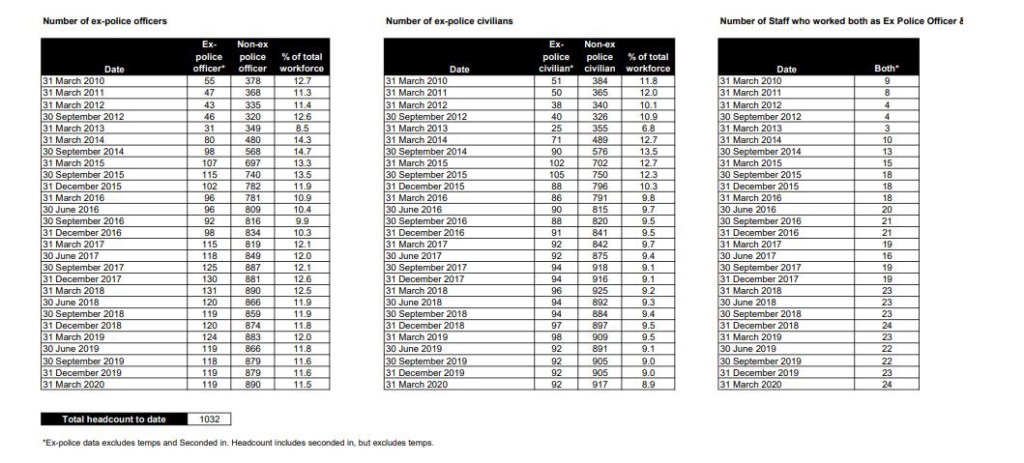
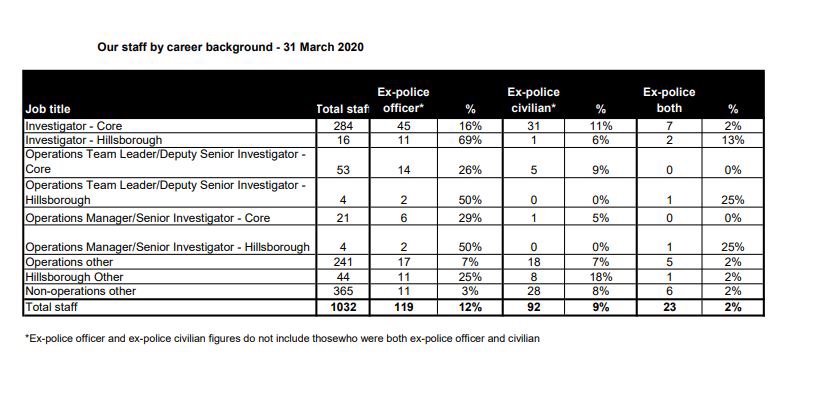
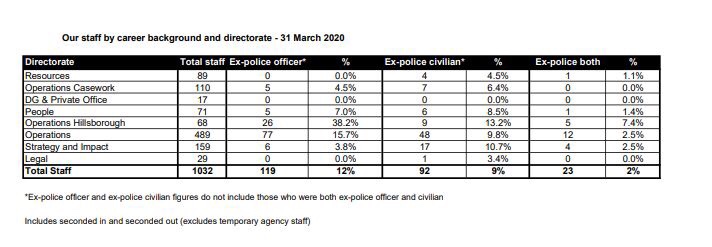
Were you aware of the numbers of former police officers working for the supposedly Independent Office of Police Complaints?

The organisation describes itself on its own website:

We are independent, and make our decisions entirely independently of the police and government.

But a document that IOPC prefers not to draw attention to can be accessed online at:

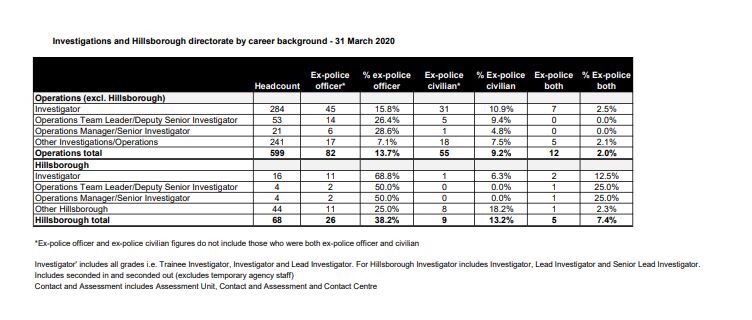
Copy of IOPC staff diversity stats 310320 FINAL proofread.xlsx (policeconduct.gov.uk)

This shows the – frankly – shocking numbers of former officers and former police civilian staff employed at IOPC. An organisation that is supposed to be independent in relation to complaints made against the police.

Can it really be expected that staff working for IOPC are prepared to justly and reasonably criticise their former force or colleagues they’ve worked with hand in glove for years? Of course not. Thereโ€™s a reason officers on Twitter use the hashtag #PoliceFamily

Indeed the figures speak for themselves: thereโ€™s a roughly one in ten chance of a complaint made about the police being upheld.

In the event of a complaint against the police you would be better off ignoring the police complaints process altogether and moving directly to instruct solicitors.

More seriously in the event of a fatality during contact with the police the staffing ratio of former officers presents a considerable barrier to a free and open investigation of the facts in such serious cases.

Ainโ€™t life in Britain grand!


Top Tips for Aspiring Criminals

Have you ever seen a magician who happens to be very capable at making watches, wallets and suchlike vanish from your pocket or wrist? Itโ€™s quite a sight when someone that capable manages to remove something from your person without you being aware of it.

A friend of mine works for a local police force. Every so often he updates me on all the recent criminal activity theyโ€™ve not been able to stop. Generally itโ€™s quite a lot: theyโ€™re forever behind the curve and not in front of it.

But like with the magician who can remove your watch or wallet in a stage show once you know whatโ€™s happening itโ€™s easier to not let it happen to you. So hereโ€™s a couple of tips which might help you to protect yourself.

There are two big recent growth areas of crime. The first of these is the theft of high powered vehicles. Audiโ€™s seem to be targeted especially at present and are then broken down for parts: Audi spares being especially expensive.

A nice new Audi.
Probably wonโ€™t be there for long!

One village with only about 140 homes was recently targeted. Each night over seven nights two homes were burgled and car keys removed. These days this sometimes comes with an assault on the homeowner if the burglar is disturbed. In the olden days such a thief would make off in fear when an upstairs light came on.

The second growth area is the wedding robbery. This again takes place by stealth. At a busy wedding the criminal (often a young woman between 18-30 years old who no-one would otherwise suspect) invites herself. When everyone is dancing around at the end of the night jewels, gold and expensive watches are removed from wrists, necks etc. and often looked after by elderly relatives who are not dancing themselves. This is when the sneak thief strikes & distraction techniques seem to be used. The gangs concerned in this type of robbery seem especially to be targeting Asian weddings.


A Christmas Card from Humberside Police!

Iโ€™ve written on here many times before about how Humberside Police are particularly useless, even in a hotly contested field of local forces.

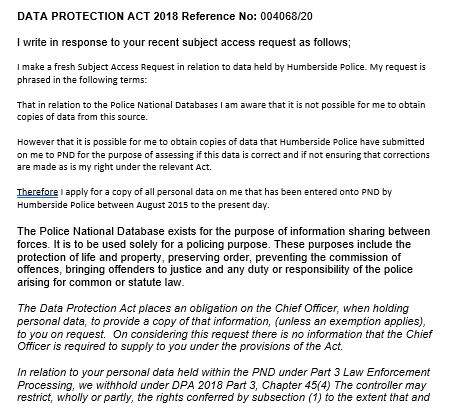
However even I fell off my chair at the sheer incompetence of the subject access response provided by their Information Compliance department this week.

A subject access request provided by the force amounts to a nonfeasance as the response:

1. Fails to provide the data requested.

2. Is issued outside the legal time limit for a response to be provided.

3. Repeats back the same information put in the original request.

Hereโ€™s the letter in full. I have redacted the header.

The key sentences are in the fourth and fifth paragraphs seen above. These are reproduced from the original request. Data cannot be obtained from the Police National Computer – however data that has been entered into the PNC by a local force can be obtained from the same regional police force. Hence the request to Humberside Police.

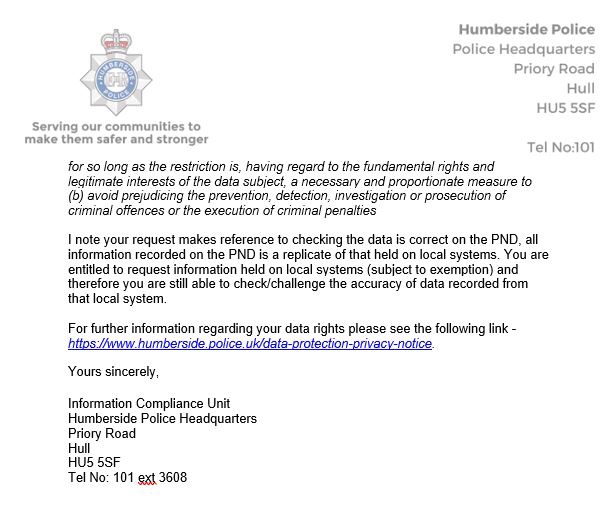
The substantive reply is seen below:

Here we focus on the second paragraph. It essentially repeats the data I put to police in the first instance.

Consequently the force has failed to react correctly to the subject access request in every conceivable aspect.

This suggests that the intention is to continue frustrate any further request made for the data using the rights conferred in italics in the letter to do so as the response to any further requests that might be made.

The Information Commissionerโ€™s Office has been informed.


Greater Manchester Police in Special Measures

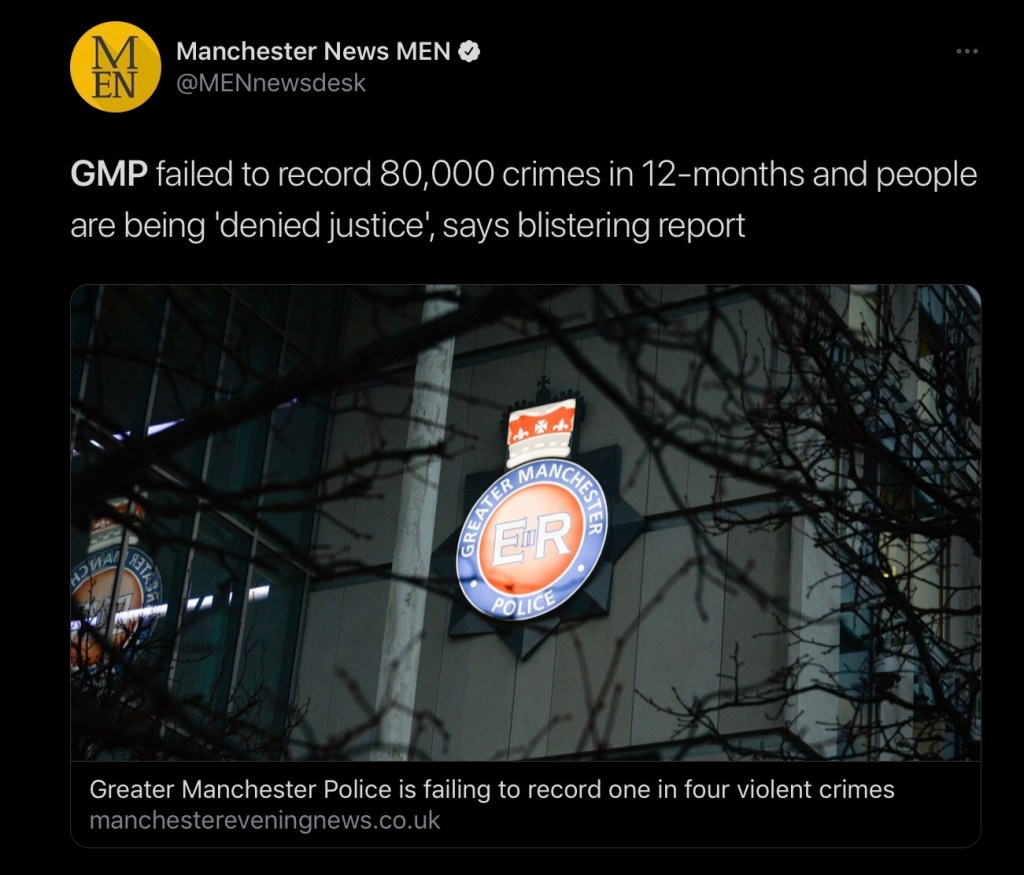
Flurry of activity at GMP in the last few days starting with this considerable shocker:

Overall GMP has been known to be a failing organisation for some time but no active intervention to stop the fall in service standards has been made by GMP itself, The Home Office or HM Inspectorate of Constabulary.

On Wednesday the Chief Constable, reckoned to be amongst the worst in a very competitive field, resigned citing โ€œlong term health issuesโ€. None of these issues had been apparent or seemed to prevent him discharging his duties prior to Tuesdayโ€™s news regarding non-recording of crimes.

On Thursday the force was placed into special measures following Home Office intervention.

Thatโ€™s a triple whammy of connected events.

Most interesting from my perspective is how GMP denied any failings in regards to service standards until the scandalous failure to record crimes became public. Like every British police force at present the effort made to hide errors and failures is tremendous. The mantra of the modern Chief Constable is that the professional reputation of the force must be maintained at all costs.

How many other forces will end up in special measures by the end of 2021? Iโ€™m willing to take bets on at least two.

Itโ€™s Miller Time! How Police Cover Up Allegations of Racism.

Iโ€™ve written on here before regarding Humberside Police. There’s something about that force that’s rather disturbing: a more blatent flouting of the College of Policing Code of Ethics, a lower standard of behaviour overall from the force towards the public and an open willingness to treat reports of crime and complaints with equal contempt.

Part of this is down to the geographical isolation of East Yorkshire and especially Hull from the rest of the UK. Humberside Police seem to have a genuine and recurring belief that they can do as they wish well away from prying eyes. The largely inept local media such as The Hull Daily Mail pay a part in assisting this of course. Rather than investigateve journalism that would reveal scandals in local policing they opt for click-bait thrill-a-minute headlines that drive traffic towards advertising. The PCC Keith Hunter is perenially inept at holding the force to account and the overall feeling is that he’s happy to sit out his tenure until pension day arrives. 

Some of this flouting of the conventions of good policing can be traced back to the period in which Humberside Police were a Chief Constable-less, rudderless and struggling force on the verge of being put into special measures. Audits routinely returned appalling reports by any metrics devised. Nor has the situation and service standards improved greatly in the four years since minor improvements began.

Like most police forces they have a unique ability to both say one thing and do another, as well as shoot themselves in the foot. While professing to detest and crack down on racism within their ranks the actual tale is quite different.

Which brings us to our story for today.

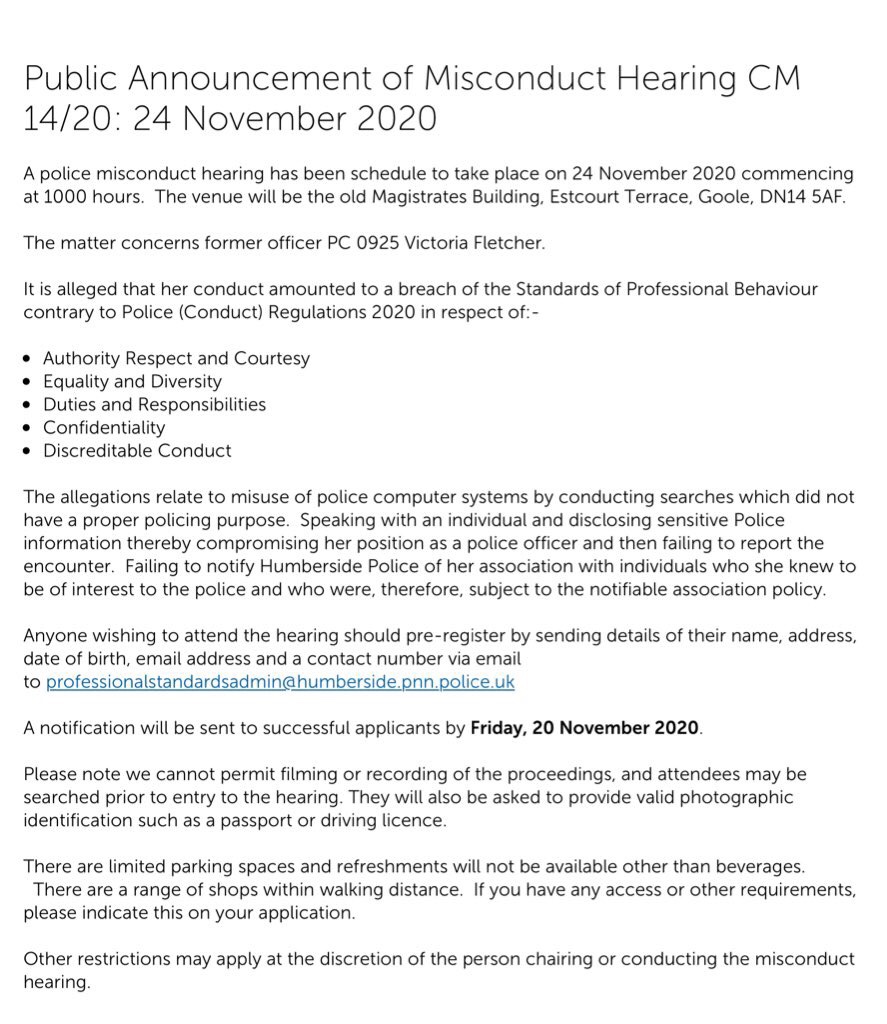
There’s a page on the Humberside Police website which details upcoming misconduct hearings for the force.

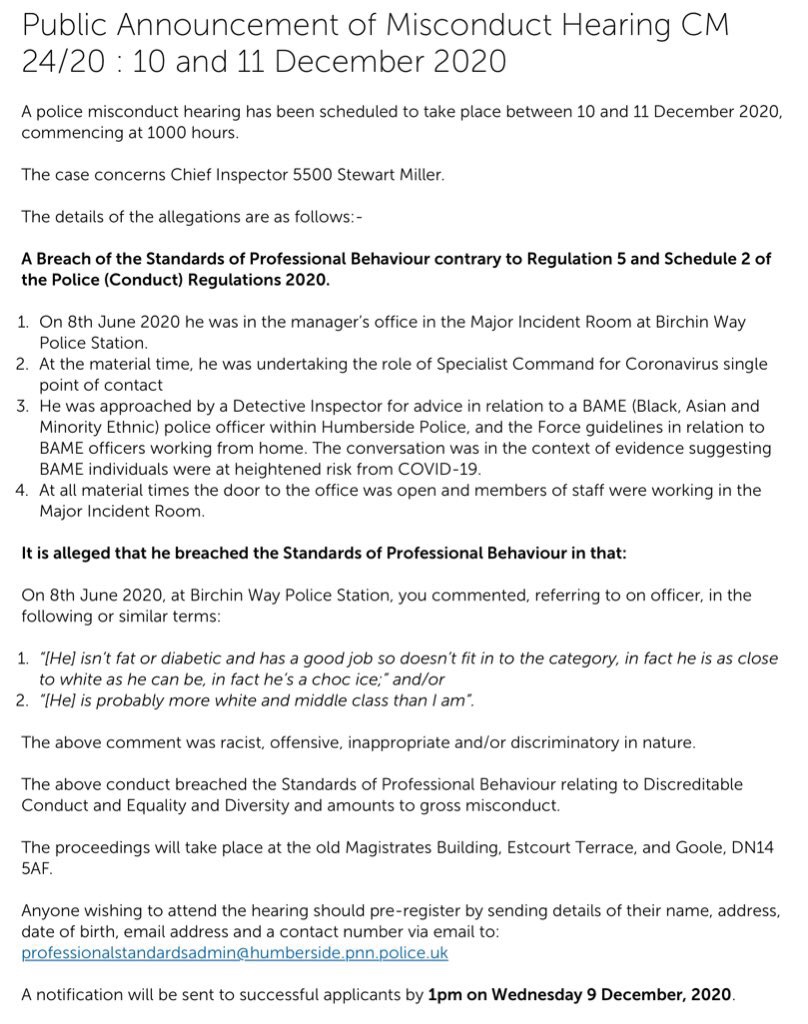
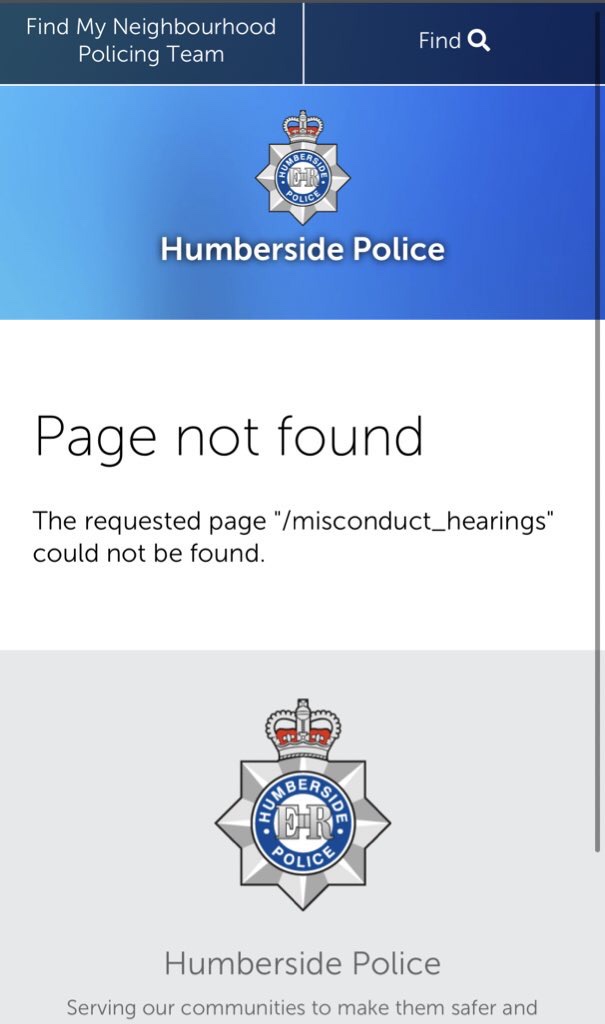
Within the last few days this was changed – without any member of the public being informed or the change advertised. The content on the โ€œnewโ€ URL as it appears currently (9.12.20) can be seen below.

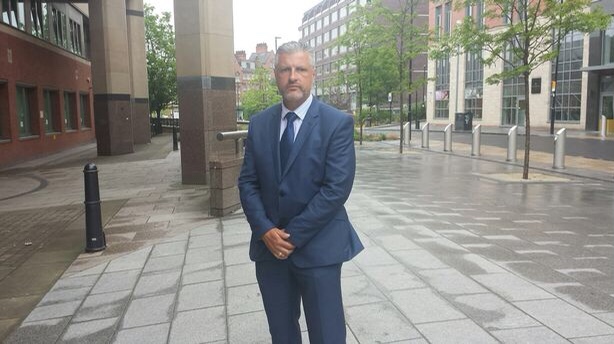
The reason for this sudden change is that a senior officer has been chaged with the use of racist language. This is Stewart Miller, a high-profile DCI with Humberside Police who correspondingly have a lot to loose if the revelation of his conduct is proven true and receives appropriate levels of national publicity.

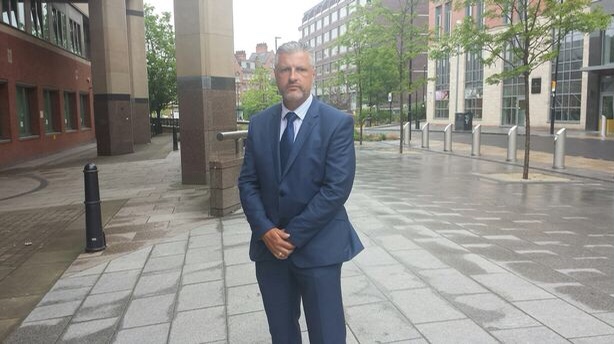
Humberside Policeโ€™s Stewart Miller pictured outside of Sheffield Crown Court.

The details of the alleged offence can be seen in the “new” misconduct page the image of which I have provided above. If true this behaviour constitutes an exceptionally severe breach of ethical and moral codes of conduct by this officer. Racist language, discrimiation and suchlike are uttely unacceptable in 2020 and repellant to the majority of civilised people. 

However aware that the revelation of this allegation may cause a stir in the national media Humberside Police have changed the URL of the misconduct hearings page just before posting details of this forthcoming hearing.

The โ€œoldโ€ page that the majority of people would see or have an existing shortcut to as of 8.12.20

This is a deliberate and purposeful act to attempt to stop the public becoming aware of these allegations against a senior officer. To see the โ€œnewโ€

The data about the hearing I have shown above can only be located from a careful search on the force’s website. This in itself is cause for concern: Humberside Police can of course claim that they have published the details of the misconduct hearing: but they have done so in a way tactically designed to hide the allegations and the public’s knowledge of the hearing. This is of course deplorable but entirely in keeping with that force’s general obsession with bad publicity. Of course now this matter is out in the open the changing of the URL looks even worse.

The effective hiding of the data regarding this misconduct hearing is also designed to protect this officer and his professional reputation. One wonders how this matter will play out in the event of a guilty finding by the force’s PSD and to what extent they will be prepared to publicise any disciplinary measures against this officer.

The alleged comments were made in summer 2020 just a few days after Humberside Police posted on their site positive content from The Association of Police Chiefs regarding the (as it turns out) aspirational aim for the UK police to be anti-racist following the death of George Floyd in the USA during contact with police.

Nor is Humberside Police the only force to be mired in a racism scandal this week as a post from investigative journalist Neil Wilby shows: https://neilwilby.com/2020/12/04/say-one-thing-do-another/

This sort of behaviour amounts to that which will not surprise seasoned watchers of Humberside Police.


9.12.20 update:

Having been caught out over this matter and it having received some publicity via Twitter on 8.12.20 Humberside Police have corrected the changed URL as of this morning, 9.12.20 so that the misconduct hearing for Mr. Miller is now advertised on the main page that most journalists and public would have a link to.

โ€œAccessing Police Systems for an Improper Purposeโ€

Humberside Police are one of those forces that you wonder how they get away with it.

Largely hidden away from the rest of the country on the edges of East Yorkshire they have a reputation every bit as unwholesome as other local forces.

One reason they do seem to get away with it is both geographical distance from the rest of the UK and of course lack of proper oversight. Their perennially ineffective Police and Crime Commissioner Keith Hunter recently showed the level of consideration he has for the local pubic by manhandling a visitor asking perfectly reasonable questions out of his office. As a former officer himself old habits die hard.


The PCCโ€™s behaviour is of course equal to the contempt for the public shown by the force itself in such matters as inadequate custody suites which – on the basis of the last inspection reports I read – were shockingly poor, particularly in regards to the welfare of young people held in custody.

But while holding the public largely in contempt officers can expect lavish prize ceremonies at The Humber Bridge Country Park Hotel, a venue synonymous with chicken in a basket style meals and budget wedding ceremonies. These police awards stem from the days the force were in a Chief Constable-less mess which almost ended up with them being put into special measures. Handing out cut glass awards helped to boost the morale of the troops, albeit on a temporary basis. Clearly no gongs were forthcoming from any other source at that time and so the force decided to award gongs to themselves.


The days in which the force almost ended up in special measures still hang heavily over Humberside Police. The epithet โ€œWhere we do what we wantโ€ has seldom applied more to a UK force in modern times, Met Police excepted. Overall in those days and to a lesser extent now Humberside officers still tend to do what they want.

The consequence to all of this is that quite a number of officers from Humberside Police end up before their Professional Standards Department and such hearings now appear to be increasing in frequency. This suggests an increasing breakdown in internal discipline and operational effectiveness that needs to be addressed urgently.

Of course PSD generally tend to go for the low hanging fruit which means the officers most likely to be prosecuted are PCโ€™s caught slacking off, pulling a sickie or whose face doesnโ€™t appear to fit around the station. Occasionally officers are thrown to the wolves just so PSD can appear to be exercising some form of oversight. The more serious miscreants and offenders further up the slippery ladder are ignored. In the modern police force assistance over cover-ups are rewarded with promotion and rocking the boat by sacking someone who knows โ€œwhere the bodies are buriedโ€, metaphorically speaking of course, has the potential to bring the whole house of cards tumbling down.

So this recent case seen directly below reminded me of a well-publicised matter from a few years back – which is still a shocker – which I will discuss in a short while.

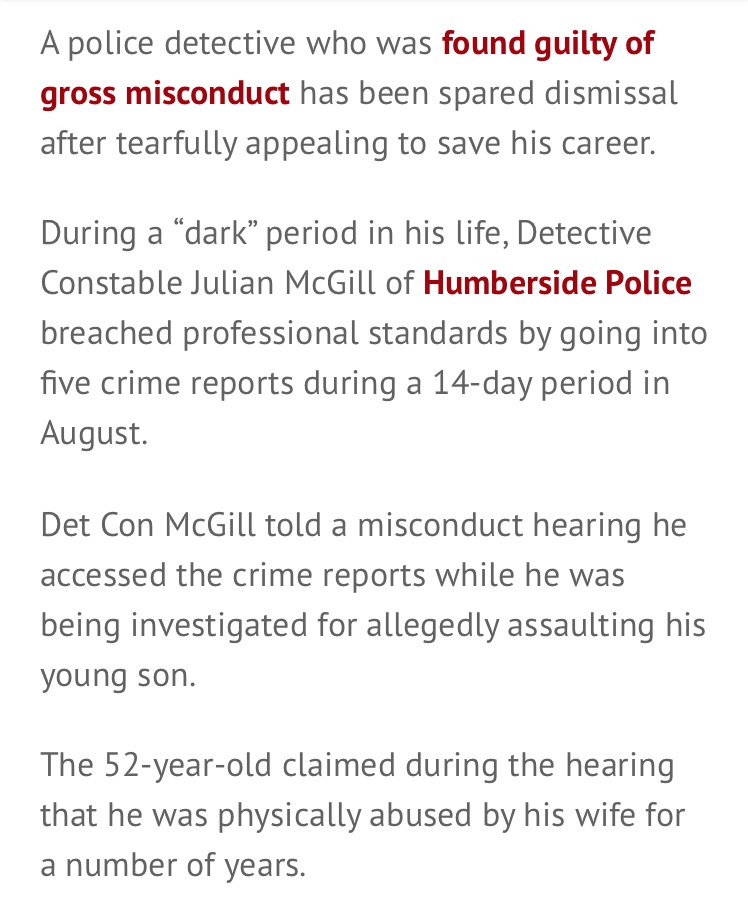
Busted!

As you can see the basic charge is that this PC has been passing confidential police information on to criminals. Guaranteed this data will have been specifically requested by Ronnie and Reggie, will be of considerable use to said criminals and there will have been a payment involved somewhere down the line. Thatโ€™s the way these things work.

Police databases include something called the PND or Police National Database. This is a huge wealth of half-truth, rumour and suspicion which will have entries on just about any person who has come into contact with the police for any purpose. Unlike the Police National Computer which must be accurate (containing as it does details of convictions, cautions etc.) the PND can contain outright unsupported rumours, slurs and spite.

Do please bear in mind you have no right of access to whatever falsehoods might be stored on the PND about you: although you can make a request for all the data uploaded by an individual force about you to PND. You then have a legal right of correction of the same.

Which brings us back round to Humberside Police.

As weโ€™ve already seen thereโ€™s a tendency in the force to dip into and out of police systems for officerโ€™s own benefit. Any access to PNC or PND is logged however so anyone doing so is easy to locate. Officers dipping into databases for their own curiosity or benefit tend to forget this.

Which brings us to DC Julian McGill.

Busted! Again.

The report above isnโ€™t the full story as thereโ€™s been several instances of computer misuse from this officer over the years. This resulted in a final written warning and the hearing described below in which his career was on the line:

Believable? You decide!

McGill at the time was serving as part of the local Police Federation. A fact that will have of course been unlikely to influence the position of the misconduct panel in any way! Generally gross misconduct results in only one outcome and since the offending act was admitted (he could hardly deny it given his access was logged) the decision of the panel was very much at odds with the seriousness of the offence.

However this all ties into my original premise that Humberside Police – situated away from prying eyes – seek to do what they like. Accessing police databases for their own use is simply one part of this and the brushing aside of an instance of gross misconduct is a further example.


Reign of Terror: The Long Shadow of the Yorkshire Ripper

The recent death of Peter Sutcliffe (a man dubbed in the media as The Yorkshire Ripper) presents a practical public-relations problem for West Yorkshire Police. It again raises the spectre of how Sutcliffe was able to kill so many people for such a sustained period. The answers make uncomfortable truths for that force.

Sutcliffe in 1974

West Yorkshire Policeโ€™s failure to catch Sutcliffe in what was one of the UKโ€™s biggest manhunts plays a significant part in their present international reputation as a force beset by incompetence and corruption. It is a reputation with considerable justification.

Sutcliffe was not blessed with high intelligence enabling him to evade capture. Nor was he the popular fiction version of a serial killer: a creature of almost animal cunning and divine luck. Granted he was aided considerably in his activities by the relative infancy of forensics in the late 70โ€™s. But this does not tell the whole story.

For the most part the reason Sutcliffe was able to carry on killing was down to long-identified administrative and operational failures on the part of the police. He is known to have been interviewed several times by officers in the course of their investigations but each time was discounted for further investigation. Other operational errors are known to have included an excess of paperwork generated in the course of the investigation. Detectives were hindered rather than helped by the weight of data generated and the primitive storage of such.


I would argue another failing contributed to the deaths of thirteen women. This is that police officers both at the time and now have a particular mindset which pre-disposes them towards both a closed minded approach to investigations and a form of โ€œtunnel visionโ€. This comprises some of the issues Iโ€™ll discuss below.


Personal characteristics

To start with itโ€™s popularly said that a Yorkshireman is a particular sort of stout character. Gruff, uncommunicative and 100% convinced heโ€™s right in the face of all opposing evidence. Bluff and stiff-necked. The Harry Enfield comedy version of a Yorkshireman isnโ€™t far from the mark. You know as well as I do the popular stereotype. For some reason beyond my capacity to fathom West Yorkshire Police provides a home to people very much of this mindset: there is a poisonous organisational culture which incubates some undesirable personality characteristics.

โ€œAhโ€™ll say what ah bloody well like!โ€

Consider the absolute certainty with which the senior officer in the Sutcliffe investigation, George Oldfield, was sure the killer was the voice on the Weirside Jack hoax tape is a tragic example of this unwillingness to admit to error once a set path has been taken. In the police both of the 70โ€™s and today face-saving is also a strong motivating force. Especially so when consistent underperformance or failure are likely to result in downgrade to civilian worker status.

A former Australian Director of Public Prosecutions Nicholas Cowdry produced a book called โ€œGetting Justice Wrongโ€ in which he argued that tunnel-vision on the part of officers (…he must have done something even if we canโ€™t get him on what weโ€™ve arrested him for!) plays a significant part in police failures. Tie this into the inability to admit to errors being make and youโ€™ve an already toxic mix.

The โ€œrightโ€ sort of victim

Sutcliffeโ€™s first few murders were women largely at the margins of society. It is only with his killing of Jane Macdonald, a shop worker, in 1977 that the investigation increased in speed and urgency. This was partly in response to media pressure. But police then and now categorise crimes reported to them in an internal value system based partly on the perceived โ€œworthโ€ of the victim in society (socio-economic status etc). Sutcliffe attacked a young woman outside of Bradford in 1974 who sustained horrific injuries but police handling of the complaint and their investigations were at best suboptimal. The same occurred later when he attacked a lady who was a member of the BAME community in Leeds. Her complaints were โ€œcuffed offโ€ (to use the current parlance of West Yorkshire Police) rather than investigated. it is likely because of her background and low educational attainment that she was not considered a significant enough figure for her complaint to be deemed โ€œworthโ€ investigation.

Presented without comment. BBC News report on the day Sutcliffeโ€™s death was announced.

The โ€œrightโ€ sort of crime

Easy to solve crime is preferred. Especially if itโ€™s hitting targets or addressing an issue of public concern. More complex investigations are likely to be shunned on the basis of the time, expenditure and difficulty of prosecuting successfully. Then and now police have one eye on the crime statistics and are more likely to address issues of public concern based on recent media exposure of such crimes. Thereโ€™s a reason The Serious Fraud Office are so notoriously unsuccessful despite The City of London being rampant with financial corruption. In the matter of the Sutcliffe investigation it is arguably only when he began to operate outside of the red light areas from 1978 onwards that the police ramped up efforts due to increased public concern. This public concern increased again from 1980 onwards.

Conclusions

Ultimately Sutcliffe was caught by sheer luck and the most basic of police work.

He was picked up by uniformed constables from South Yorkshire Police in a situation in which he was likely preparing to kill again. Having disposed of his weapons behind a toilet cistern under the pretext of needing to urinate it is the quick-thinking of a South Yorkshire PC which led to the discovery of the weapons and the eventual confession of Sutcliffe that he was the killer.

The hugely expensive and lengthy investigation by West Yorkshire Police had been an excruciating waste of time and money. Arguably by tying itself in knots by a combination of weak administration and blinkered mindset the investigation had allowed Sutcliffe to carry on killing.

Serial killers are thankfully exceptionally rare and unusual. The advances in forensic technology and other policing methods in the forty nine years since he was caught render another Yorkshire Ripper type of killer thankfully even less likely.

However a weak spot remains in the mindset and attitude of police officers as I have discussed. Then and now significant barriers exist in investigations due to habits itโ€™s almost impossible for police officers to break. This is partly fostered by an inherited organisational culture and thus will remain with us for some time yet.

Design a site like this with WordPress.com
Get started