This blog is in danger of becoming a post largely carping on about service level failures by court staff at HMCTS.
Having said that the errors they make are sufficiently numerous and serious in consequence that they’re like busses: there’s always another one along in a minute. This makes it very easy to produce material for this blog. Although I’m likely to get bored of telling you about all of these errors long before HMCTS stop making them.
Doncaster: the County Court here fails to serve the people of the city well.
The kind of service level failures court staff specialise in would – in any normal workplace – result in disciplinary proceedings. But HMCTS is presently sufficiently desperate to retain any form of staff to keep at least a semblance of function in civil courts that even the most spectacularly gaff-prone employees are retained. Better the devil you know than someone even more slackly incompetent.
The end result of this for court users is of course loss of time, expense and waste of effort.
And so it has been today in relation to a claim at Doncaster County Court, (already noted for more than its fair share of errors in handling this particular claim) at which yet another service level failure has take place.
In several occasions in the past both parties have been all set for trial only for the trial to be cancelled when all are in attendance. Grounds: over-running of a prior matter, file in poor condition etc. On one occasion the file was even lost!
There’s always an excuse for appalling service but the basic grounds ultimately come down to two things: an inability on the part of court staff to administrate claims properly and the failure of District Judges to deploy appropriate oversight of a case or to get a grip on case management issues.
An application in this claim was made in April 2020. Estimated time to hearing was 12 weeks, which of course came and went without any Notice of Hearing.
Two other hearings In the same claim took place in October and November at which the application could have been scheduled to be heard. Needless to say it wasn’t even though the District Judge made clear she was aware of its existence.
This is a critical fact: that staff failed to schedule the application in a way that would have dealt with it reasonably at an appropriate time within the claim, saving the parties time and effort. Having acknowledged receipt of the application they simply forgot all about it
…until the point I sent them a timely reminder in relation to the application. This brought a further hearing date. Which again drags all the parties over to Doncaster for what ultimately ends up as a futile exercise.
When the matter of the application could have been heard within other hearings in the same claim but wasn’t because court staff forgot about it we have clear evidence that the civil court system has collapsed and cannot now administrate in even the most basic respects.
How do many legal professionals react to their cases being so poorly run? Often by keeping their heads down and accepting the situation. To speak out in public or in the court itself would perhaps cause damage to careers and lead the judiciary to take against them on future appearances. And so nothing in the civil system improves.
HMCTS service standards are… well not very good at all really!
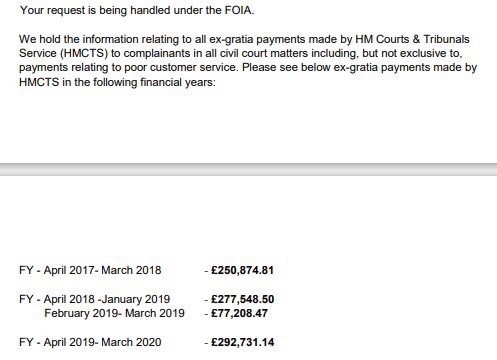
A Freedom of Information Act request to The Ministry of Justice produced the following data.
Payments made for poor service from HMCTS increasing year on year.
The data largely speaks for itself. Payments made to court users for poor service increase year on year as HMCTS falls apart.
Poor customer service by HMCTS is costing at least £292k per year in payments made to disgruntled court users. This is of course not counting the time taken to correct errors they have made which also counts as a loss to the public purse and creates delay overall in the system.
Most importantly if you’ve been in receipt of poor service from a court make sure you complain. And don’t be fobbed off: they’re experts at dissembling and denying. Of course at every stage also request to be compensated. It’s only when the budget for payment of compensation exceeds what The Ministry of Justice is prepared to pay out that service standards will improve.
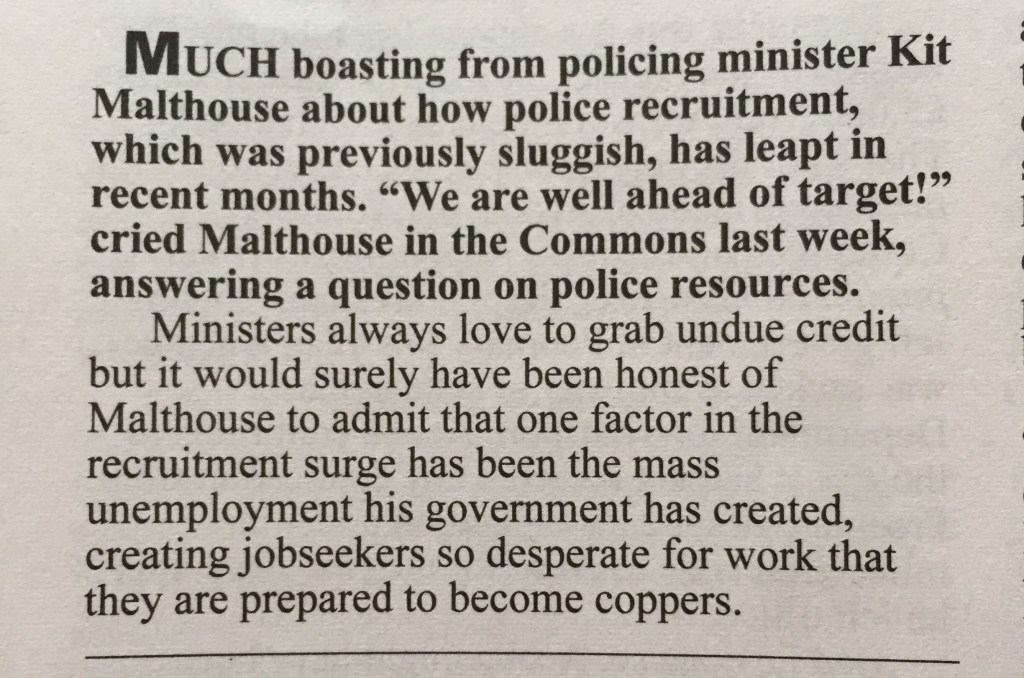
Many ticklesome articles in the new Private Eye magazine (no. 1535, 20th November 2020) including this choice one on police recruitment.
Private Eye comments on police recruitment.
As always there’s many a truth spoken in jest.
At present the workload of the average Plod would incline anyone with the ability to obtain employment elsewhere to do so. Truly a policeman’s lot is not a happy one.
Nor are matters likely to improve with the new recruits when they’ve finally got some wool on their backs.
The lesson The Ministry of Justice learned to their cost was that sacking every experienced prison officer within range meant that the newer and less experienced were unable to handle the job with subtlety and skill. This caused a further recruitment problem as newly recruited staff also began to leave in droves once they realised the true horrors of the job they’d be facing daily.
So it will be with the new police recruits.
Possibly also unwise to have a large surge of untested youngsters in uniform, pumped up with testosterone and a newly-found sense of self-importance, kitted out with weaponry and the power of arrest let loose on the public.
One can only hope that new recruits will be paired with more experienced officers. But PC George Dixon is long since retired and these days six months or more in the frontline on the force and you’re considered a veteran. Stay for a year and doubtless South Yorkshire Police – the force that loves to hand out awards to underperforming officers – will have a decanter set and tin plaque to pass over to you.
An additional problem. Recent reports in the local press show South Yorkshire Police and West Yorkshire Police finding themselves and their transport under severe attack on entering some estates in Leeds and Sheffield. Police cars and vans were recently destroyed as they have also been outside of Goldthorpe Police Station in South Yorkshire.
Here we can see how spirited local residents have offered their opinion on police service standards.
Can it be long before armoured “snatch squads” operating in a similar fashion to those grabbing terrorist suspects in post-invasion Baghdad are sent in to spirit suspects away from troubled estates?
So if you do see such officers on the streets soon be sure to look out for their armoured snatch too.
A superb example of how the civil courts in the UK operate.
Laurel & Hardy-ish levels of incompetence from staff at Leeds Combined Court.
A hearing was set for last week and the appropriate Notice of Hearing was sent out for that case.
However what the merry pranksters at civil section failed to point out was that there were two other pending civil cases to be heard by the same High Court Judge at the same hearing on the same day.
No Notice of Hearing document was sent out in relation to these other two cases. Equally no Order in relation to them was made ahead of the hearing. In short no notification of these two other claims being in play that day at all.
Therefore there could be no case preparation for these other two claims as I was blithely unaware that these were due to go ahead in the same hearing as a claim that I was notified about.
This is pretty much par for the course with HMCTS these days: an organisation in which the right hand doesn’t know what the left hand is doing.
The consequence of this overall for court users is delay, confusion and ultimately injustice.
The consequence for your poor bloody correspondent is of course more time, effort and expense spent correcting the errors made by court staff.
Twist ending to the tale: an application in respect of this matter was sent to the court just a few moments ago with an inquiry as to what the fee would be to file this. The answer was returned almost immediately.
However a complaint about the poor standard of service in the failure to notify me of two cases to be heard hasn’t been answered at all.
Conclusion: HMCTS is more interested in taking your money to correct service level errors they’ve made than they are in responding to legitimate and justified complaints.
Two blog entries on two separate days about how HMCTS deals with services users money.
Tomorrow is the more complex blog entry which deals with some of the underhand ways civil courts like to part you from your cash. Stay tuned!
Today is a simpler tale of how awkward they are when you try to get it back.
An artists impression of the inside of the Fees Office at The Royal Courts of Justice.
In April this year a fee was paid to Queen’s Bench Division at The Royal Courts of Justice.
Due to the pandemic QBD was largely out of action for some time, or at least the office to deal with the application was.
By July it was clear that the grounds and reasons for making the application had passed. The time which had gone without any staff present to man the appropriate office at QBD rendered the application pointless.
So the fees were requested to be returned.
“No problem!”, say QBD.
And the appropriate notification was supposed to have been sent to Fees Office. Lead time on return was reckoned to be six weeks maximum.
Four months later I’m still waiting.
Not that the fee paid was large or exorbitant. Which makes the continued retention of it even more baffling.
But what really boils my blood is that of several emails sent to both QBD and Fees Office at RCJ can you guess how many have received a response?
Go on! Have a wild guess!
That’s right. None. Over a period of some four months now Fees Office & QBD has failed totally to respond to several emails chasing this matter.
This is of course very HMCTS.
Nor have emails to The Court Manager at QBD about the lack of response received a reply. This is even more HMCTS!
Just today an email response to a separate matter has been issued by HMCTS. That took a blindingly quick two months without any explanation of why so much time had elapsed.
In separate proceedings last week the DJ complained that the case file was in very poor condition. A prior hearing in the same matter had to be abandoned on the basis that the file had been lost.
All of the above and the general woeful experiences to be had with HMCTS suggest the organisation – visibly tottering for some time – is now actually on the verge of collapsing or has actually done so. Staff largely unable to cope pre-COVID-19 appear now to be hopelessly overwhelmed by the day to day administration of cases.
Customer Relations at HMCTS dealing with another complaint with customary sensitivity and respect.
Brief post for today. Well a brief post by the standards of this blog!
In yesterday’s blog post one of the themes touched upon was how The Ministry of Justice had sent data in error to a third party. This was a serious breach of the data subject’s rights and potentially quite dangerous to the data subject as MoJ shared the subject’s name, address, date of birth and financial details.
The post discussed the attempts The Ministry of Justice made to get back at the accidental recipient of this data which included a false complaint to police to ensure he was arrested, although fully aware police would not be able to bring charges as no offence had taken place.
Elizabeth Denham, UK Information Commissioner
The Information Commissioner’s Office (ICO) is a quasi-Governmental organisation reliant on public funding. Their stated aim is to enforce data access rights of people in the UK and also to adjudicate on data protection issues: in other words to monitor that your personal data held by companies and Government organisations is kept safe.
So we can naturally expect ICO to fully comply with data protection legislation and be extra specially careful with their own handling of other people’s data.
Can’t we?
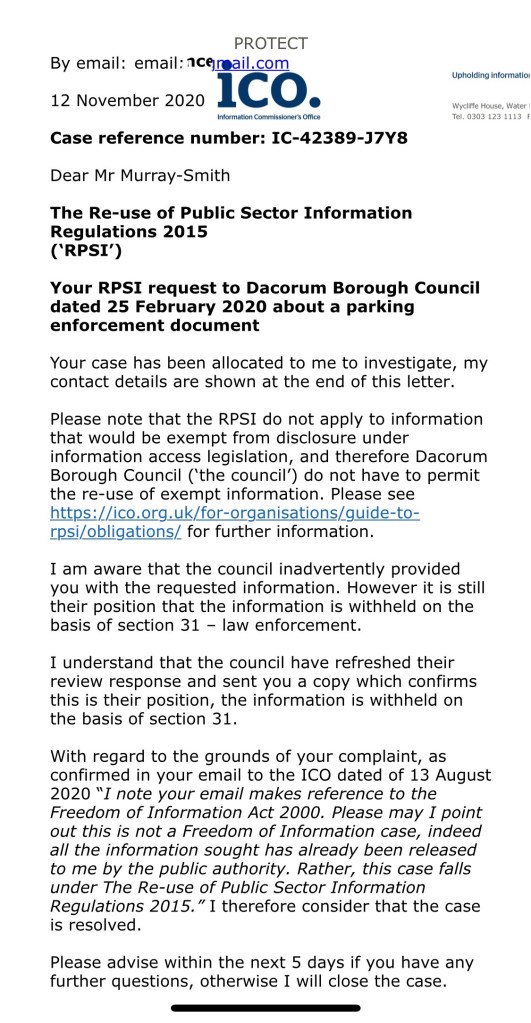
In a delicious piece of timing just after I’d written yesterday’s blog post about The Ministry of Justice emailing data to the wrong person ICO go and do the same by sending a letter in error to me which was intended for a third party, just like the error MoJ made!
I have of course deleted the email address of the intended recipient of this letter.
It seems that Dacorum Borough Council also suffers from the problem of email incontinence as they appear to have sent the intended recipient of the ICO letter some information despite claiming an apparent exemption over the data sent!
The ICO letter states:
I am aware that the council inadvertently provided you with the requested information.
Significantly the letter also states the grounds for the council attempting to withhold this data (but clearly not managing to) were under section 31 – that is a claimed exemption from disclosure as the data is related to law enforcement.
One might hope the ICO takes appropriate action against itself for this data breach.
In all honesty I wouldn’t hold my breath.
ICO’s present logo. Strange use of lower case letters and an inappropriate full stop.
Like many of the UK’s regulatory bodies such as The Parliamentary and Health Service Ombudsman or The Local Government Ombudsman the ICO has selective blindness in relation to even large scale and ongoing breaches of GDPR and The Data Protection Act.
Ultimately the best most complainants can hope for is a letter from the ICO informing them that their complaint has been upheld and that ICO will keep a record of the data protection concerns logged regarding the data controller complained of. This does not of course produce the data that has been requested! Occasionally ICO will assist by instructing the data controller to supply data if it is being clearly withheld. However if the data controller is sufficiently obstreperous there exists enough “trapdoors” in the relevant legislation that a (often misapplied) exemption will be used to avoid supply of the data.
The efforts organisations used to evade production of data include the mishandling of applications such as considering a subject access request for personal data as if it were a Data Protection Act request and so rejecting it without giving sufficient grounds to the requester. A further trick is to label everything as the personal data of a third party and thus exempt from disclosure: on this basis large scale parts of any data disclosed can be redacted (meaning blanked out).
In these circumstances ICO becomes like a turtle placed on its back: it spins around to no real effect.
Let’s look at the wider picture. A key thing to recall about most of the non-departmental public bodies supposed to supervise how the law or organisations work in Britain is that they rarely do. These supervisory bodies often exist instead to confirm the decisions made by the lower organisation or as a way to diffuse complaints safely and without litigation. Having said this ICO is better than most and does occasionally pursue misconducting organisations through the courts. But due to the pressure of time and resources they also habitually pursue only those organisations who have committed a blatant breach of the law which has been made public, or who would be less likely to defend themselves in court and thus drive up ICO’s expenses. The majority of the fines issued in successful judgments are not paid.
One example of this willingness to turn a blind eye on the part of ICO: a 2017 significant data breach by the NHS involving some 50,000 patients medical records – the largest loss of data in NHS history – was not prosecuted by ICO. This is a matter I will comment on in detail in a blog another day.
The West Yorkshire Police and Crime Commissioner is Mark Burns-Williamson, a largely gaff-prone failed politician. Heaven knows there’s sufficient data out there in the public domain to show that by any stretch of the imagination the man is unsuited to any role requiring public trust.
My favourite one details how he sent an inadvisable letter in a “love triangle” which would ordinarily have rendered him open to criminal prosecution. This was however covered up by West Yorkshire Police’s (then) DCI Simon Bottomley leading to the eternal gratitude of Burns-Williamson to the force he is supposed to scrutinise.
It also appears his office is prepared to manipulate and ignore facts to protect the very organisation it should be holding to scrutiny.
This blog entry tells the story of one such incident.
Burns-Williamson demonstrates the degree to which he hold the local force to scrutiny.
In May 2020 The Ministry of Justice’s Data Access Office sent data to a person (who we will call the recipient) in error.
This data was information on a third party who lived in the London area. This amounted to a serious data breach as the disclosure included the subjects name, address, date of birth and bank account details etc. as well as other disclosures regarding a series Proceeds of Crime Act proceedings against the data subject.
The recipient of the data informed The Information Commissioner’s Office and The Ministry of Justice as well as the data subject whose information had been disclosed. He also posted regarding this on Twitter but did not reveal any confidential information in so doing.
Data Access at MoJ requested the recipient remove the mocking tweet. The recipient of the data refused citing his freedom of expression under The Human Rights Act and that no offence in civil or criminal law had been committed by the tweet.
Three days later the recipient of the data was arrested at his home by West Yorkshire Police on the basis that he had breached The Data Protection Act. The allegation being that he had shared the confidential data sent to him in error on Twitter.
This was palpably untrue as an examination of the tweet would have confirmed. However police did not examine the tweet for themselves but took it “on trust” from MoJ that a supposed offence had taken place. Of course it hadn’t but MoJ were burning with indignation that a serious data security error had been made public and to their official regulator on data matters the ICO.
Police were aware that no offence had occurred.
The bar for arrest for any offence is set very high as recent cases such as Rachid v. The Chief Constable of West Yorkshire Police (2020) show. Instead police took it on trust from The Ministry of Justice that an offence had occurred in a situation in which the Security Manager for MoJ’s correspondence (seen by this blogger) reveals his desire to give the recipient “a nasty shock”.
The recipient’s home was entered by police on his arrest. In the middle of the Spring 2020 pandemic a vulnerable family member who was shielding was subject to interaction with police who did not wear PPE or take any form of precautions regarding introducing COVID-19 infection into the home. Electronic devices were removed and the home was ransacked in the search. The officer leading this was PC Alan Jackson. Police actions amount to trespass to property (since there were no reasonable grounds for arrest) alongside trespass to goods and wrongful arrest.
The home of the recipient of data was raided by police without PPE in the middle of the spring pandemic.
Predictably no charges were brought. Emails seen between the Officer in Charge (OIC) and The Ministry of Justice reveal MoJ immediately loose interest when the recipient was arrested which fits in with the prior email claiming MoJ wanted to give him a nasty shock. No further action resulted to the recipient from either Police or MoJ.
A complaint was duly made by the recipient to West Yorkshire Police Professional Standards Department (PSD). Their internal investigation under The Police Reform Act 2002 confirmed – but only internally to the police – that the arrest was wrongful on the basis that WYP had not seen or been provided by MoJ with any indication that a criminal offence had taken place. Other aspects of the complaint made were ignored by PSD and not investigated.
An organisation such as West Yorkshire Police which has an international reputation for both corruption and incompetence needs to be able to head off complaints and minimise them early on. The investigation concluded in a document called an Assessment and Progress Log that there had indeed been no reasonable grounds for arrest, therefore logically the arrest was unlawful. This document was an internal document not for public or complainant’s consumption.
Police of course cannot admit that they have erred to the complainant. It opens the door for civil action for wrongful arrest and payment of compensation. It also amount to loss of professional reputation.
Thus the results of the PSD investigation which were presented to the complainant in August 2020 were totally at odds with the actual true findings of the investigation. The official line was that nothing untoward had occurred and that the arrest was legitimate: the unseen internal report stated quite the opposite. A copy of this report has since been obtained from WYP and examined.
If you find that the above shocks you then I would respectfully point out you may have little experience of the police complaints process and the extent to which it seeks to hide the conduct of misconducting and underperforming officers.
The complainant found some 21 issues with the PSD investigation response which were either suboptimal or evaded examination of the facts. Of course if you’re prepared to commit mendacity on such a scale as a police complaints office then it’s best to keep any communication simple. The response provided by PSD’s Vicky Silver was clearly exceptionally evasive and the errors in it were manifest.
Police Professional Standards Departments go to any length to dismiss valid complaints.
The complaint was progressed as an appeal to The Office of The Police and Crime Commissioner for West Yorkshire, this being a body with supposed oversight of the local force. Karen Gray at PCC was tasked with the examination of the appeal.
It is a basic element of any investigation that the investigator should have access to all of the data available to be able to reach a reasoned conclusion. This is common sense. In the course of the PCC’s investigation they either failed to obtain copies of documents such as the PSD Assessment and Progress Log or else were provided with a copy of the relevant data but chose to ignore it in favour of a rubber-stamped approval of the earlier PSD investigation.
Thus the office of West Yorkshire Police and Crime Commissioner have shown themselves to be either as throughly dishonest or professionally incompetent as the police force they are supposed to supervise. Further they are prepared to support the local force in their dishonesty.
A further complaint was made regarding the failure of the PCC to obtain all relevant data meaning that the Karen Gray investigation was fundamentally flawed. This was responded to more recently by PCC’s Jane Owen who has stated that Karen Gray could not have been aware of the Assessment and Progress Log on the basis that it was produced after the conclusion of the original PCC review.
However the document in question from PSD is dated 5.6.20.
Therefore it was produced BEFORE the complaint was referred to PCC by around two months. The response that it was not available in the original PSD investigation is therefore an outright lie.
It is of course inconceivable that an investigation properly conducted would not have requested a copy of, assessed and examined the PSD Assessment and Progress Log which was in existence by this point and therefore PSD’s position that Karen Gray had access to all of the required documentation to enable correct conclusions is not only incorrect but also deliberately misleading.
The essence of the complaint to PSD regarding wrongful arrest etc. was proven – as that office was well aware – by 5.6.20.
All subsequent efforts of PSD and the office of the PCC for West Yorkshire have sought to bury the facts under an increasing mound of guff and nonsense.
PSD chose to issue a response completely opposite to the facts they had themselves established and The Office of The Police and Crime Commissioner has assisted them in this cover-up and continues to do so.
In a desperate final attempt to avoid further scrutiny Jane Owen writes:
I have concluded that you have used the Office of the Police and Crime Commissioner’s complaints process to try and change the outcome of your complaint… and the subsequent review undertaken by this office but – in line with the statutory guidance that has been issued that sets out how reviews have to be handled – you do not have a further right of review
Is it any wonder that both West Yorkshire Police and The Office of the Police and Crime Commissioner have such a poor reputation both locally and nationally?
Certainly both are prepared to bend the truth into impossible angles to avoid any admission of error or loss of professional reputation. Perversely this ends up in a situation as described above in which loss of face and reputation end up occurring both from the original issue and the labyrinthine efforts made to conceal it.




















 Legal Babble