
An Easter Miracle!

Only around one in ten complaints made to the police of poor conduct, breach of the College of Policing Code of Ethics etc. are found in favour of the person whoโ€™s complained.

This is because poor, ineffectual and incompetent investigations into complaints are par for the course from police forces. The more misconduct thatโ€™s happening in a force the greater the urgency to suppress public admittance of this by mishandling complaints.

The mantra is โ€œWe investigated ourselves and found nothing wrongโ€. Every police force does this.

As a police force West Yorkshire Police has more to hide than most. Theyโ€™ve an international reputation for corruption and incompetence but also an obsession with maintaining a public image. Consequently obtaining agreement from them about their low standards of policing requires more of an effort than with most other forces.

In this instance however they were banged to rights.

A transcript of a online live chat with an officer left them with no wriggle room. This is proof of why all your interactions with the police should always be recordedโ€ฆ because the first instinct of most police officers when caught out is to lie.

The report made concerned a crime committed in the breach of s.92 of The Care Act 2014 (as amended). Wakefield Council had knowingly as a care provider created false information on a person receiving care in their area. This is a criminal offence under the Act.

Iโ€™ll write more on this in a blog entry one day soon.

Note also the length of the replies given. When police are trying to hide something in a complaint response they avoid discussing the subject, fail to speak to relevant people and avoid issues theyโ€™d find uncomfortable to discuss. Here, as I said, a transcript of the chat means they canโ€™t avoid making a finding against themselves.

It should be noted that police have still failed to investigate this offence reported. So despite an unusual degree of honesty seen below itโ€™s still a case of โ€œbad cop – no donut for youโ€.

I present the Professional Standards Department response in full with a few small redactions.


From: Allen, Gemma <gemma.allen@westyorkshire.police.uk>
Sent: 14 April 2022 07:32
To: XXXXXX
@XXXXXX <XXXXXXXXXX>
Subject: Your complaint to West Yorkshire Police [OFFICIAL]

Classification: OFFICIAL

Dear Mr. XXXXX,

I refer to the complaint that you made to West Yorkshire Police. I am sorry that you have felt dissatisfied with the service offered by West Yorkshire Police on this occasion and, where we can, seek to learn from feedback offered by members of the public.

I can confirm that this matter has been recorded in accordance with the Police Reform Act 2002 under Complaint reference CO-2675-21. Please quote this reference number in any future correspondence regarding your complaint arising from the same matter.

It has been established that your complaint raised the following concerns / allegations. In response, I have made reasonable and proportionate enquiries into this matter and can offer you the following explanation of the enquiries conducted, what facts have been established, the outcome and any proposed action to be taken:  

Complaint 1: Delivery of duties and services

Employee concerned:  Staff member 730037 Maroof

Details of allegation:

You state that the call taker has incorrectly referred you to the council to make a complaint whom you state have committed a criminal offence under The Care Act.

The operator has asked you to provide evidence that the councilโ€™s acts were purposeful and fraudulent however you believe that this should be the role of the police and is not your responsibility.  

Enquiries conducted: 

The details of the Police chat transcript have been reviewed. 

The call taker, staff member 730037 Maroof has been requested to provide a response.

The Department of Health guidance for providers regarding The False or Misleading Information Offence has been reviewed.

I have consulted with The Police National Legal Database (PNLD). 

A request for review has been made to The Force Crime Registrar. 

Facts established: 

The Police chat transcript shows that you have made an allegation to West Yorkshire Police that Wakefield Council have produced a social care document which includes the purported current health situation of a family member which is out of date. You state that your family members health has deteriorated over the past year and yet old records have been used to produce the report. You report that you believe this was an intentional act by a social worker as it was likely to avoid the provision of social care for the patient who would otherwise be identified as having clear social care needs. The chat transcript shows that the call taker, 730037 Maroof sought advice and directed you to make a formal complaint against the council in the first instance. You state to the call taker that the โ€œArticle 16 right to restrict the processing of the data has been applied.โ€

The call taker, 730037 Maroof has responded to your complaint to state that he felt that referring you to the Councils complaints process was an appropriate response at the time. The call taker has expressed his apologies if his assessment of the information was incorrect. 

It has been confirmed that The Care Act 2014 has put in place a new criminal offence applicable to care providers who supply, publish or otherwise make available certain types of information that is false or misleading, where that information is required to comply with a statutory or other legal obligation. The offence is contained at Section 92 of the Care Act 2014. FOMI is a criminal offence and the investigating body for that offence will be the police, conducted in line with the โ€œThe Director’s Guidance On Chargingโ€. The police can pursue all reasonable lines of enquiry. FOMI is a strict liability offence that applies to providers of care services as corporate bodies or partnerships. This means that a prosecutor has to prove that the information was, as a matter of fact, false or misleading, but does not have to prove that there was intent to provide false or misleading information on the part of the corporate body or partnership.

The Police National Legal Database (PNLD) outlines that Section 92 of the Care Act 2004 creates an offence so that providers of health services and adult social care in England, which supply, publish or otherwise make available information that is false or misleading, could be subject to criminal sanctions. The offence applies to a care provider as a corporate body.

92(1) A care provider of a specified description commits an offence if –

(a) it supplies, publishes or otherwise makes available information of a specified description,
(b) the supply, publication or making available by other means of information of that description is required under an enactment or other legal obligation, and
(c) the information is false or misleading in a material respect.

However, it is stated in law that it is a defence for a care provider to show that it took all reasonable steps and exercised all due diligence to prevent the provision of false or misleading information as mentioned in subsection 1. This means that if the Council have already taken reasonable steps to rectify the matter then the offence has not been committed. By taking steps to restrict the data by invoking Article 18 of the General Data Protection Regulation (GDPR) which provides an individualโ€™s right to restrict the processing of the data, they have fulfilled this responsibility. Article 16 of GDPR then covers the rectification of the data.

Detective Chief Inspector (DCI) Fraser from the Force Crime Registrar has reviewed the matter and confirmed that your report is a state based crime therefore the Police only have to record the offence when the relevant โ€œpoints to proveโ€ are made out. Unlike victim based crimes the Police do not have to record these offences at the point they are reported.

Finding: The service level was not acceptable under the circumstances

Rationale: 

The information you have provided on the chat record shows that the matter has been reported to the council and that they have already taken reasonable steps and exercised due diligence in restricting the data. The matter does not require recording or further investigation at this time. 

My enquiries show that Call taker Maroof has attempted to ask reasonable questions during your chat report when he has asked you if you have evidence to prove that it was done purposely and fraudulently. The call taker appears unfamiliar with Police Procedures around reporting of potential state based offences however he is not a Police Officer and could not reasonably be expected to know that the offence of FOMI does not require criminal intent on the part of the perpetrator. The call taker has attempted to seek advice whilst you remained on the chat facility and it appears he has been given information which has led him to make a recommendation that you should firstly report the matter to the council. His assessment would have been reasonable and proportionate under the circumstances if you had not already provided information to suggest that you had already reported the matter to the council. It appears that the matter was not fully understood and that you required further clarification before the chat was ended. It would have been more helpful to your understanding for the call taker to refer you for an appointment with a Police Officer so that the outcome could be fully understood and explained in more detail.

In conclusion, it is considered that learning has been identified in respect of this complaint.

Outcome/Action: Learning from Reflection

Details: An opportunity for learning has been identified which has been provided to the call taker through his direct supervisor.

Complaint 2: Individual behaviours

Employee concerned:  Staff member 730037 Maroof

Details of allegation: You state that the call taker terminated the chat abruptly with no explanation

Enquiries conducted: 

Call taker Maroof has been requested to provide a response. 

The chat transcript has been reviewed. 

Facts established: 

Call taker Maroof has responded to state that due to time passed he cannot fully remember his reasons for ending the chat at the time. After review of the transcript he states that he may have felt that he had advised you what to do and so believed the chat could be closed. It may have been that you had gone offline after receiving his response so he assumed it was completed. He added that he canโ€™t say for sure given the time that has passed but either way he does not think that he gave โ€œno explanationโ€ as he clearly provided advice on what you should do.

The chat transcript shows that the chat was ended 20 seconds after the call takers last response to you.

Finding: The service level was not acceptable under the circumstances

Rationale: 

The outcome of this complaint should be read in conjunction with the information provided in Complaint 1. Although the call taker has remained respectful throughout the chat, it does appear that you had not been provided with a sufficient explanation of the outcome or the opportunity to understand the advice provided. This is believed to be because the call taker did not fully understand the police procedures around state based crime reporting.  

In conclusion, it is considered that learning has been identified in respect of this complaint.

Outcome/Action: Learning from Reflection

Details: An opportunity for learning has been identified which has been provided to the call taker through his direct supervisor

It is considered that reasonable and proportionate enquiries have been made into this matter. The issues you raise in your complaint do not justify criminal or disciplinary proceedings against any officer concerned and therefore the matter has not been considered by the Crown Prosecution Service. 

You have the right to a review of the above decision. Should you wish to request this, please contact the below review body by the 13th May 2022. Please quote the relevant complaint reference number (above) if you request a review. 

Due to the wording of your initial complaint, the review body is: 

West Yorkshire Mayorโ€™s Office for Policing and Crime. Should you wish to request a review, please contact:https://www.westyorks-ca.gov.uk/policing-and-crime/complaints-and-conduct.

Please accept my apology on behalf of West Yorkshire Police for any confusion, inconvenience or distress that this incident has caused, and I thank you for bringing this matter to our attention. I hope the above action taken re-assures you that your complaint has been taken seriously and demonstrates West Yorkshire Policeโ€™s commitment to continuous improvement.

I hope that any future contact you may have with West Yorkshire Police will not be adversely affected by this experience.

Yours sincerely,

PC 1449 Allen

Service Review Team

22566

Professional Standards Directorate

*   Email: Gemma.allen@westyorkshire.police.uk

+ Address: West Yorkshire Police, Professional Standards Directorate, Headquarters, WF1 3QP


West Yorkshire Police Caught Out Over Serious Misconduct Issue

When caught out the first reaction of many police officers is to lie.

The blog entry below relates to an illegal arrest and breach of PACE by West Yorkshire Police. Even by the low standards of that force this is a shocker.

This blog entry also relates to a effort to hide information by Plodโ€™s Right of Access dept. and a clear effort to deceive by West Yorkshire Police Professional Standards dept.

The last two offences were exposed by the active intervention of The Information Commissioner’s Office (ICO) who have forced police to produce documents Plod has spent the best part of a year trying to hide precisely because they prove misconduct in public office.

The background to the complaint is related to an ultra vires arrest of myself on 22nd of May 2020 without legal justification or reasonable grounds. Hereโ€™s a little background:

In May 2020 I was sent in error documents and data intended for the Metropolitan Police. This data concerned Proceeds of Crime Act proceedings against an individual living in Kent and was sent to me accidentally by The Ministry of Justice.

The data amounted to a significant data breach containing as it did many personal and financial details for this man. Given the seriousness of this I informed The Information Commissioner’s Office that a significant data breach had taken place.

Four days later I was arrested by West Yorkshire Police on the request of The Ministry of Justice under allegations that I myself had breached The Data Protection Act.

This is of course not true. Emails obtained from the Data Security Manager at HMCTS Liverpool state that they intend to have me arrested โ€œto give him a shockโ€ following my referral of this matter to ICO. And of course the matter was not pursued beyond the inconvenience of arrest.

This arrest also resulted in the removal of electronic devices from my home containing legally privileged, legally professionally privileged and litigation privileged materials stored electronically on those devices. This is a breach of PACE 19.6. The subsequent examination of the contents of these devices by digital forensics officers at West Yorkshire Police without triage of the privileged contents amounts to a breach of common law, which Plod then tried to hide.

As you might expect from the generally inept nature of this force the efforts to hide the data on this illegal examination resulted in the eventual revelation of misconduct in public office.

A complaint about the illegal arrest was made to West Yorkshire Police Professional Standards (PSD) in June 2020.

Part of the response to this dated 14.8.21 from the reliably evasive PC Vicky Silver at West Yorkshire Police PSD states:

The devices which were seized from your home were booked into property stores under crime reference 13200256161 and itemised to be โ€˜Nokia Mobile phoneโ€™ Exhibit reference DMW1 and a โ€˜HP Laptopโ€™ Exhibit reference DMW2, seized devices were booked into property with the intention for these to be examined, upon the MoJ being informed of the process and timescales involved they requested no further action be taken and for your devices to be returned. PS Shand confirmed no examination took place on your devices and they were not examined, nor switched on whilst in Police possession. The records held show the devices were only removed from property stores in order to affect their return to yourself. 

Much of the above was a lie. The most significant elements of which West Yorkshire Police have now been caught out on. 

PS Shand refers to Police Sgt. Anthony (Tony) Shand. The disclosures forced by ICO show that his testimony to PSD regarding the devices not being digitally examined was a lie.

The Information Commissioner’s Office has been involved in a data access request made to Right of Access at West Yorkshire Police from August 2020. This request was originally made 27.8.20.

West Yorkshire Police Right of Access dept. has ever since been attempting to withhold evidence such as radio traffic, CCTV footage and the record of what happened to the electronic devices when in police custody.

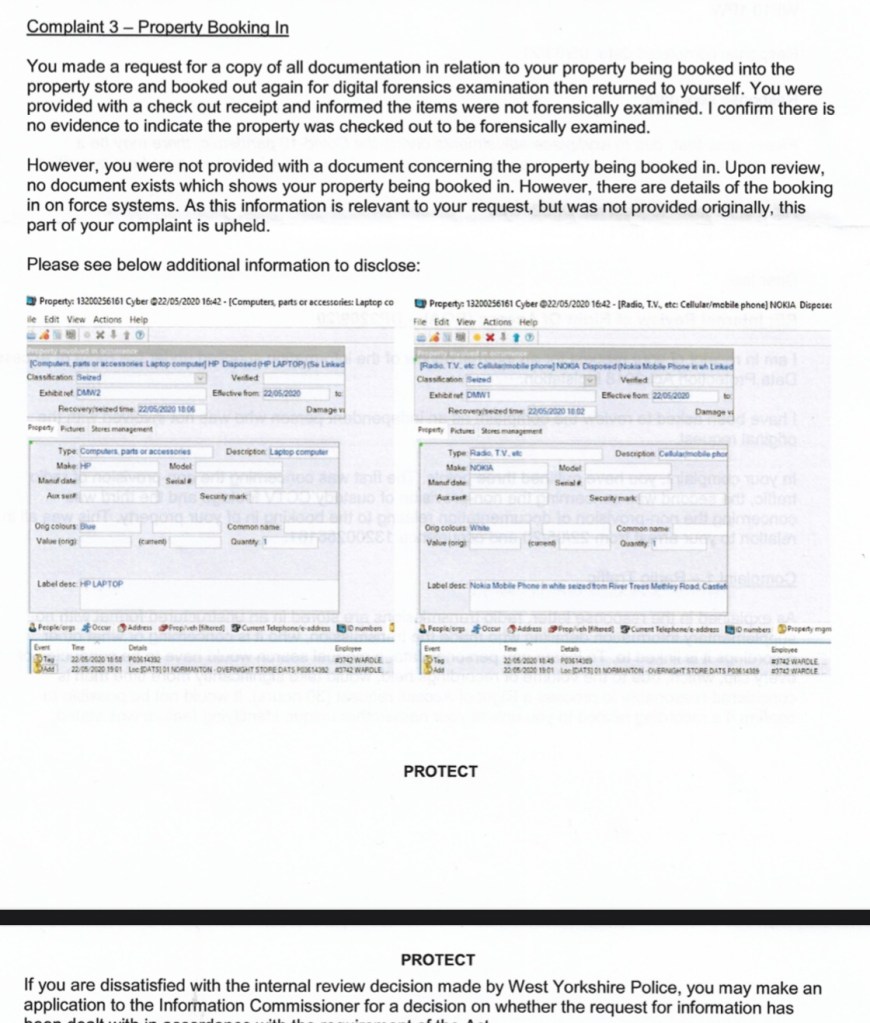
The below is an extract from a Right of Access dept. letter to me dated 5.3.21. It can be seen that both the image showing the property record is cropped and they also deny the items were taken out of the property store for digital examination.

Cropped at the point of items being booked in. ICO later compelled the release of the unedited data.

ICO as Right of Access departmentโ€™s professional regulator has made an active intervention and compelled the release of documents from West Yorkshire Police which were previously withheld.

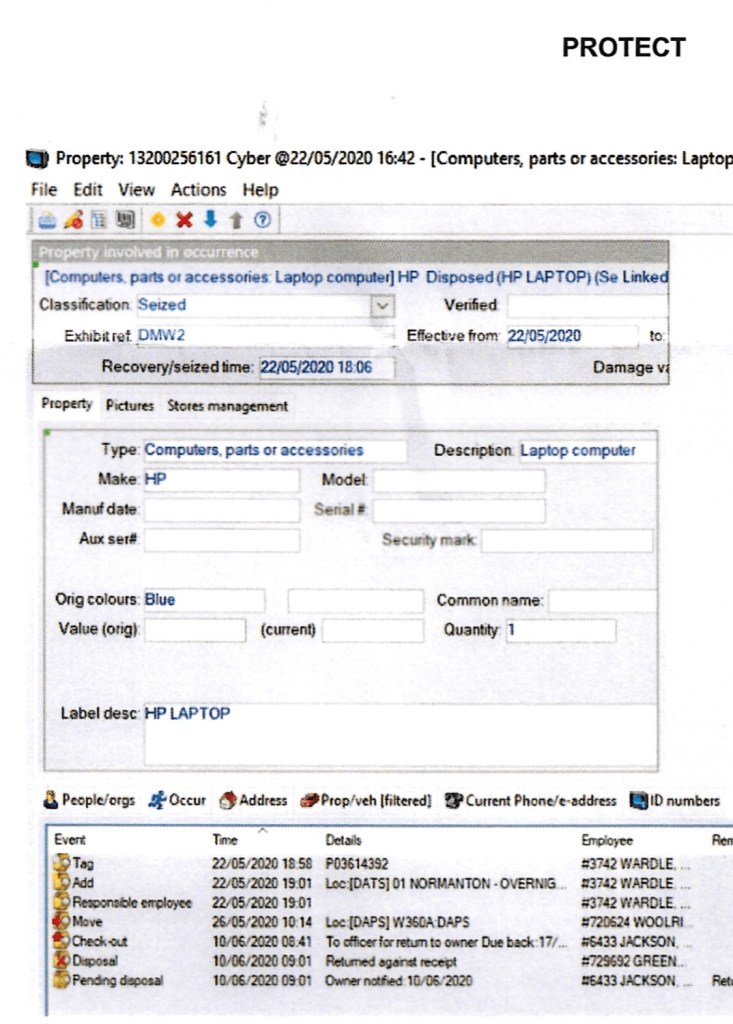
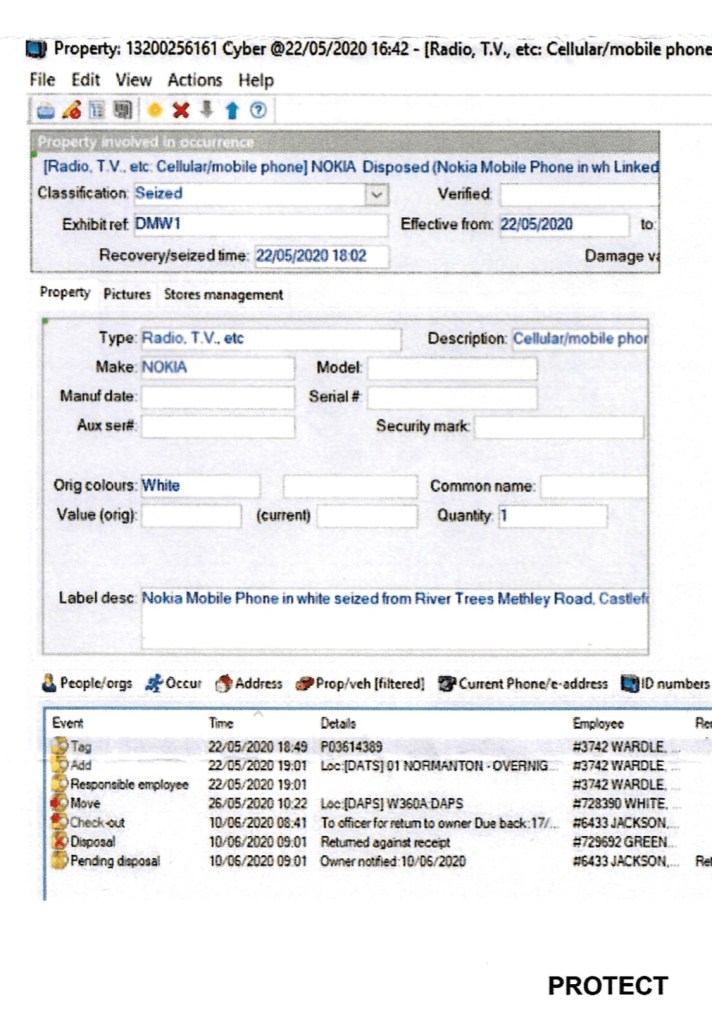
These documents show the booking out of the electronic devices when in the property store for digital forensic examination, thus breaching common law, as of course legally privileged materials were stored on them. The version seen above was cropped to hide the removal of the devices for examination, breaching common law in so doing.

A copy of the most recent disclosure showing the data which ICO forced police to disclose is below. This shows data wholly contrary to what was stated in the PSD complaint response, seen above, of August 2020 and Right of Access departmentโ€™s response of March 2021. The devices clearly were removed on the dates shown for digital forensic examination. Below is seen the unedited version of the property record – that shown above was edited by Right of Access dept. to remove incriminating data.

Laptop booked out for forensic examination 26.5.20 and returned to property store 10.6.21.
Likewise phone booked out on same date and later returned when examined.

On this basis PS Tony Shand in his testimony to PSD and PC Vicky Silver both sought to purposefully mislead in the response to the complaint made.

Right of Access dept. also sought to mislead in their response to me of March 2021 and further edited the property record by cropping out the incriminating data.

Both departments and individuals at West Yorkshire Police have stated things that they know to be untrue in an effort to avoid professional embarrassment, an allegation of misconduct in public office and the breaching of Common Law in relation to privileged material on the electronic devices. There is also the breach of PACE 19.6 in the removal of the devices from my home.

Right of Access dept. attempted to withhold the relevant document until instructed by their professional regulator ICO to release the information. Indeed an examination of the images on this page shows that they deliberately cropped the first disclosure sent to me in March 2020 to hide data. This amounts to a breach of S.77 of FOI 2000 by West Yorkshire Police as there has been a purposeful effort to hide relevant data. This is a criminal offence under the relevant Act.

That there existed significant opportunity for WYP to produce the relevant data prior to ICO intervention but they avoided doing so to try to hide misconduct in relation to the electronic devices.

The purpose of withholding the data was to avoid professional embarrassment to West Yorkshire Police over a breach of Common Law in the retention and examination of legally privileged material contrary PACE 19.6 and the seizure and retention of the same without a warrant.

It is now clear from the disclosure made as the result of pressure from ICO that West Yorkshire Police has not only committed purposeful misconduct in public office over the seizure, retention and examination of legally privileged material without a warrant but also that they have attempted to cover this up by wholly misleading statements in the complaint response and the subsequent effort made to hide disclosure requested.

Had ICO not forcibly intervened in this matter then the degree of misconduct and breach of legally privileged material would have remained hidden.

Given that they lie so glibly over such a serious matter none of the other assertions made by West Yorkshire Police Professional Standards dept. in any complaint response can be trusted to be factual and truthful.

As anyone who has ever dealt with that department will be aware!

Dirty Tricks in The High Court

The text below is the wording of a statement given to The High Court in a set of proceedings presided over by The Hon. Mr. Justice Lavender on 9.6.21.

They detail the efforts of that judge to derail straightforward civil claims and to prevent the use of the civil courts to gain material in relation to wrongful conviction.

It concerns the application of a civil restraint order against me, the grounds for this being made and the manipulation of cases and civil procedure by The Hon. Mr. Nicholas Lavender in order to protect state organisations from the effects of their own misconduct.

Interestingly the only public bodies sending representation to the hearing were those within the CJS who have the most to loose from civil actions which would force them to obey the law. Equally of interest is that I was not provided by the Court or one of these parties with a copy of their statement for the proceedings.

The statement begins:

The original CRO of February 2018 was made in respect of an application for judicial review proceedings against Humberside Police and CPS in respect of their failure to comply with The Data Protection Act request for production of data. This followed their failure to produce materials under their obligations as per The Criminal Procedure Investigation Act 1996 which led directly to my wrongful conviction at Hull Crown Court in November 2016.

The GCRO subject to this hearing was imposed for a similar claim in relation to Humberside Police. In both instances the data sought from Judicial Review and other proceedings was information withheld in Crown proceedings contrary S.8 CPIA 1996.

Both CROโ€™s have been imposed following civil claims to obtain data in relation to wrongful conviction. The purpose of the CROโ€™s has been to protect organisations within the CJS from the consequences of their own misconduct and from having to comply with such data protection regulations which would produce the materials sought. The organisation with the most to lose from being made to comply with their obligations at law is the CPS, who have also provided the longest statement in these proceedings. The statement contains a significant factual errors regarding wrongful conviction. This is very CPS. They have been asked to amend this in an addition to their statement by email 7.6.21. There has been no reply to this. Again this is very CPS.

It has been noted across my involvement with Lavender J that he invariably acts to protect state institutions from the effects of their own misconduct. The original CRO was entirely made to protect elements of the CJS from the exposure of their malfeasance in 1XXXXXXXX5 in the Hull Crown Court and to frustrate and complicate the process of appeal proceedings in relation to the wrongful conviction. As such the application of the CRO amounted to abuse of process in such a situation as I was in. The reasonable thing to have done would have been – if the claims at issue were indeed poorly particularised – to have allowed for an amended set of particulars to be filed. But the intention however has never been to allow a reasonable opportunity for me to use the civil system to correct such as the wrongful conviction but rather to limit, deny and frustrate the ability to do so.

CPR 3C 5.1 allows other parties to apply for CROโ€™s. It is noted that in relation to all of the organisations I refer to in these submissions which are outside of the CJS that no such application has been made from any of them. This suggests that they are aware that the basis of civil claims made against them are strong and that the claims themselves are properly particularised and pleaded. The difficulty comes from a judge who seeks to strike out applications made and who in the wording of his Orders in relation to such reveals a degree of personal antipathy towards me which further suggests it is unwise to allow him free reign over any application or claim in which I am involved.

The purpose of the original CRO was to protect Humberside CPS and Humberside Police from the effects of their own misconduct and the revelation of their making substantial efforts to gain a wrongful conviction. And ultimately the CROโ€™s have turned out to be pointless. They have has certainly created frustration, delay and difficulty but they have not prevented the acquisition of documents presently in the possession of a London based solicitor and obtained from Humberside Police via the efforts of an independent justice charity which were sought as the goal of the original judicial review proceedings. Withheld evidence showing factual innocence, documents showing the police at one point dropped the entire prosecution and that it was accepted there was no travel to the complainant on the day of supposed offences has now been obtained. Also requested now are copies of statements not provided to the Court or defence in the original set of proceedings but known to exist as these are referenced in other documents which do. The GCRO and ECRO from 2018 onwards simply has made the entire process of obtaining documents more complex and lengthy. It has required the involvement of an independent charity to obtain disclosures and arguably has lengthened the time for which I am wrongfully convicted. This in itself is a further injustice against me.


I have been involved with The All Party Parliamentary Group on Miscarriages of Justice since 2018. I have also submitted evidence to The Westminster Commission on Miscarriages of Justice and am credited in their recent report for having done so. One of the areas I explore in my evidence to the Commission is how the civil system has been denied to me as a route to obtain evidence and information to enable to overturn of a wrongful conviction. I have been explicit in the background detail leading to the making of the GCRO and the ECRO and have stated that the CROโ€™s were imposed to prevent use of the civil system to embarrass elements in the CJS for their professional misconduct and misconduct in public office. Nor do I expect that I am the only person to have been subject to CROโ€™s to protect the CJS.

As stated all that the CROโ€™s since 2018 have done in relation to the wrongful conviction is to frustrate and delay. The evidence showing factual innocence required to enable a return to The Court of Appeal Criminal Division (CACD) is now obtained. As such the application of CROโ€™s in relation to matters pertaining to wrongful conviction has been a purposeful effort to cause difficulties in relation to appeal in such a way as to seek to end the appeal. As stated this has not worked and so the CROโ€™s in relation to wrongful conviction turn out to have been an act of phenomenal spite and vindictiveness against me personally as well as a means of attempting to protect the CJS from the effects of their own misconduct.

They have failed. Significant data showing the conviction is manifestly unsafe has been obtained. The appeal proceeds. It may be worth recalling in relation to the statement of CPS in this matter that the organisation withheld evidence of factual innocence in 2016 and continues to do so.

However Lavender J now has something of a bee in his bonnet about me, as evidenced by personal comments made regarding me in several Orders. Thus while the original purpose of the CROโ€™s was to prevent access to data Lavender J seeks to now prevent any other use of the civil system by them. I will now illustrate how this takes place, the injustice caused and the effects of this by considering the effects of the CROโ€™s in relation to other civil claims.

In DXXXXX0 the claim was issued pre-CRO yet the CRO was used as grounds to reject this running claim, the same applies for DXXXXX8. The retrospective application of a CRO to end meritorious running claims is an abuse of process and this indicates that the CRO was created for the purpose of ending meritorious claims against elements in the CJS even those which do not abut onto matters related to my wrongful conviction.

Now to consider the wider context: The civil system as a whole has fallen apart. The progress of any civil claim is met with incompetence, delay and poor service at all stages. The civil system was collapsing even before covid and is presently unable to function in any meaningful sense as a means of obtaining redress against any tortfeasor. To quote some examples from claim no. EXXXXX in the Leeds County Court. Court staff recently supplied the first defendant with my financial details in error. Kerching! Money awarded as a consequence. The claim in respect of the second defendant was delayed for over a year due to error on the part of court staff. Kerching! More money awarded. Presently a hearing due for w/c 26.4.21 has still not been scheduledโ€ฆ and on and on these errors goโ€ฆ
As a consequence of all the errors made by court staff a complaint is made each time. Over the course of the last year the errors made by court staff have resulted in payments to me of just under three thousand pounds made either by the court itself of by Customer Investigations at Petty France. On one occasion a payment of ยฃ450.00 was made for one single incident.

These errors are systemic in the civil system. They show an operation in total collapse and that HMCTS is in denial about exactly how fractured and unable to function the system presently is. Hilariously the initial response to any complaint is either to deny the mistake has taken place or else to ignore the complaint. Outright incompetence, lack of motivated staff and the prevalence of administrative errors are the significant difficulties that any civil litigant ordinarily faces in using the courts to correct torts against them. The civil system has ceased to function or have any meaningful purpose when the process of taking a claim to trial becomes in itself so prevalent with frustrations and difficulties that any settlement recouped is hardly worth the loss of time and effort.

On top of these issues for me are thrown in the difficulties created by the CRO.

Now to consider the issues raised by the GCRO created almost two years ago.

The GCRO began in FXXXXX6 in relation to Humberside Police โ€“ it is odd that the judge in question makes such CROโ€™s following claims against the police stemming from a constabularyโ€™s failure to act in relation to their obligations in law in order to protect their professional reputation from the consequences of their efforts to obtain a wrongful conviction. Lavender J made a GCRO which mirrored the ECRO made following the Judicial Review CO/5693/2017 in respect of the same organisation.

That in order to find material to justify the granting of a GCRO, as the claim itself had merit, the judge assessed and sifted material from as far back as 2012. This material was of course available when the ECRO was made but was not cited or used in relation to the same. This trawl through numerous past cases is odd since this material was available to the judge prior to the imposing of the ECRO in 2018. That this amounts to an incident of behaviour which chimes with some online allegations regarding the way the judge handles claims in relation to public bodies which I will discuss more further into this matter.

Thus the granting of two CROโ€™s in relation to proposed proceedings against bodies in the CJS gives rise to the suggestion that the Courts are acting to protect a wrongful conviction and the reputation of the CJS by the application of civil restraint orders and strike out of meritorious applications which would, if allowed to continue, provide evidence of malicious conduct, incompetence and malfeasance leading to wrongful conviction. That this forms an abuse of process and a breach of my Convention Rights as well as a manipulation of the civil system.

Let us consider one other example of how this works to create difficulties which I will confine to one case, this being DXXXXXX6.

In relation to the appeal into wrongful conviction fresh evidence has periodically been obtained from 2017 onwards even before the involvement of an independent justice charity who have since done astonishing work. Legally privileged material is created in the pursuit of appeal into wrongful conviction and legal advice is obtained which is also privileged. Periodically West Yorkshire Police attend my home to seize such materials which are removed and never returned bar on one occasion. Again as with the original CRO and its later incarnations the purpose of this removal is to frustrate and delay the process of appeal to assist the CJS. DXXXXXX6 was begun to obtain the return of devices and materials seized by police contrary to common law. The claim proceeded for some two years until the point where it met Lavender J who decided to strike out a civil claim which had been before three previous judges and which pre-dated any CRO. The grounds for this were that the claim apparently had no merit. If this were the case then it would have been struck out long before.

In the matter of DXXXXXX6 part of the claim was for the removal of and failure to return electronic devices. Even though no proof of wrongdoing in relation to the same is produced or subject to criminal proceedings devices are routinely not returned, replaced or compensated for. Assurances were given that I would be recompensed by West Yorkshire Police which were recorded in the judgment striking out that matter of October 2019. And immediately reneged upon by them. The purpose of the CROโ€™s in full can be seen here: that they work to deny access to the civil system at the same time as allowing tortfeasors to carry on towards me with whatever level of malfeasance they wish safe in the knowledge that Lavender J is prepared to act as a gatekeeper to the civil and criminal system to prevent the outcome of their behaviour from having any consequences for them. Consequently I have been subjected to what amounts to theft of electronic devices, legally privileged materials and also breach of agreement made before the judge. This has created additional work to recover LP / LPP materials and financial loss. These are the fruits of the CRO.

It is noted that Mike Percival of West Yorkshire Police was the person offering assurance before Lavender J in respect of the return and repayment for devices. He has made a statement for these proceedings but failed to attend in person as he would be liable to be questioned over the failure to act in accordance with his assurances. Thus any matters raised by West Yorkshire Police in relation to the continuation of a CRO must be understood in the light of this behaviour. Recent correspondence with Percival over the matter of the return and replacement of devices included a direct threat to me from Percival over his intended actions in the event that I did not drop the matter. Copies of all such emails have been retained. At para. 4 of his statement he refers to correspondence with PSD which PSD has not been responded to in line with The Police Reform Act 2002 and that matter is presently before IOPC. Percival fails to mention this. Indeed there is a great deal Percival fails to mention as this does not suit his aims of protecting his force from the consequences of their own misconduct. Sufficient materials available easily online from investigative journalists such as Neil Wilby will give reasons for disquiet regarding the integrity and reliability of Percival. It is noted that when a pre-legal letter arrives from a firm to West Yorkshire Police their first reaction is to conduct a harassing doorstep visit and this has taken place twice now on the days following pre-legal correspondence being sent to West Yorkshire Police. It is in the light of this that the reliability of the statement of West Yorkshire Police in these proceedings should be considered.
Indeed since the end of DXXXXX6 there have been several other instances of WYP removing legally privileged material or newly located evidence to the extent that any such in relation to appeal proceedings is now immediately retained wholly by firm instructed in appeal proceedings and not by myself.

Incidents such as those I have described above lead to my acceptance that regardless of the extent of the misconduct practiced against me that I now cannot seek assistance from the civil courts on the basis that any claim will be funnelled to straight to Lavender J who will dismiss the claim at the first instance. Again this is the fruit of the CRO. Whilever a CRO is in place it is an invite for misconducting organisations to bully, harass and commit torts against me. I now look at the efforts of Lavender J to interfere and end running claims not related to the CRO and which have been before other judges. In EXXXXXX4 I was surprised that a document from late 2019 from Lavender J should suddenly appear. This was claimed to be produced in November 2019. It was however supplied in the claim in March 2020 I further do not believe the account from the Court in an email of 4.3.20 (which alerted me to this document) that document was drawn in November 2019 and lost by the Court for some four months. The document is sealed stating 4.3.20. It was sent to me on 4.3.20 at 12:22.

Now on the day before this three applications in claim no.’s GXXXXXX8, GXXXXXXX7 & EXXXXX5 were sent 3.3.20 at 16:32. Each of these applications referenced materials located online which questioned the integrity of Lavender J . The content of these materials roughly mirrored the experiences I have had with Lavender J. As the site stated that he sought to close down any claim against a public body regardless of the merits of the claim. I have retained a full copy of this site.

The wording of the Orders produced in response to the applications made on 3.3.20 almost veer into personal attacks on me as a claimant. This is clearly anger on the part of Lavender J in relation to the materials found online and my reference to them in the applications. Then the sudden, mysterious appearance of an Order in a separate claim, which the Court stated was produced some four months late which strikes out the claim.

The three applications were that that the judge recuses himself from dealing with me in future, that prior judgments made by him are peer reviewed and that no further civil restraint orders are imposed by this judge. That the Orders of 5.3.20 in relation to the application seemed to suggest intemperance on the part of the judge as the online references may well have touched a nerve.

I then find that an Order comes through the following day from the same judge to delay and frustrate an existing claim and which is claimed by the Court to be from November 2019. The Order claimed to have been drawn in November 2019 was in fact not created at that point but rather by the judge in a fit of pique in relation to the content of the three applications entered with the Court on 3.3.20.

Is it reasonable to assume that an Order would be made and lost for some five months by the Court? Since the case file will have been accessed several times since October 2019 in relation to applications made in the case and hearing dates set etc. the assertions that the Order was drawn and “lost” are not credible. It is too much of a coincidence that it is claimed that this document was located so soon after the 3.3.20 applications and the intemperate responses to these applications in Orders.
Thus the claims regarding the Order being created in 2019 amount to misconduct in public office, and abuse of process as does the drafting of the Order itself. That this amounts to misconduct in a public office by judiciary and members of HMCTS staff.

That the judge at issue would – it is hypothesised – have wished to act to cause difficulty for me in a separate claim on the basis of the comments made regarding materials found online which were contained in the applications in GXXXXX8, GXXXXX7 & EXXXXXX5 of 3.3.20.

Of course this gives additional grounds for concern regarding the actions of the judge at issue and for this reason the applications in respect of this judge recusing himself etc. are reinforced by the actions described.. An application was made to request the judge recuse himself from any future involvement with me in those three applications. This was refused. The production of the Order referred to is an abuse of HMCTS’ staff, systems and processes for an improper collateral purpose. In this instance to frustrate the process of justice in relation to ongoing claims.   


And yet when Lavender J is not involved with claims they work remarkably well. Consider HXXXXXXX1 in The Queenโ€™s Bench Division. 
Over a running period of two years this claim was successful and achieved its goal. Before both Master Davison and Mr. Justice Eady none of the particulars were deemed to be inadequate in the way that applications via Lavender J are deemed to be as justification for early strike-out, or more often a late strike out of ongoing claims. The claim achieved its goals and progressed smoothly. Indeed such as DXXXXX6 also progressed smoothly until referred by HHJ Kelly to Lavender J who proceeded to strike out a claim which had been running for two years prior, doing so on spurious grounds.
  

At present any application in an existing claim or application to commence proceedings are referred, under the CRO to Lavender J who immediately acts to strike these out. Often this is done on the grounds that the particulars are insufficiently pleaded. However if HXXXXXXX1 can progress successfully at QBD where the standards of written particulars are higher then I would suggest to you that the pleadings made in claims are not at fault so much as the desire to strike out claims of merit to protect such the MoJ, HMCTS and suchlike. Several other claims have been issued in the last few years prior to the GCRO and have progressed to a successful outcome. Therefore it is not that I as a litigant in person cannot draft a set of particulars or issue unmeritorious claims but that claims against bodies in the CJS are stated to be this way as grounds for strike out.

Where it is not possible to strike out a claim on the grounds of merit or such a matter is outside of the field of Lavender J to interfere other means are deployed to try to dismiss claims. Consider EXXXXX7 which was a data protection act claim in relation to Doncaster Children’s Services. In January 2020 a hearing was held in Doncaster County Court before DDJ Nix. Produced for this hearing from Judicial Office was a copy of an incorrect certificate of conviction (doubtless the same that CPS refer to in their statement for these proceedings, corrected since). At the same time a copy of the GCRO was supplied to the Court by judicial office together with the claim that the case impinged upon the Order and thus stood to be struck out. The claim pre-dated the GCRO and did not impinge upon it. Of more serious significance was the production of the certificate of conviction since it was factually incorrect and clearly produced in order to sway the Court’s opinions. In an email from Jane Yoxall at Sheffield Combined Court the source of this malicious data was stated to be the judiciary. The purpose of the supply of both of these documents was to stop the trial due to take place. The claim was eventually won by me as the judge agreed that the GCRO was not relevant to the claim and a copy of the correctly worded certificate of conviction was supplied to the Court by me. But interference in relation that claim from judicial office is a matter of exceptional seriousness and shows the extent to which certain parties will go in order to delay and deny access to justice.
The person responsible at judicial office has never been located as judiciary hide behind the fact that they do not operate under data protection or data access legislation. However I am reasonably confident that I am sure in myself as to who was responsible for this outrageous and unacceptable behaviour.

Another odd thing to have happened was the inclusion of the judgment of Mr., Justice Butcher on CaseMine. It is odd that a case which had no significant features which would have resulted in it being included on such a site and indeed clearly set no precedent should have found its way into such a public forum. Perhaps because the judgment mentioned the wrongful conviction so prominently and significantly there were reasons why it was submitted by someone for inclusion on the site. A few persuasive arguments from me to CaseMine and it was just as quickly removed from the site. It remains removed from the site. However the appearance of it online in the first instance is perturbing: both of the above incidents suggest that suggesting that there is someone prepared to act in a cloak and dagger manner unbecoming to their position.

Lavender J is of course familiar himself with embarrassing material appearing online. I was notified in March 2020 of a specific website hosted by WordPress which is:

https://www.bentjudgenicholasLavender.site/(accessed February and March 2020)

I do not intent to repeat all of the content of this site here suffice to say that if correct then the handling of any claims and applications by The Hon. Mr. Justice Lavender J together with judgments and Orders made in respect of me are ripe for review. The site alleges that this judge mishandles claims against public authorities such as the cases referred to above and states a possible motivation for the judge to do this. This site and one other site contain allegations of perverting the course of justice by Lavender J particularly it seems in cases in which Police or local authorities are involved. I believe the site was produced by someone in the Norwich area.
The judge has declined to comment on this matter in the judgments given of 5.3.20 in relation to claims at GXXXXX8, GXXXXX7 & EXXXXX5. This fails wholly to address the issues brought within the applications that the judge may be disinclined to allow meritorious applications and claims to proceed against public authorities for reasons best known to himself but which are stated in the sites quoted. However it is noted that in addition to myself at least one other person has reached the conclusion that this judge will dismiss claims made against public bodies despite the strength of the case. In several Orders now the wording of the Orders rejecting the application made โ€“ often in proceedings that pre-date the Order tends to run the same. It is likely that there is a template pre-prepared in relation to this! I would be interested to see the wording of other Orders in relation to persons subject to a CRO from Lavender J to see if the wording is the same. The wording โ€œMr. KXXXXX wastes public costs and had done so for yearsโ€ always appears at a set part of the Order. Likewise other identical comments appear in the same position in other parts of the Orders.

In cases such as DXXXXX6 & FXXXXX4 applications were made in the expectation of a 14-day turnaround as HMCTSโ€™ standard. Both of these applications before Lavender J took six months before a response was received: in both instances the purpose of the application was lost because of the time taken to respond. Again this represents an injustice and the time taken to respond to matters is simply a further way of delaying and denying justice. This cannot be accidental.
The six months taken to responds in respect of DXXXXXX6 & FXXXXX4 did not apply however in relation to those three claims I mentioned earlier, being GXXXXX8, GXXXXX7 & EXXXXX5. In the applications for each of these I mentioned the WordPress site I had been notified of which carried the allegations in respect of Lavender J skewing judgments in favour of state organisations and striking out such claims. These three applications did not take six months to action: they took three days. And the Orders issued in relation to them contained language which verged on the intemperate. It is clear from the wording that Lavender J was rattled and angry by the mention of the sites discussed and that this contributed to the wording of the Orders and the dismissal of the claims. The style of the wording used in the Orders issued in GXXXXX8, GXXXXXX7 & EXXXXX5 has formed the template for any Orders issued since which I discussed a moment ago. This consists of allegations regarding my conduct and character which are not supported by reference to the facts or to the manner in which I conduct myself in proceedings: they are comments designed to upset and distress me as a claimant and to create prejudice and bad feeling in any other party who reads them. The contents of these Orders show a degree of personal antipathy the existence of which is re-enforced by the other issues I have raised in these submissions. It is undesirable that a person who holds such feelings should be able to make significant decisions on these claims or that the CRO the they have imposed should remain. My opinion in relation to these matters is this behaviour from Lavender J amounts to targeted discrimination.

At this point you may well of course throw your hands in the air and profess that these are ludicrous accusations

[Following section redacted from online publication as concerns ongoing investigation into third parties not concerned with this matter.]

The relevance of this in relation to these matters are that judgeโ€™s can engage in actions which are ethically questionable and sometimes for personal reasons.

Despite what is written scurrilously in various Orders from Lavender J I neither relish nor enjoy the process of bringing civil claims. There are many other more worthwhile things to do with my time and in every instance I give the other party sufficient chances to avoid any form of proceedings before they begin. However the existence of such as a CRO, if the other party is aware of it as several I have cited in this statement are, means that they are less likely to settle an issue pre-action as there is no incentive for them to do so if they can cite the existence of a CRO as part of grounds for striking out a claim at an early stage. While I do not enjoy the process of civil claims if this is the only means by which I can obtain redress then I will not allow an injustice to sit. This is rather the purpose of the civil system, is it not? To allow a person to obtain satisfaction for torts committed against them. In judicial review CO/XXXX/2017 – another successful claim properly particularised and with merit – the purpose was to obtain a copy of the court file in relation to my wrongful conviction. The court initially and wrongfully denied access to this. The judicial review proceedings once issued obtained it. Another instance of my bringing a case which has merit and is successful. Had such an application for the Court file been made today it would have been denied by Lavender J on some obscure basis and the data of value to appeal would have not been available to me.

I will give one more example of the extent to which the existing CRO makes me an aunt sally for all and sundry. On 18.5.20 MoJ mistakenly sent me materials intended for The Metropolitan Police in respect of a POCA application regarding a man in the Kent area. The data sent to me in error contained every significant personal detail of this man and his bank accounts etc. the data would have proved gold for anyone of criminal intent. I informed ICO of this on the grounds that it formed a significant data breach. MoJ took exception to this and so sought to have me arrested. Subsequent data obtained from subject access requests shows that the Data Security Manager at MoJ suggested the need to โ€œgive him a shockโ€ rather than because of any wrongdoing on my part. Indeed I was arrested in relation to this matter and โ€“ youโ€™ve guessed correctly โ€“ any devices containing LP / LPP materials were again taken breaching common law. This is standard West Yorkshire Police practice to ignore such common law rights.
Much in the way of proceedings could stem from this: the malignancy of MoJ for wanting me arrested due to the embarrassment caused to them (and of course this is another glimpse into a malfunctioning justice system), the predictable removal of LP / LPP without triage and of course wrongful arrest and detention and the loss of liberty.
However is there any point in bringing any form of proceedings in a situation in which all and any grounds for a claim will be struck out by Lavender J at the first opportunity? Well yes as the same rights in relation to protection from such as wrongful arrest and loss of liberty apply to me as everyone else but the process for pushing the claim forward becomes considerably more complex and costly financially and in terms of time.
There is no incentive for either MoJ or WYP to settle this matter amicably or at all since both are well aware that the ultimate sanction in the event that pre-legal negotiations were to fail is not open to me. Thus they can and have compounded their initial torts by failure to respond in any meaningful way to complaints made. Both can do this โ€“ and indeed they are not the only bodies to fail to engage with issues raised โ€“ as they are aware that my ability to cause them discomfort and inconvenience via legal action is severely limited by a CRO. This is the reason for Percival wishing the CRO to continue: they wish to evade civil proceedings for wrongful arrest.
Thus if you are considering extension of any CRO you need to consider if the Order is likely to extend a period in which I am prejudiced against and mistreated by such as MoJ because of such as the proceeding appeal or โ€“ as I have stated โ€“ due to their own malice. I would say that there are sufficient examples I have given you here of injustice caused by the CRO that it cannot reasonably continue. The aim of the CRO in the first instance was to prevent Humberside Police and CPS producing material which would show they obtained a wrongful conviction by abuse of process so the very basis of the initial CRO and the later GCRO was in itself to perpetuate an injustice. Sufficient material for appeal has now been obtained via an independent campaign group.

This hearing was originally set for 17.5.21. I could not make that date as I have to act as advocate in medical matters for a vulnerable family member who had a medical review that day and informed the Court of this. The response came back from Lavender J on 12.5.21: โ€œThe judge is prepared to adjourn the hearing currently fixed for Monday 17 May 2021, on the basis that general civil restraint order will be extended until the adjourned hearing.

CPR states at PD 3C:

4.9 A general civil restraint order โ€“

(1) will be made for a specified period not exceeding 2 years;   

4.10 The court may extend the duration of a general civil restraint order, if it considers it appropriate to do so, but it must not be extended for a period greater than 2 years on any given occasion.  


The judge has in effect attempted to issue an Order (that the CRO is extended beyond two years) without putting such into a formal Order and without formal proceedings. Such an Order made properly could be challenged via appeal. But I cannot challenge formally challenge at Court a decree issued via quotes in emails. This thus represents a further injustice. Issue of an edict by email with no Order has no legal validity and the extension was originally for an unspecified period.   

In an email of 15.5.21 I stated my concerns with Orders issued via emails quotes and not in the normal way.  
  

Since a judge can extend a CRO for up to two years beyond the initial Order and there are no reasonable grounds to do so the opinion of other organisations has been sought in Schedule 2 of the Order of 7.5.21. These are invariably (with one exemption) organisations in the CJS who have misconducted themselves in relation to me and thus have most to loose from the removal of the CRO. It is noted that other bodies subject to proceedings have not been contacted and this re-enforces the idea that the purpose of the CRO is to protect bodies and persons in the CJS from the consequences of their own actions as well as protect the reputation of the CJS.

Little surprise then that two organisations happy to put their opinions into these proceedings are two with the most to lose from the removal of the CRO: CPS and West Yorkshire Police. Let us consider the former to begin with. In relation to the wrongful conviction at Hull Crown Court in November 2016 it is known that some 30 documents were purposefully withheld. These included ANPR evidence showing no travel to the complainant on the date of the supposed offences and two additional statements from the complainant which are referenced in other documents but which were not produced for the Court or the defence. CPS were subject of an application for Judicial Review of their refusal to produce these documents under relevant information right law. They have much to lose from being forced to produce the documents: these will show systemic misconduct on the part of CPS to obtain wrongful conviction.  The assertion that there has been no contact with CPS over the duration of the CRO made in their statement is wrong: I have attempted to obtain a copy of consent to prosecute over supposed indecent images which has been denied. I have also attempted to confirm that an MG6B was supplied to CPS detailing the prior misconduct of an officer in the case who claims to have carried out digital forensics work, a DC Julian McGill, given that we are now aware of prior disciplinary offences for computer misuse. One further thing regarding the CPS statement. It is noted that this is written by the wife of the head of CPS for Yorkshire and Humber and someone together with their husband Gerry will stand considerable reputational damage from the forthcoming appeal proceedings. As with the West Yorkshire Police statement, the accuracy of which I will mention, the material you are being presented with by CPS is not factually accurate or the whole picture. Here at para. 6 I am claimed to have been found guilty of meeting a child following sexual grooming. This is not an offence I have been convicted of but they are happy to put this data before the Court. Thatโ€™s very CPS: incompetent, careless and inaccurate.   


It would appear also that the complainant in the Crown Court case and her mother have been contacted in relation to these proceedings and invited to offer an opinion. That neither is willing to take part is not a surprise. LXXX TXXXXX has since been outed in the national media as a serial sex offence complainant and compensation seeker following her attempt to target BXXr RXXXXn, or Viscount RXXXXn of CXXXXXa as he is known, son of Lord GXXXXe. The press articles on this 2018 incident are still plentiful on the internet. One thing a serial compensation seeker needs to carry out their work is anonymity and it it known she has targeted at least one other male between myself and the Viscount. Little wonder she is not prepared to take part in these proceedings as she’s taken the money and run each time. 


Thus the existence of the CROโ€™s โ€“ publicised online contrary to such as the Right to Privacy โ€“ for all to see enables organisation with whom I come into contact to be able to act with whatever level of misconduct they wish towards me secure in the knowledge that they can cite the CRO in relation to any proceedings which might miraculously get as far an initial hearing as justification for an early strike out. This has taken place in relation to the actions of the First Defendant in EXXXXX4. The CRO creates prejudice in the mind of any district judge that a claim is before.To revert to my earliest comments in relation to the CROโ€™s: the original of these was made to frustrate the goal of obtaining data from Humberside Police pursuant to their failure to provide the same contrary their obligations at law. 

Thereโ€™s an interesting power dynamic going on here. A High Court judge who seems to have a maligant interest in a litigant in person and who seeks to end any application or claim he makes by whatever means possible. The judge at issue will act to end meritorious claims against public authorities, has done so in the week the 7.5.21 Order for these proceedings was made  and would appear to be doing so for reasons incompatible with his judicial oath, duty of care or the interests of justice   


If an application has no merit then it can be struck out by the first judge who it comes before, often at the paperwork stage or around the point of issue. The system thus exists already to strike out unmeritorious, vexatious or hopeless claims outside of the existence of CROโ€™s. There is no requirement for a CRO except to limit and restrict me personally. Indeed as stated many of the claims I have issued in the last four years have gone to be successful and I have cited examples of these. No. The purpose of the CRO is to protect the CJS from applications in the civil system to obtain data and information which may be of value to appeal proceedings at CACD. This can be seen in the strike out of claims related to CJS matters by Lavender J which pre-date the CRO and have clear merit, having been before other judges prior. This is the reason all but one of the organisations invited to contribute to todayโ€™s hearing are in the CJS. They have the most to lose by further correct use of the civil system to obtain satisfaction or enforce legal rights. No other organisation outside of the CJS has an opinion on todayโ€™s proceedings: those who routinely practice misconduct and malfeasance within it of course do.

I have raised serious issues regarding the conduct of Lavender J. Full materials in relation to the same have been retained and I would expect any Court before which these issues are raised to consider proper investigation of the matters as appropriate.

End

The Force Wonโ€™t Be With You! Illegality at West Yorkshire Police

BEING the story of how a data access request led to a breach of the law by West Yorkshire Police.

Few people would argue against the notion that West Yorkshire Police has an international reputation for corruption and incompetence. One of the less enviable roles to have at the force is in the Data Management departments dubbed, rather imaginatively as Information Compliance and Right of Access. Those pesky members of the public requesting data theyโ€™re perfectly entitled to must grate! This in those departments you stand as gatekeeper for great swathes of your information that must not be released as it could show your brother officers out to be inept, lazy or actually corrupt.

Consequently the job of anyone in a data access role at West Yorkshire Police is more akin to a doorman at the gates of Hell stopping Desmond from escaping than the role suggested in legislation as a facilitator of access to information.

Consider Section 77 of the Freedom of Information Act which states that a person…

โ€œis guilty of an offence if he alters, defaces, blocks, erases, destroys or conceals any record held by the public authority, with the intention of preventing the disclosure by that authority of all, or any part, of the information to the communication of which the applicant would have been entitled”.

…at West Yorkshire Police data access employees certainly consider this. Particularly the blocking and concealing aspects. And it probably keeps them awake at night.


A data access request was made to Right of Access department at West Yorkshire Police in early October 2020.

Eventually the data was provided (in February 2021) and as is par for the course this was considerably outside of the time limits allowed in law for the production of it and is thus is a breach of the law.

Additionally the mishandling of the original requests suggests misconduct in public office and willingness to commit a Section 77 offence on the part of a person or persons at Right of Access dept. It is for you, dear reader, to decide if this also constitutes a criminal offence of misconduct in public office.

A complaint was made to the (equally imaginatively named) Professional Standards Department (PSD) which they fudged. They were then instructed to re-investigate the complaint by The Office of the Police and Crime Commissioner (OPCC) for West Yorkshire.


Part of the re-investigation instructions relate to data that was clearly withheld by Right of Access Dept. from PSD in contravention of their duty of care and candour. That this withholding of data skewed the result of the PSD investigation resulting in the matter being referred to OPCC.

I’m willing to take a pretty safe bet that Right of Access did not inform PSD of the matters below in the original complaint investigation…

Eland Road Police Station, Leeds.

The original request for data made in October 2020 resulted in a letter of 4.11.20 from Right of Access dept. which stated that the request was rejected for 60 days as ROA had decided to impose an arbitrary and illegal ban on my making data access requests. The illegality of the ban was pointed out to ROA.

The pointing out that the ban was illegal appears to have generated a change of heart. A few days later (16.11.20) this ban was lifted and a further letter of 16.11.20 assigns the request a reference number. Great! Itโ€™s finally moving forwards! The letter of 16.11.20 claims the request is being processed.

However illogically the following day the request was then again refused in a letter from Right of Access dept. of 17.11.20.

This attracted an internal review request from me. The response from ROA to this was:

โ€œinternal reviews [has been set up]… an independent member of the team who was not involved in this decision will assess your requests and whether they should be processed.

The matter was also referred to the independent watchdog for data access rights, The Information Commissionerโ€™s Office (ICO) as a formal complaint.

ICO considers that 40 days is sufficient for the production of an internal review. The internal review was of course not concluded after this time and so the reviews were both chased with ROA after 40 days on 12.1.21.

West Yorkshire Police staff hard at work.

The result of the internal reviews were inconclusive and weak in that they upheld the original failure to produce the data without giving sustainable grounds in law.

Now hereโ€™s a hot tip next time a police force refuses your data access rights:

In order to act as a check on Right of Access dept. at West Yorkshire Police (experience leads me to not believe a word they say) I occasionally request the same data as has been requested from ROA from another police force to check matters such as the right of access in law to the data and entitlement to the same. This is something I specifically do as in the case discussed here where there is an outright refusal to supply the data. Having an uninvolved second party check what youโ€™ve been told is truthful is frequently invaluable.

A letter in response from Humberside Police from them confirmed the rights to the same type of data requested from West Yorkshire Police.

So I wrote back to ROA on 20.1.21:

I refer to the attached correspondence with Humberside Police in relation to [reference number given]. In this correspondence I requested from that force the same documentation that has been requested from West Yorkshire Police…

Following the usual game of silly bastards that police force’s like to play in their initial response letter the data was provided in accordance with the obligation on Humberside Police in law.

The same legal obligation that has compelled Humberside Police to provide a copy of the data also obliges West Yorkshire Police to provide the same to me. Your internal review of the matter and the provision of the same from a local force must mean that the law compelling disclosure of this data from Humberside also compels the disclosure from your force.

I await a copy of the data requested…

A copy of the covering letter from Humberside Police confirming the right of access to the data requested was also sent to ROA on 19.1.21.

ROA wrote back on 21.1.21 saying the matter is with the ICO but that I am not prevented from making further requests.

I request again on this date a copy of all the data originally requested in October 2020. This request is acknowledged on 22.1.21. The data was finally provided in February 2021.

After the original refusals and messing around by ROA it must have galled the that theyโ€™d been backed into a corner with no further escape route. If the data is obtainable from one force it must logically be obtainable from all.

The point of the lengthy backstory above is this: ROA habitually seek to retain data that the production of would prove embarrassing to West Yorkshire Police. This purposeful retention of data breaches the law as it activates both yours and my Section 77 rights under data access legislation and the illegal retention of it is an example of misconduct in public office as the law is habitually flouted to avoid the production of data access requests.

In the above matter once the entitlement to data had been established from another force ROA had no option than to provide the data requested, but of course prior to this the data had been subject to so much hand-wringing and wrangling to avoid its disclosure, including the illegal imposition of a ban on requests being made and the arbitrary refusal of a legal and legitimate data access request.


Conclusion

I should not have to fact-check the legal position with requests to other police forces when a request for data has been refused by West Yorkshire Police. But it does help! Equally I should not have to do this for the purpose of getting ROA department backed into a corner from which they cannot continue to refuse access to data. Again though this does help! This is wasting my time and public money simply because ROA sees its position as a gatekeeper for information rather than accepting its actual position in law as a facilitator.

Section 77 cited above is clear: it is an offence to attempt to block access to data that the public has a right to.

Recently The Office of the Police and Crime Commissioner for West Yorkshire Police has had a number of members of the public complain about the policeโ€™s Right of Access dept. Will this lead to a broader investigation of systemic and purposeful effort to block public access to data by delay, dithering and denial? Watch this space.

Daylight Robbery! How Police Evade Accountability on Data Access Requests

In a November 2020 report The Information Commissioner (or ICO) wrote the forward to a report and stated:

โ€œIt is my hope that police forces, and other organisations, will read this report, understand their current position and identify actions they can take to improve or maintain good performance. We will continue to work with the police to support their compliance with information rights laws.โ€

Some hope of that!

When the Commissioner wrote of โ€œtheir current positionโ€ she was using soft-soap language for what would have been more accurately described as clear flouting of the law and institutional efforts to evade disclosure of information.

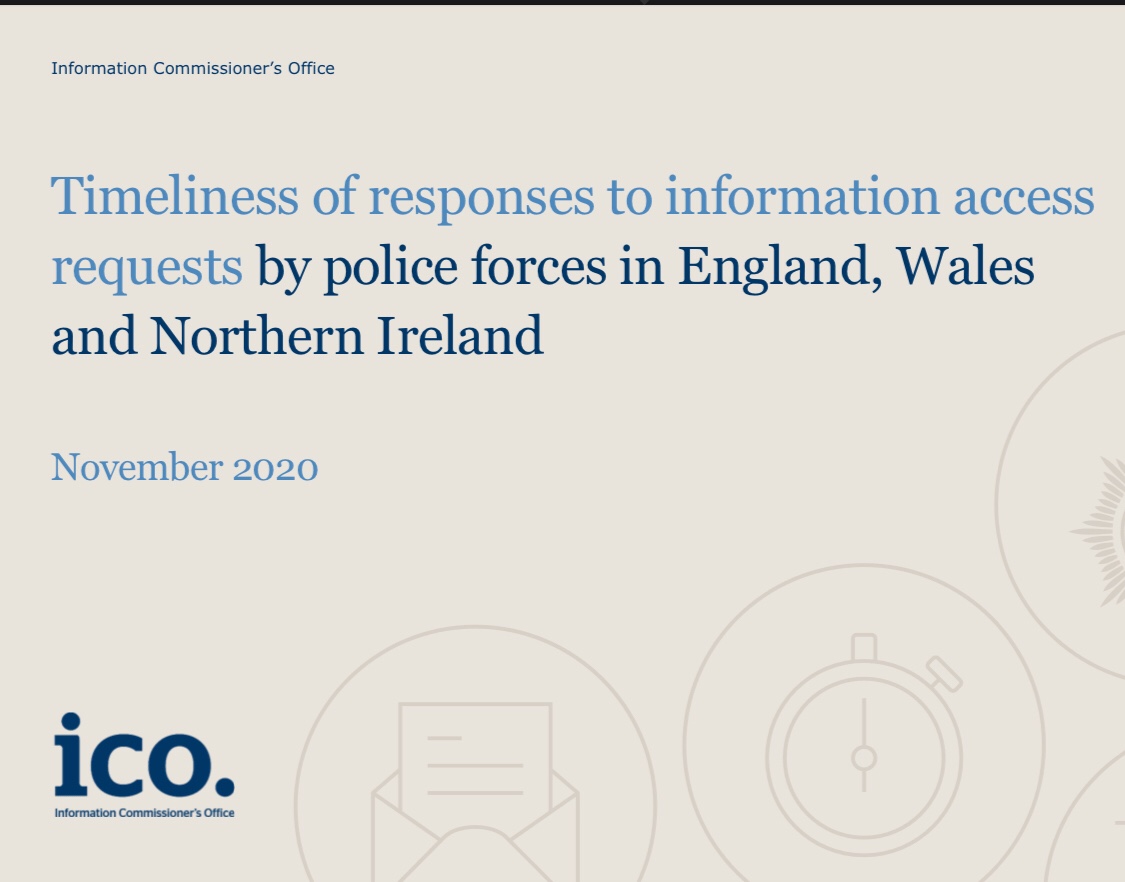
The full report can be read at https://ico.org.uk/media/action-weve-taken/reports/2618591/timeliness-of-responses-to-information-access-requests.pdf

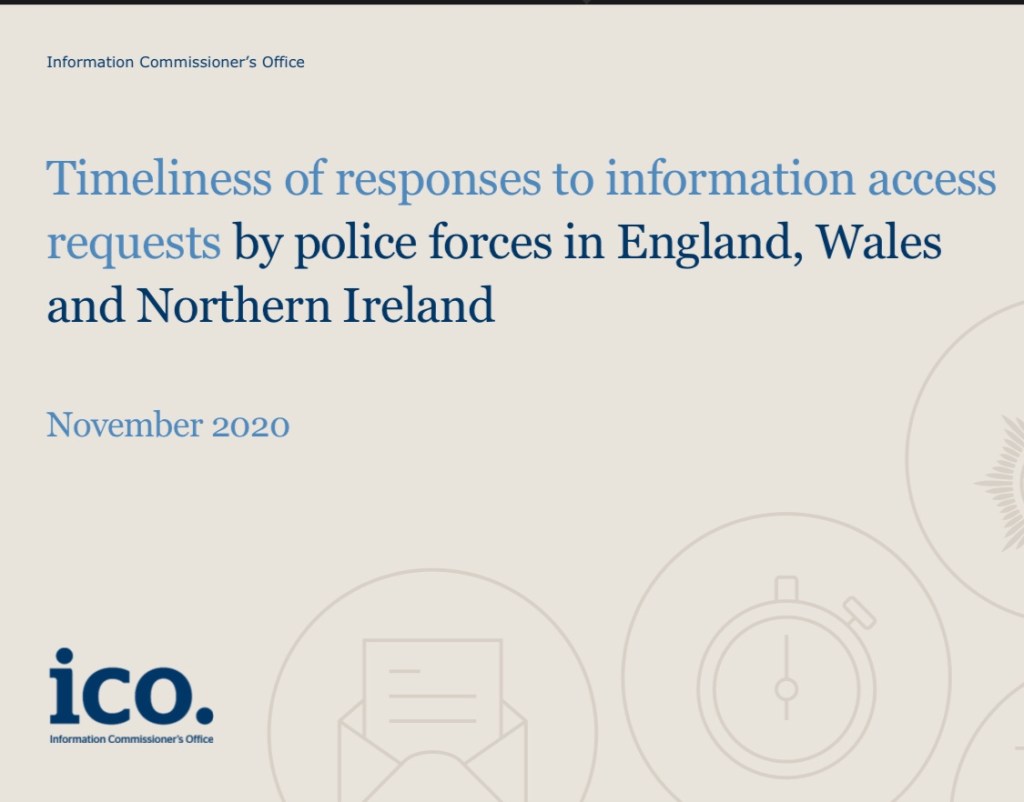
A copy of the title page of the report.

Letโ€™s take a look at West Yorkshire Police as being a recent example of this failure to comply with both the law on data access requests, ICO guidance and their general obligations to maintain good relations with the public.

The Office of The Police and Crime Commissioner for West Yorkshire has for some months now been aware of suboptimal handling of data access requests by West Yorkshire Police. They have noted an increasing number of complaints from members of the public about poor service and inadequate provision of data by Information Access departments at that force.

A Professional Standards Department investigation into a complaint brought by a member of the public that subject access requests made had been delivered late, were missing data and had been purposefully frustrated by police was mishandled by Professional Standards Department. The Office of The Police and Crime Commissioner for West Yorkshire (the PCC) found that the investigation had been substandard in several areas.

As per usual for a police Professional Standards Department the conclusion to the investigation ran along the lines of โ€œWe have investigated ourselves and found nothing wrongโ€. This outcome is usually achieved by PSD adjusting the frame of reference to the complaint to disregard all that inconvenient evidence that proves the complaint is correct. This indeed appears to have been done in this instance.

Accordingly PCC wrote in their examination of the complaint handled by PSD:

โ€œThe decision I have reached is that the outcome of the complaint was not reasonable and proportionate… [that a proper complaint investigation involved] Full consideration of the Information Management Departmentโ€™s handling of [the complainants] requests over the last year, including all the ones he brought to the complaint handlerโ€™s attention and the involvement of the ICO in those requestsโ€

Which is as I stated: police complaints department ignoring evidence which proves the force has misconducted itself.

PCC wants a re-examination of major aspects of the complaint and also wants to see:

โ€œFull consideration of the wider context concerning the timeliness of replies to Subject Access requests by West Yorkshire Police, including the engagement with the ICO. This should take into account the findings and recommendations from the ICOโ€™s report from November 2020 โ€œTimeliness of Responses to Information Access Requests by Police Forces in England, Wales and Northern Irelandโ€

…in other words the report I referenced above.

This is to say the least mildly inconvenient for police. An examination of the timelines for a dip-sample of data access requests made (but not fulfilled on time) is one of the easiest ways to see that police have broken the law in relation to these requests.

But of course if West Yorkshire Police were to investigate themselves and report to PCC the errors made in supplying data requested by members of the public then it would be impossible to hide the scale of information deliberately hidden.

So the response of Rene Prime, Reviewing Officer at Professional Standards Department to PCC states:

โ€œUnfortunately, I do not agree with the actions you propose should be taken to resolve the complaint. I agree that full consideration should be given to [the complainantโ€™s] contact and requests to Information Management over the last year and the issues that have arisen around those requests, however I do not consider that it is appropriate to consider the wider context of perceived issues within the Information Management Team.โ€

Which is as slippery a way as can be found to avoid PCC discovering the full extent of West Yorkshire Policeโ€™s efforts to evade the production of data requested by members of the public. This reply also in effect โ€œcuffs offโ€ (to use a West Yorkshire Police term) the recommendations of PCC which have been made in the light of the many other individual complaints from members of the public regarding failed data access requests.

The standard approach to data access requests made by police forces is not compatible with legislation allowing the public access to data.

Secretive, evasive and mendacious: police hate requests for information from the public.

Instead they seek to frustrate access requests, deny even the production of non-contentious materials and in most cases seek to delay the production of data beyond time limits in law so that the requester will be liable to forget all about the request and go away. At all stages the intention is to frustrate, vex and delay. This is often because the police operational mindset is focused towards evading any form of insight into their working practices or accountability. Ergo the more the public get to know about police methods and actions by data access requests the less the freedom for police to do more or less as they wish. An informed public is aware of the abuses of power and the bending of the law that the police perform daily.

The above correspondence gives you something of an insight into the attempts police make to avoid production of data which would make them accountable. This time last year the police complaints process was subtly changed to make the local PCC engage more with appeals into poorly handled complaints. It will be interesting in the light of the above to see if West Yorkshire Policeโ€™s PCC has the guts to challenge ongoing breaches of the law over data access requests to West Yorkshire Police.

Desperate Times – Desperate Measures

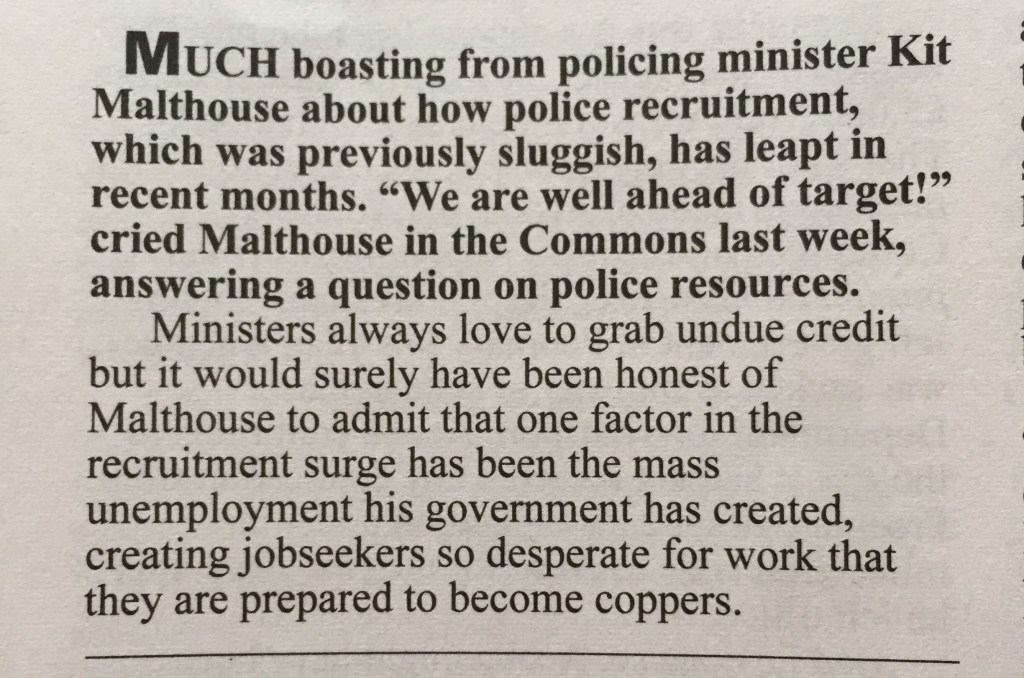
Many ticklesome articles in the new Private Eye magazine (no. 1535, 20th November 2020) including this choice one on police recruitment.

Private Eye comments on police recruitment.

As always thereโ€™s many a truth spoken in jest.

At present the workload of the average Plod would incline anyone with the ability to obtain employment elsewhere to do so. Truly a policemanโ€™s lot is not a happy one.

Nor are matters likely to improve with the new recruits when theyโ€™ve finally got some wool on their backs.

The lesson The Ministry of Justice learned to their cost was that sacking every experienced prison officer within range meant that the newer and less experienced were unable to handle the job with subtlety and skill. This caused a further recruitment problem as newly recruited staff also began to leave in droves once they realised the true horrors of the job theyโ€™d be facing daily.

So it will be with the new police recruits.

Possibly also unwise to have a large surge of untested youngsters in uniform, pumped up with testosterone and a newly-found sense of self-importance, kitted out with weaponry and the power of arrest let loose on the public.

One can only hope that new recruits will be paired with more experienced officers. But PC George Dixon is long since retired and these days six months or more in the frontline on the force and youโ€™re considered a veteran. Stay for a year and doubtless South Yorkshire Police – the force that loves to hand out awards to underperforming officers – will have a decanter set and tin plaque to pass over to you.

An additional problem. Recent reports in the local press show South Yorkshire Police and West Yorkshire Police finding themselves and their transport under severe attack on entering some estates in Leeds and Sheffield. Police cars and vans were recently destroyed as they have also been outside of Goldthorpe Police Station in South Yorkshire.

Here we can see how spirited local residents have offered their opinion on police service standards.

Can it be long before armoured โ€œsnatch squadsโ€ operating in a similar fashion to those grabbing terrorist suspects in post-invasion Baghdad are sent in to spirit suspects away from troubled estates?

So if you do see such officers on the streets soon be sure to look out for their armoured snatch too.

West Yorkshire Police: COVID-19 Super-Spreaders?

Presently the East Yorkshire city of Kingston Upon Hull has the highest COVID-19 rates of infection in the UK. The virus appears to be running rampant in the city causing a significant numbers of deaths.

The Guardian has quoted local Hull resident Gavin Storey in an article published this week. The original article can be found at:

https://www.theguardian.com/world/2020/nov/18/gypsyville-hull-most-deprived-and-covid-infected-suburbs-in-england

It states that Storey thinks it suits the ruling class have let the virus run riot through deprived communities like his. He says:

โ€œIt seems like they are trying to get rid of us. That way when itโ€™s over they wonโ€™t have to spend so much money around here. Let the kids go to school, spread it to their parents and then let them all die. Most of the people in the country who are on benefits will be dead.โ€

Twitter users react to Mr. Storeyโ€™s comments in the article.

This all got me thinking about the initial wave of the pandemic to hit the UK in spring 2020.

According to information passed over to me in a conversation in spring 2020 from one of Leedsโ€™ top criminal defence solicitors West Yorkshire Police were arresting and pulling suspects in for questioning with an urgency and speed which was quite at odds with the nature of a lethal pandemic and the requirement for people to self isolate.

Those arrested were not given masks and at that point before the end of the first lockdown self-sourced PPE was not commonly owned like today. The overall idea at that point was to protect by keeping your distance from others which makes the arrests carried out seem even more bizarre. Command Teams must have been aware of the risk of police stations as focal points for the spread of the virus. Frontline officers were of course given PPE but of dubious effectiveness which had been sold to the force, desperate to be seen to protect officers, as a โ€œjob lotโ€.

This is also unusual behaviour for a force which remains in financial dire straights considering the potential costs of increasing the pace in ongoing investigations.

Indeed I was told that at that time even people who had been released under investigation for a long period and who had no notification of progress on potential charges were being re-arrested and brought in for interview.

UK police tend to be toxic at the best of times.

In the same way as Mr. Storey thinks schools are being used to spread COVID-19 in deprived communities the sudden urge of West Yorkshire Police to pull in suspects for interview in the initial wave of a lethal pandemic seems… unsettling.


Were these actions part of a deliberate policy to assist the virus to spread in deprived communities?

Is this too outlandish an idea? Then consider also that in spring 2020 the elderly and frail were discharged from hospitals into care homes without adequate screening to ensure they were not infecting others.

The initial Government policy on the virus was to let it run through the population. This was the planning in the early stages of the UKโ€™s response until SAGE, the Governmentโ€™s scientific advisory group, suggested this strategy would lead to potential UK deaths of up to 250,000. This initial discredited strategy meant excess deaths through the initial lockdown coming too late. It is known that former Government advisor Dominic Cummings is a eugenicist who employed another advisor for a short period in February 2020 before that personโ€™s past writings in eugenics were made public leading to their dismissal.

In every one of multiple other respects the UKโ€™s response to the pandemic was lethargically slow and inept. This situation continues to this day.

The idea then that there has been purpose in the UKโ€™s handling of COVID-19 has some merit. That the initial plan to allow the virus to rip through the population is still in play but not stated openly as a matter of State policy.

It is likely then that people with either criminal records or suspected of committing a criminal offence have been considered in the same light as the fail and elderly: a potential burden to society and something best gotten rid of. That the virus provides (to the State) a convenient ability to do just this.

I know of one clear instance of West Yorkshire Police officers attending at a suspectโ€™s home without masks or PPE in May despite being aware of a vulnerable person being present at the home. Breaking subject access request laws the Right of Access Department at West Yorkshire Police have failed to release body worn video footage of this incident showing officers attending without PPE.

The theory that West Yorkshire Police were actively pulling in suspects in an attempt to spread Coronavirus around is just a theory.

But itโ€™s a theory that does seem to fit into the overall approach of the authorities towards the virus from the inept Test and Trace system to Eat Out to Help Out. All of these have assisted the virus to move through the poorer sections of the population to the point where weโ€™ve ow reached the second point of national lockdown within one year.


In South Korea there have so far been less than 600 deaths from COVID-19. Britain has (at a low estimate) 60,000 to date.

Reign of Terror: The Long Shadow of the Yorkshire Ripper

The recent death of Peter Sutcliffe (a man dubbed in the media as The Yorkshire Ripper) presents a practical public-relations problem for West Yorkshire Police. It again raises the spectre of how Sutcliffe was able to kill so many people for such a sustained period. The answers make uncomfortable truths for that force.

Sutcliffe in 1974

West Yorkshire Policeโ€™s failure to catch Sutcliffe in what was one of the UKโ€™s biggest manhunts plays a significant part in their present international reputation as a force beset by incompetence and corruption. It is a reputation with considerable justification.

Sutcliffe was not blessed with high intelligence enabling him to evade capture. Nor was he the popular fiction version of a serial killer: a creature of almost animal cunning and divine luck. Granted he was aided considerably in his activities by the relative infancy of forensics in the late 70โ€™s. But this does not tell the whole story.

For the most part the reason Sutcliffe was able to carry on killing was down to long-identified administrative and operational failures on the part of the police. He is known to have been interviewed several times by officers in the course of their investigations but each time was discounted for further investigation. Other operational errors are known to have included an excess of paperwork generated in the course of the investigation. Detectives were hindered rather than helped by the weight of data generated and the primitive storage of such.


I would argue another failing contributed to the deaths of thirteen women. This is that police officers both at the time and now have a particular mindset which pre-disposes them towards both a closed minded approach to investigations and a form of โ€œtunnel visionโ€. This comprises some of the issues Iโ€™ll discuss below.


Personal characteristics

To start with itโ€™s popularly said that a Yorkshireman is a particular sort of stout character. Gruff, uncommunicative and 100% convinced heโ€™s right in the face of all opposing evidence. Bluff and stiff-necked. The Harry Enfield comedy version of a Yorkshireman isnโ€™t far from the mark. You know as well as I do the popular stereotype. For some reason beyond my capacity to fathom West Yorkshire Police provides a home to people very much of this mindset: there is a poisonous organisational culture which incubates some undesirable personality characteristics.

โ€œAhโ€™ll say what ah bloody well like!โ€

Consider the absolute certainty with which the senior officer in the Sutcliffe investigation, George Oldfield, was sure the killer was the voice on the Weirside Jack hoax tape is a tragic example of this unwillingness to admit to error once a set path has been taken. In the police both of the 70โ€™s and today face-saving is also a strong motivating force. Especially so when consistent underperformance or failure are likely to result in downgrade to civilian worker status.

A former Australian Director of Public Prosecutions Nicholas Cowdry produced a book called โ€œGetting Justice Wrongโ€ in which he argued that tunnel-vision on the part of officers (…he must have done something even if we canโ€™t get him on what weโ€™ve arrested him for!) plays a significant part in police failures. Tie this into the inability to admit to errors being make and youโ€™ve an already toxic mix.

The โ€œrightโ€ sort of victim

Sutcliffeโ€™s first few murders were women largely at the margins of society. It is only with his killing of Jane Macdonald, a shop worker, in 1977 that the investigation increased in speed and urgency. This was partly in response to media pressure. But police then and now categorise crimes reported to them in an internal value system based partly on the perceived โ€œworthโ€ of the victim in society (socio-economic status etc). Sutcliffe attacked a young woman outside of Bradford in 1974 who sustained horrific injuries but police handling of the complaint and their investigations were at best suboptimal. The same occurred later when he attacked a lady who was a member of the BAME community in Leeds. Her complaints were โ€œcuffed offโ€ (to use the current parlance of West Yorkshire Police) rather than investigated. it is likely because of her background and low educational attainment that she was not considered a significant enough figure for her complaint to be deemed โ€œworthโ€ investigation.

Presented without comment. BBC News report on the day Sutcliffeโ€™s death was announced.

The โ€œrightโ€ sort of crime

Easy to solve crime is preferred. Especially if itโ€™s hitting targets or addressing an issue of public concern. More complex investigations are likely to be shunned on the basis of the time, expenditure and difficulty of prosecuting successfully. Then and now police have one eye on the crime statistics and are more likely to address issues of public concern based on recent media exposure of such crimes. Thereโ€™s a reason The Serious Fraud Office are so notoriously unsuccessful despite The City of London being rampant with financial corruption. In the matter of the Sutcliffe investigation it is arguably only when he began to operate outside of the red light areas from 1978 onwards that the police ramped up efforts due to increased public concern. This public concern increased again from 1980 onwards.

Conclusions

Ultimately Sutcliffe was caught by sheer luck and the most basic of police work.

He was picked up by uniformed constables from South Yorkshire Police in a situation in which he was likely preparing to kill again. Having disposed of his weapons behind a toilet cistern under the pretext of needing to urinate it is the quick-thinking of a South Yorkshire PC which led to the discovery of the weapons and the eventual confession of Sutcliffe that he was the killer.

The hugely expensive and lengthy investigation by West Yorkshire Police had been an excruciating waste of time and money. Arguably by tying itself in knots by a combination of weak administration and blinkered mindset the investigation had allowed Sutcliffe to carry on killing.

Serial killers are thankfully exceptionally rare and unusual. The advances in forensic technology and other policing methods in the forty nine years since he was caught render another Yorkshire Ripper type of killer thankfully even less likely.

However a weak spot remains in the mindset and attitude of police officers as I have discussed. Then and now significant barriers exist in investigations due to habits itโ€™s almost impossible for police officers to break. This is partly fostered by an inherited organisational culture and thus will remain with us for some time yet.

Malfeasance at the Office of West Yorkshire Police and Crime Commissioner

The West Yorkshire Police and Crime Commissioner is Mark Burns-Williamson, a largely gaff-prone failed politician. Heaven knows thereโ€™s sufficient data out there in the public domain to show that by any stretch of the imagination the man is unsuited to any role requiring public trust.

My favourite one details how he sent an inadvisable letter in a โ€œlove triangleโ€ which would ordinarily have rendered him open to criminal prosecution. This was however covered up by West Yorkshire Policeโ€™s (then) DCI Simon Bottomley leading to the eternal gratitude of Burns-Williamson to the force he is supposed to scrutinise.

It also appears his office is prepared to manipulate and ignore facts to protect the very organisation it should be holding to scrutiny.

This blog entry tells the story of one such incident.

Burns-Williamson demonstrates the degree to which he hold the local force to scrutiny.

In May 2020 The Ministry of Justiceโ€™s Data Access Office sent data to a person (who we will call the recipient) in error.

This data was information on a third party who lived in the London area. This amounted to a serious data breach as the disclosure included the subjects name, address, date of birth and bank account details etc. as well as other disclosures regarding a series Proceeds of Crime Act proceedings against the data subject.

The recipient of the data informed The Information Commissionerโ€™s Office and The Ministry of Justice as well as the data subject whose information had been disclosed. He also posted regarding this on Twitter but did not reveal any confidential information in so doing.

Data Access at MoJ requested the recipient remove the mocking tweet. The recipient of the data refused citing his freedom of expression under The Human Rights Act and that no offence in civil or criminal law had been committed by the tweet.

Three days later the recipient of the data was arrested at his home by West Yorkshire Police on the basis that he had breached The Data Protection Act. The allegation being that he had shared the confidential data sent to him in error on Twitter.

This was palpably untrue as an examination of the tweet would have confirmed. However police did not examine the tweet for themselves but took it โ€œon trustโ€ from MoJ that a supposed offence had taken place. Of course it hadnโ€™t but MoJ were burning with indignation that a serious data security error had been made public and to their official regulator on data matters the ICO.

Police were aware that no offence had occurred.

The bar for arrest for any offence is set very high as recent cases such as Rachid v. The Chief Constable of West Yorkshire Police (2020) show. Instead police took it on trust from The Ministry of Justice that an offence had occurred in a situation in which the Security Manager for MoJโ€™s correspondence (seen by this blogger) reveals his desire to give the recipient โ€œa nasty shockโ€.

The recipientโ€™s home was entered by police on his arrest. In the middle of the Spring 2020 pandemic a vulnerable family member who was shielding was subject to interaction with police who did not wear PPE or take any form of precautions regarding introducing COVID-19 infection into the home. Electronic devices were removed and the home was ransacked in the search. The officer leading this was PC Alan Jackson. Police actions amount to trespass to property (since there were no reasonable grounds for arrest) alongside trespass to goods and wrongful arrest.

The home of the recipient of data was raided by police without PPE in the middle of the spring pandemic.

Predictably no charges were brought. Emails seen between the Officer in Charge (OIC) and The Ministry of Justice reveal MoJ immediately loose interest when the recipient was arrested which fits in with the prior email claiming MoJ wanted to give him a nasty shock. No further action resulted to the recipient from either Police or MoJ.


A complaint was duly made by the recipient to West Yorkshire Police Professional Standards Department (PSD). Their internal investigation under The Police Reform Act 2002 confirmed – but only internally to the police – that the arrest was wrongful on the basis that WYP had not seen or been provided by MoJ with any indication that a criminal offence had taken place. Other aspects of the complaint made were ignored by PSD and not investigated.

An organisation such as West Yorkshire Police which has an international reputation for both corruption and incompetence needs to be able to head off complaints and minimise them early on. The investigation concluded in a document called an Assessment and Progress Log that there had indeed been no reasonable grounds for arrest, therefore logically the arrest was unlawful. This document was an internal document not for public or complainantโ€™s consumption.

Police of course cannot admit that they have erred to the complainant. It opens the door for civil action for wrongful arrest and payment of compensation. It also amount to loss of professional reputation.

Thus the results of the PSD investigation which were presented to the complainant in August 2020 were totally at odds with the actual true findings of the investigation. The official line was that nothing untoward had occurred and that the arrest was legitimate: the unseen internal report stated quite the opposite. A copy of this report has since been obtained from WYP and examined.


If you find that the above shocks you then I would respectfully point out you may have little experience of the police complaints process and the extent to which it seeks to hide the conduct of misconducting and underperforming officers.


The complainant found some 21 issues with the PSD investigation response which were either suboptimal or evaded examination of the facts. Of course if youโ€™re prepared to commit mendacity on such a scale as a police complaints office then itโ€™s best to keep any communication simple. The response provided by PSDโ€™s Vicky Silver was clearly exceptionally evasive and the errors in it were manifest.

Police Professional Standards Departments go to any length to dismiss valid complaints.

The complaint was progressed as an appeal to The Office of The Police and Crime Commissioner for West Yorkshire, this being a body with supposed oversight of the local force. Karen Gray at PCC was tasked with the examination of the appeal.


It is a basic element of any investigation that the investigator should have access to all of the data available to be able to reach a reasoned conclusion. This is common sense. In the course of the PCCโ€™s investigation they either failed to obtain copies of documents such as the PSD Assessment and Progress Log or else were provided with a copy of the relevant data but chose to ignore it in favour of a rubber-stamped approval of the earlier PSD investigation.

Thus the office of West Yorkshire Police and Crime Commissioner have shown themselves to be either as throughly dishonest or professionally incompetent as the police force they are supposed to supervise. Further they are prepared to support the local force in their dishonesty.

A further complaint was made regarding the failure of the PCC to obtain all relevant data meaning that the Karen Gray investigation was fundamentally flawed. This was responded to more recently by PCCโ€™s Jane Owen who has stated that Karen Gray could not have been aware of the Assessment and Progress Log on the basis that it was produced after the conclusion of the original PCC review.

However the document in question from PSD is dated 5.6.20.

Therefore it was produced BEFORE the complaint was referred to PCC by around two months. The response that it was not available in the original PSD investigation is therefore an outright lie.

It is of course inconceivable that an investigation properly conducted would not have requested a copy of, assessed and examined the PSD Assessment and Progress Log which was in existence by this point and therefore PSDโ€™s position that Karen Gray had access to all of the required documentation to enable correct conclusions is not only incorrect but also deliberately misleading.

The essence of the complaint to PSD regarding wrongful arrest etc. was proven – as that office was well aware – by 5.6.20.

All subsequent efforts of PSD and the office of the PCC for West Yorkshire have sought to bury the facts under an increasing mound of guff and nonsense.

PSD chose to issue a response completely opposite to the facts they had themselves established and The Office of The Police and Crime Commissioner has assisted them in this cover-up and continues to do so.

In a desperate final attempt to avoid further scrutiny Jane Owen writes:

I have concluded that you have used the Office of the Police and Crime Commissionerโ€™s complaints process to try and change the outcome of your complaint… and the subsequent review undertaken by this office but โ€“ in line with the statutory guidance that has been issued that sets out how reviews have to be handled – you do not have a further right of review


Is it any wonder that both West Yorkshire Police and The Office of the Police and Crime Commissioner have such a poor reputation both locally and nationally?

Certainly both are prepared to bend the truth into impossible angles to avoid any admission of error or loss of professional reputation. Perversely this ends up in a situation as described above in which loss of face and reputation end up occurring both from the original issue and the labyrinthine efforts made to conceal it.


Design a site like this with WordPress.com
Get started