
Elder Abuse? Social Worker Coverup in Evidence to The High Court


This article, as seen below, was originally printed on this blog in August 2022.

Following an application made in September 2022 by the legal firm Weightmans of Liverpool at The High Court the blog was temporarily removed.

It is clear why the firm wished to remove the contents of this post. This is because they intended to commit significant malpractice towards Mrs. X, the subject of legal action brought by the firm on behalf of Wakefield Council as can be seen in a new blog entry which can be found at:

https://legalbabble.law.blog/2023/06/27/what-is-the-cost-of-a-human-life-in-modern-britain/

That entry details matters in more depth. The data seen here shows the position as of mid-2022 before the more significant misconduct carried out against Mrs. X took place.
The level of professional misconduct by the firm alongside the negligent handling of the case by the Court, who were well aware Mrs. X had protected characteristics and suchlike, led directly to the death of Mrs. X in February 2022. I have, therefore re-published this blog post, and it should be read in conjunction with the more recent post, the link to which can be seen above.


The position of Social Worker provides unique opportunities to the holder of such a post.

People who have a manipulative desire to insert themselves into the lives of others for malignant intent have a golden set of opportunities in such as social work.

When such a person is found out there is invariably an attempt to cover up their tracks. Often assisted by the Local Authority that employs them.

Just such an incident is the subject of this blog post.

In this post you will learn of the efforts of a social worker from Wakefield District Council to harass an elderly person within their region and the subsequent medical effects of the harassment on the elderly person. For the purpose of this we shall call her Mrs. X.

Youโ€™ll also see how the social worker then attempted to lie regarding communications with the elderly persons general practitioner.

Most damningly the social workerโ€™s lies appear in a statement to the High Court made in order to try to cover up her actions and distance herself from being the cause of Mrs Xโ€™s subsequent deterioration.

Joanne Cave is a social worker for Wakefield District Council.

There have been a series of errors, omissions and malpractices from Wakefield District Council Social Services over a period of time lasting more than a year. Mrs X, the pensioner concerned, has had to suffer a series of significant errors in documentation created by the council, and the creation of reports by social services which failed to properly mention Mrs Xโ€™s medical conditions in order in part to deny her access to council services.

The Council has also sought to withhold documents requested as part of subject access requests and mishandled applications for such as discretionary disregard. In short Mrs X has been subject to appalling service by Wakefield District Council who refuse to accept responsibility for such.

An NHS assessment of Mrs. X in May 2022 at which social worker Joanne Cave was also present was the turning point for this.

This assessment showed that the prior reports written by social services at Wakefield District Council which failed to mention Mrs Xโ€™s medical conditions were clearly factually incorrect and that the medical conditions suffered by Mrs X are severe and have a significant effect on her quality of life.

Mrs X commenced series of legal proceedings regarding the council over such matters as their failure to correctly record data on her. Social worker Joanne Cave rang Mrs X to ask her questions about such legal proceedings and did so in such a way as to place Mrs X under undue stress and anxiety.

You may well wonder why a Social Worker was ringing to question someone under their care about legal issues and the claim they were bringing when Wakefield District Council has its own legal representation employed to do such things.

Social worker Joanne Cave and her immediate superior Mehmun Nessa were aware that these calls were placing Mrs X under undue stress and causing anxiety. This is clear from the content of a separate statement to The High Court not included here.

This does not stop them calling Mrs X on three separate occasions however to ask about legal proceedings Mrs X brought.
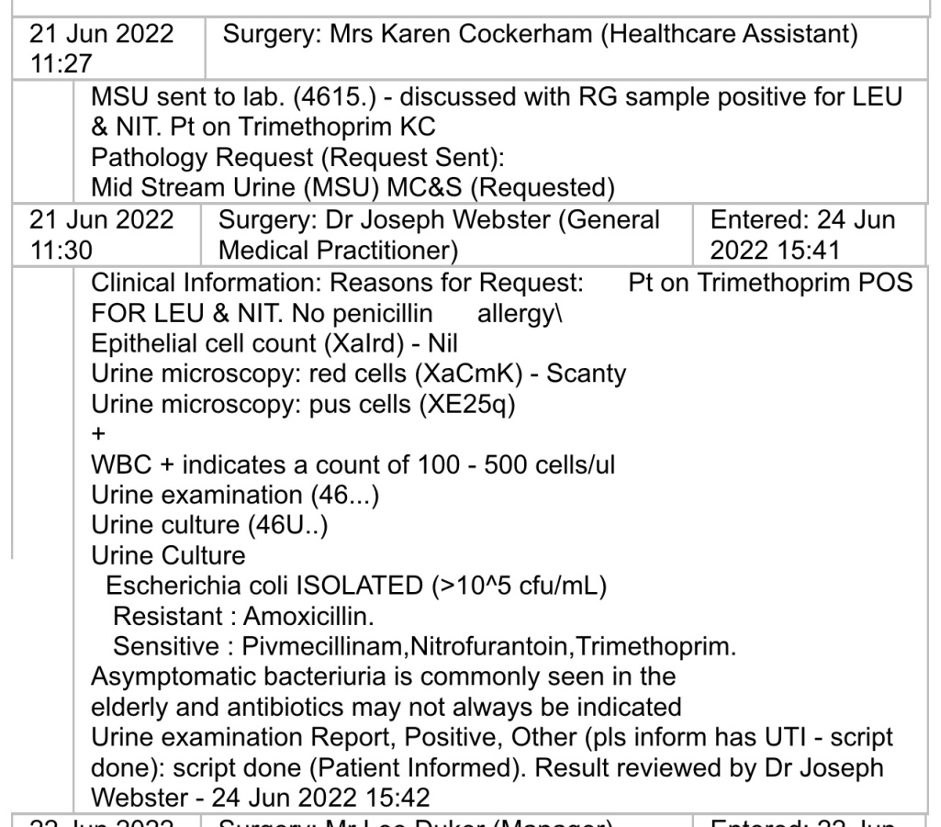


Medical report showing UTI contracted in the immediate aftermath of the call.

Because of a frail health suffered by Mrs X the stress she was placed under by the initial phone call from Joanne Cave induced in her a urinary tract infection which has since led directly to a permanent nocturnal incontinence. This can be seen in the above medical report. The UTI was contracted immediately following the phone call as a result of worry and anxiety caused by it.

Above is an extract from the GPโ€™s medical report showing this UTI. As stated during this call Cave attempted to question Mrs X about legal proceedings, putting her to great distress and anxiety.

As a result of this a complaint was made to Social Care Complaints at Wakefield District Council. The council acted immediately on this complaint By deciding to ignore it and refusing to take any action.

However Joanne Cave herself was made aware of the terms of the complaint by Social Care Complaints and attempted to contact Mrs Xโ€™s GP to determine the extent of the urinary tract infection caused by her oppressive and distressing phone call.
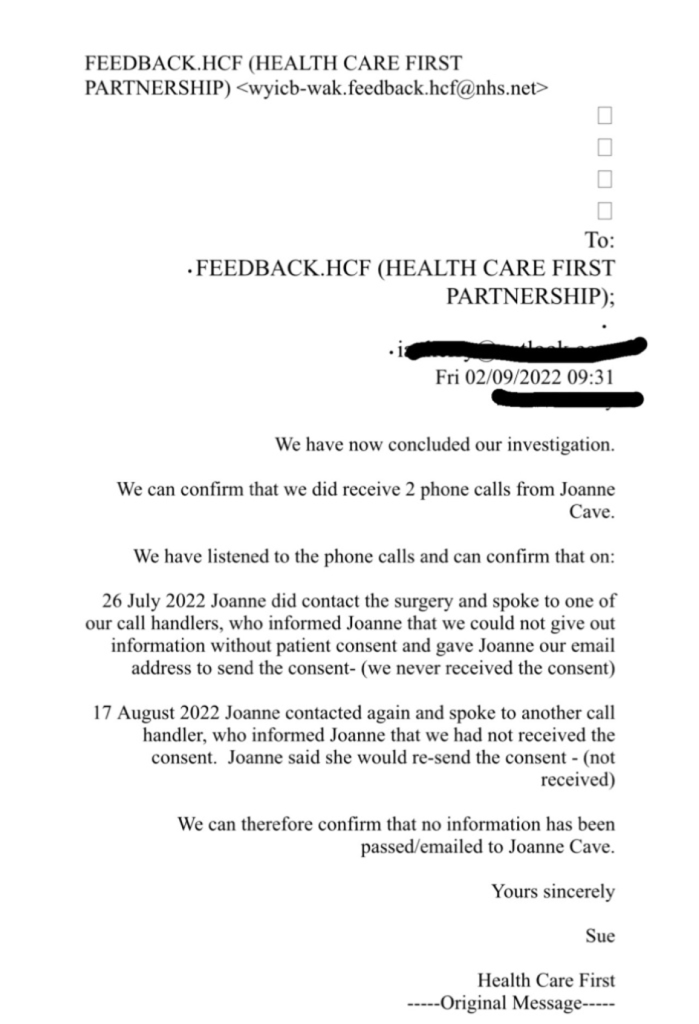
Email from the GP practice confirms no data was passed to Joanne Cave.

It is clear from the data above that social worker Joanne Cave attempted to obtain information on the medical situation regarding the UTI from Mrs Xโ€™s GP.

However this was not obtained as Cave failed to obtain or to supply copies of any form of authority and indeed no authority to access her medical records was given by Mrs X.


What are the significant errors in Caveโ€™s statements to the court?

 Cave tactically lies in her statement and claims the contact with the surgery for help came 31.5.22.

The medical record show the matter was actioned by a GP on 24.5.22. This is to minimise her involvement in the UTI contracted by Mrs X. There is no other reason Cave would have miss-reported the date of the call for help by Mrs X to the GP.

 Cave purposefully states that Mrs X was seen in the surgery. This is clearly incorrect.

 Cave claims she emails the surgery twice.

This is not the account given by the surgery. They do not state an email was received. Instead they explicitly state no email was not received. Cave claims they were emailed twice. No copy of any consent was received by the surgery. This is clear.

 Cave seems to claim asking the surgery to contact Mrs X on her behalf.

The surgery did not make contact with Mrs X or relatives in respect of any matter related to Caveโ€™s call to them.

 The dates of calls etc. given in the surgery email and Caveโ€™s statement are also inconsistent.


The content of the GP email seen above are clear on this. Joanne Cave appears to have acted to mislead The High Court.

The issues are now clear. Joanne Cave sought to mislead the Court in respect of information passed over from Mrs Xโ€™s GP.

There are numerous claims across each of Caveโ€™s two statements to The High Court regarding dates of calls with the GP and data passed over. Invariably these claims seek to put the date of the UTI contracted outside of the timeframe around the call made by Cave to Mrs X.

But regardless of the distress and medical effects caused by the first call a second call from Joanne Caveโ€™s supervisor Mehmun Nessa was made in July 2022 and then a further call from Cave herself in August. A statement provided in proceedings by Cave makes is clear Wakefield Social Services are aware of the distress this places on Mrs X.

In statements to the High Court Cave have sought to mislead regarding information passed over by the GP surgery. That the surgery is clear that no information was passed over and no forms of authority were returned.

Joanne Caveโ€™s assertions in her statements regarding data passed over by Mrs Xโ€™s GP are therefore total fabrications.

Recordings made by the GP surgery confirmed this, and the surgery itself confirms that no data was passed over to social worker Joanne Cave.

Itโ€™s clear then that Joanne Cave has misled the court in her statements. This amounts to perjury, misconduct in public office and an attempt by Cave to absolve herself of any responsibility for inducing in Mrs X a urinary tract infection in May 2022.

That anyone should lie in a statement in court is a serious matter. Any person doing so has committed perjury and is liable to find themselves in contempt of court for such behaviour. Generally we would expect that anyone acting as a social worker, who has regular and frequent contact with the vulnerable, the confused and the easily harmed should hold themselves to higher standards.

In this matter Joanne Cave rang Mrs X in May 2022 to attempt to obtain information which was related to legal proceedings. This is clearly not her job as a social worker but Mrs X was more likely to โ€œlet her guard downโ€ with such a person than if a solicitor called. In order to be able to discuss these mattes with Mrs X Cave began the conversation on a separate matter, discussing any care that Mrs X may want and her medical needs. Joanne Cave then began to broach the subject of civil legal issues causing Mrs X distress and anxiety. This a direct cause of a UTI and subsequent lasting nocturnal incontinence.

Mrs X is currently therefore worse off medically and in terms of her health and well-being as a result of contact with Wakefield Social Services.

In happier days a Social Worker would not lie to a court in order to try to cover up the fact of their own misconduct toward a client.

These are not happy days. These are days in which people who work for large organisations will lie, conceal, dissemble and manipulate in order to cover up facts around their own professional misconduct and incompetence.

Joanne Cave, Social Worker for Wakefield District Council has been thoroughly and completely caught out on this matter.

Will we have to wait too long to see the effect of any internal investigation into the provision of knowingly incorrect data in court proceedings by Wakefield District Council? An internal investigation as been requested but those familiar with this Councilโ€™s propensity for dissembling, hand-wringing and wrangling would be wise not to hold their breath.


HMCTS Under Fire From The Information Commissionerโ€™s Office. Again!

Hard to think of two more poorly run institution than HMCTS and itโ€™s parent
organisation The Ministry of Justice.

This is a very simple post detailing a simple but significant error. So no lengthy explanation as to whatโ€™s happened on this occasion!

HMCTS shared my personal financial details with a third party.

Thatโ€™s it. Thatโ€™s basically all that can be said in the post.

But wait!

Stop and think for a few moments and we can see this is matter is actually considerably more significant and serious than it first looks.

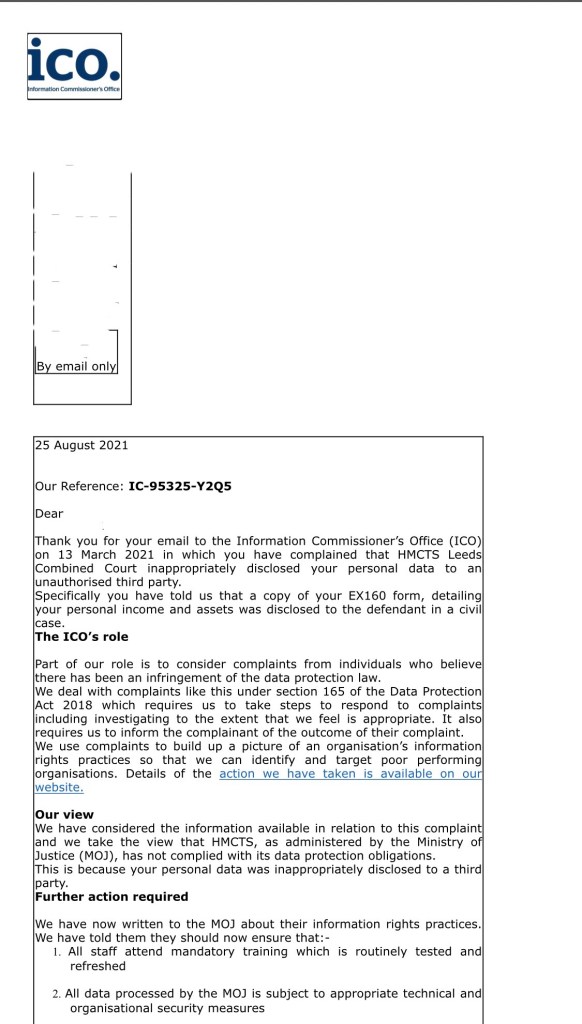
The letter from The Information Commissionerโ€™s Office (ICO) finding against HMCTS can be seen below.

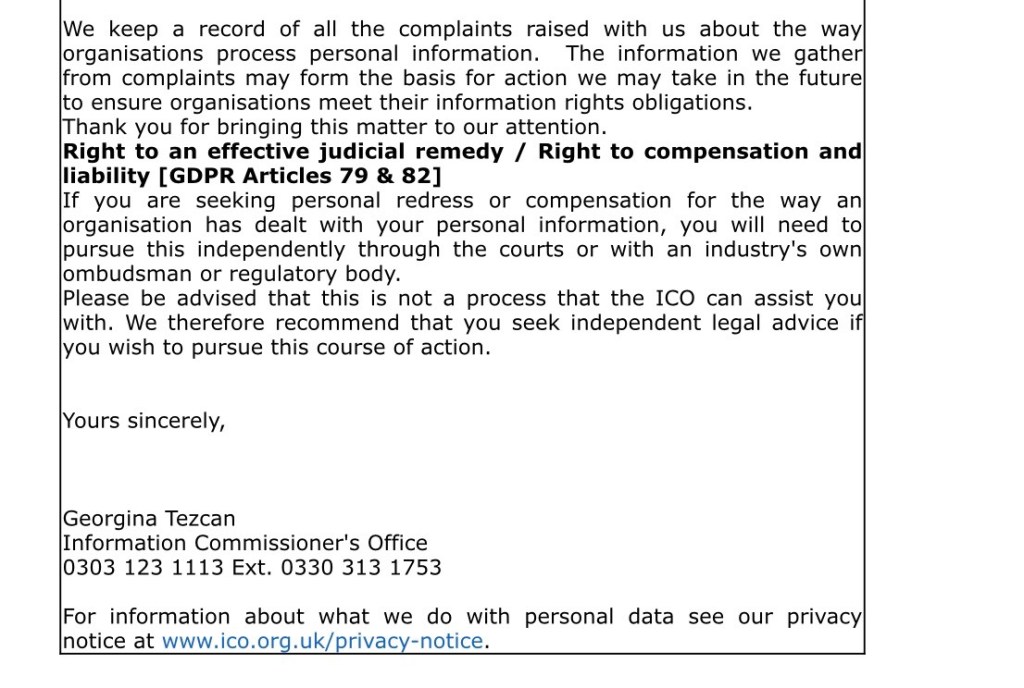
But the operative paragraph from it is simple and plain:

The nub of the issue.

Why should this matter?

Personal data in the care of such as HMCTS and MoJ has the potential to cause significant damage if released inappropriately. Release to a third party with no requirement for or rights to such data can and does cause significant issues.

The simple fact is that the incompetence of County Court staff knows no bounds.

Indeed the vindictiveness of their management towards anyone who has received appalling service from HMCTS also knows no bounds. In this matter an out-of-court settlement was agreed upon to be paid fourteen days from the agreement. Some three months after this agreement I was still awaiting payout.

HMCTS and MoJ are simply two organisations which have ceased to function in any meaningful way and the amount of time spent on damage limitation, denying errors have occurred and attempting to maintain an image of professionalism would be better spent actually running courts efficiently in the first instance.


How Ministry of Justice Evades Data Access Requests

A request was made in August 2020 for data from a subdivision of The Ministry of Justice. The response (issued outside the time limits for such in law) stated:

This is actually a two-headed matter. A complaint of poor service thrown in with a data access request for the data which proves the grounds of the complaint are correct and that multiple errors occurred. Needless to say the subdivision ignored the complaint and requested I make the data access request to London, as seen above.

You will see how this letter refers me to Data Access office as being the correct source of the data required. So Data Access were contacted in late September 2020 and the data again requested from them.

Some five months later and several chase-ups by email and Data Access deny they are the source of the data. The data is apparently best obtained from the office I originally wrote to.

There is little that can be said for this game of piggy-in-the-middle except to say that I will not play it.

The source of the apparent information that they cannot fulfil this data access request are unnamed โ€œsenior managers” whose details I have requested. Odd how itโ€™s always some unnamed person as the source of an instruction that sends the public on a wild goose chase.

The disclosure team for MoJ are ultimately responsible for the production of data access requests made to sub departments within MoJ. The requests made in mid-2020 are indeed data access requests. They seek specific data and this is clear from the requests themselves. It is the job of Disclosure Team to work with the sub department of MoJ I first communicated with to obtain the data from them and then relay it to me.

It looks very much like both offices are attempting to evade the production of data via a game of piggy-in-the-middle and delay. Unsurprisingly the subsidiary office originally contacted has failed to respond to the initial complaint linked to this data request.

This request has been before Data Access office since September 2020 and has only just received the response of “go back to the start”. Taking this delay in response alone as a single issue would render the handling of the request wholly unacceptable and a breach of the relevant law.

By seeking to frustrate the request in this way The Ministry of Justice has earned itself a referral to The Information Commissionerโ€™s Office.


Daylight Robbery! How Police Evade Accountability on Data Access Requests

In a November 2020 report The Information Commissioner (or ICO) wrote the forward to a report and stated:

โ€œIt is my hope that police forces, and other organisations, will read this report, understand their current position and identify actions they can take to improve or maintain good performance. We will continue to work with the police to support their compliance with information rights laws.โ€

Some hope of that!

When the Commissioner wrote of โ€œtheir current positionโ€ she was using soft-soap language for what would have been more accurately described as clear flouting of the law and institutional efforts to evade disclosure of information.

The full report can be read at https://ico.org.uk/media/action-weve-taken/reports/2618591/timeliness-of-responses-to-information-access-requests.pdf

A copy of the title page of the report.

Letโ€™s take a look at West Yorkshire Police as being a recent example of this failure to comply with both the law on data access requests, ICO guidance and their general obligations to maintain good relations with the public.

The Office of The Police and Crime Commissioner for West Yorkshire has for some months now been aware of suboptimal handling of data access requests by West Yorkshire Police. They have noted an increasing number of complaints from members of the public about poor service and inadequate provision of data by Information Access departments at that force.

A Professional Standards Department investigation into a complaint brought by a member of the public that subject access requests made had been delivered late, were missing data and had been purposefully frustrated by police was mishandled by Professional Standards Department. The Office of The Police and Crime Commissioner for West Yorkshire (the PCC) found that the investigation had been substandard in several areas.

As per usual for a police Professional Standards Department the conclusion to the investigation ran along the lines of โ€œWe have investigated ourselves and found nothing wrongโ€. This outcome is usually achieved by PSD adjusting the frame of reference to the complaint to disregard all that inconvenient evidence that proves the complaint is correct. This indeed appears to have been done in this instance.

Accordingly PCC wrote in their examination of the complaint handled by PSD:

โ€œThe decision I have reached is that the outcome of the complaint was not reasonable and proportionate… [that a proper complaint investigation involved] Full consideration of the Information Management Departmentโ€™s handling of [the complainants] requests over the last year, including all the ones he brought to the complaint handlerโ€™s attention and the involvement of the ICO in those requestsโ€

Which is as I stated: police complaints department ignoring evidence which proves the force has misconducted itself.

PCC wants a re-examination of major aspects of the complaint and also wants to see:

โ€œFull consideration of the wider context concerning the timeliness of replies to Subject Access requests by West Yorkshire Police, including the engagement with the ICO. This should take into account the findings and recommendations from the ICOโ€™s report from November 2020 โ€œTimeliness of Responses to Information Access Requests by Police Forces in England, Wales and Northern Irelandโ€

…in other words the report I referenced above.

This is to say the least mildly inconvenient for police. An examination of the timelines for a dip-sample of data access requests made (but not fulfilled on time) is one of the easiest ways to see that police have broken the law in relation to these requests.

But of course if West Yorkshire Police were to investigate themselves and report to PCC the errors made in supplying data requested by members of the public then it would be impossible to hide the scale of information deliberately hidden.

So the response of Rene Prime, Reviewing Officer at Professional Standards Department to PCC states:

โ€œUnfortunately, I do not agree with the actions you propose should be taken to resolve the complaint. I agree that full consideration should be given to [the complainantโ€™s] contact and requests to Information Management over the last year and the issues that have arisen around those requests, however I do not consider that it is appropriate to consider the wider context of perceived issues within the Information Management Team.โ€

Which is as slippery a way as can be found to avoid PCC discovering the full extent of West Yorkshire Policeโ€™s efforts to evade the production of data requested by members of the public. This reply also in effect โ€œcuffs offโ€ (to use a West Yorkshire Police term) the recommendations of PCC which have been made in the light of the many other individual complaints from members of the public regarding failed data access requests.

The standard approach to data access requests made by police forces is not compatible with legislation allowing the public access to data.

Secretive, evasive and mendacious: police hate requests for information from the public.

Instead they seek to frustrate access requests, deny even the production of non-contentious materials and in most cases seek to delay the production of data beyond time limits in law so that the requester will be liable to forget all about the request and go away. At all stages the intention is to frustrate, vex and delay. This is often because the police operational mindset is focused towards evading any form of insight into their working practices or accountability. Ergo the more the public get to know about police methods and actions by data access requests the less the freedom for police to do more or less as they wish. An informed public is aware of the abuses of power and the bending of the law that the police perform daily.

The above correspondence gives you something of an insight into the attempts police make to avoid production of data which would make them accountable. This time last year the police complaints process was subtly changed to make the local PCC engage more with appeals into poorly handled complaints. It will be interesting in the light of the above to see if West Yorkshire Policeโ€™s PCC has the guts to challenge ongoing breaches of the law over data access requests to West Yorkshire Police.

The Information Commissionerโ€™s Office: Mark Your Own Homework

The rights of the public in the UK to access data held by state-run organisations are enforced by The Information Commissionerโ€™s Office. I say enforced but effectively unless thereโ€™s a very significant series of large-scale errors or deliberate mischief ICO chooses to look the other way.

Theyโ€™ll more often choose to look the other way in the event that the miscreant organisation is a public body: a large-scale data breach by the NHS in 2017 / 2018 attracted only a note from ICO to NHS Digital gently chiding their error.

Some of the means of looking the other way include ICO issuing a โ€œfindingโ€ that the organisation youโ€™ve requested data from has failed to comply with the law, or a โ€œrecommendationโ€ that that misconducting organisation complies with the law. Neither of these two results has sufficient force to compel a turnaround from the data controller if theyโ€™re determined to dig in their heels. None of these weak regulatory methods described above actually produce the data youโ€™ve requested: if the organisation is sufficiently obstreperous youโ€™ll need to enforce your right of access to the data via civil legal action.

Yes, folks. Youโ€™ve guessed it! Another supposed โ€œwatchdogโ€ that turns out to be toothless, doddering and tame.

At the beginning of the pandemic hitting the UK in March 2020 ICO issued guidance to organisations over handling data access requests which effectively boiled down to โ€œdonโ€™t misuse the fact that thereโ€™s a national emergency to get around your statutory obligationsโ€.

Eight months on and the initial finger-wagging approach has been replaced with a new edict from ICO: mark your own homework.

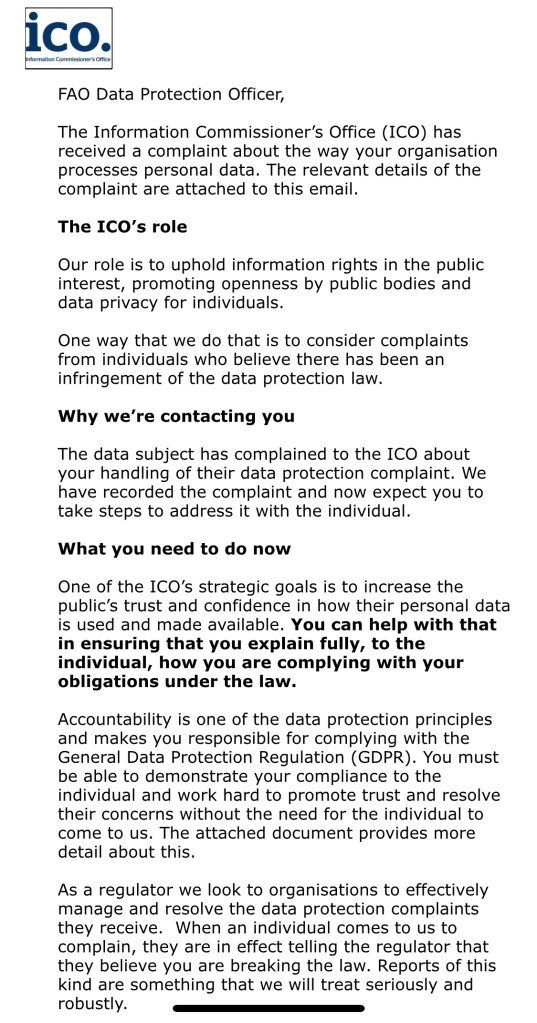
Organisations that infringe the law on data access issues are now routinely in receipt of this standard form letter the first page of which appears below:

Easier than enforcing the law: ICO states the bleeding obvious to data controllers breaching the law.

The โ€œseriously and robustlyโ€ in the above extract doesnโ€™t apply to any actions ICO have taken in my experience of the organisation. Even in the face of large scale data breaches for which ample evidence of a data subjectโ€™s Section 173 rights being infringed exists ICO still takes the lethargic approaches mentioned above.

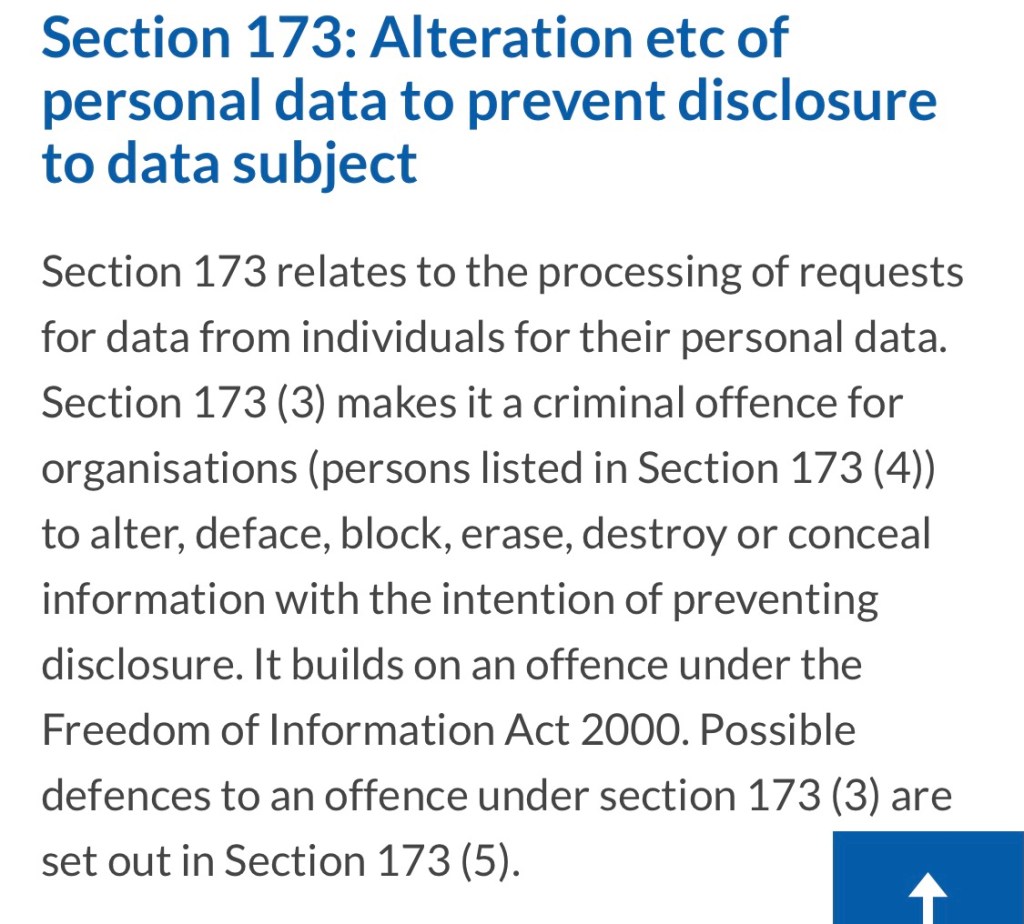
Briefly yours and my Section 173 rights are this:

Extract from CPS website.

The letter sent out by ICO continues:

…all of which explains the obligations on an organisation that they are already / should already be aware of.

One wonders what the point is of informing an organisation thatโ€™s already purposefully screwed up such as a subject access request what their obligations are. If the body is determined to withhold data for the purpose of – for example – preventing revelation of their own misconduct then a weakly worded letter from ICO will not make them correct their ways.

Misconducting organisations must be quaking in their boots regarding the powers and sanctions bit in the second to last paragraph, knowing ICO is notoriously weak on enforcement.

Thus the Merry-Go-Round of the UKโ€™s weak regulatory and enforcement structure rumbles on.

Malfeasance at the Office of West Yorkshire Police and Crime Commissioner

The West Yorkshire Police and Crime Commissioner is Mark Burns-Williamson, a largely gaff-prone failed politician. Heaven knows thereโ€™s sufficient data out there in the public domain to show that by any stretch of the imagination the man is unsuited to any role requiring public trust.

My favourite one details how he sent an inadvisable letter in a โ€œlove triangleโ€ which would ordinarily have rendered him open to criminal prosecution. This was however covered up by West Yorkshire Policeโ€™s (then) DCI Simon Bottomley leading to the eternal gratitude of Burns-Williamson to the force he is supposed to scrutinise.

It also appears his office is prepared to manipulate and ignore facts to protect the very organisation it should be holding to scrutiny.

This blog entry tells the story of one such incident.

Burns-Williamson demonstrates the degree to which he hold the local force to scrutiny.

In May 2020 The Ministry of Justiceโ€™s Data Access Office sent data to a person (who we will call the recipient) in error.

This data was information on a third party who lived in the London area. This amounted to a serious data breach as the disclosure included the subjects name, address, date of birth and bank account details etc. as well as other disclosures regarding a series Proceeds of Crime Act proceedings against the data subject.

The recipient of the data informed The Information Commissionerโ€™s Office and The Ministry of Justice as well as the data subject whose information had been disclosed. He also posted regarding this on Twitter but did not reveal any confidential information in so doing.

Data Access at MoJ requested the recipient remove the mocking tweet. The recipient of the data refused citing his freedom of expression under The Human Rights Act and that no offence in civil or criminal law had been committed by the tweet.

Three days later the recipient of the data was arrested at his home by West Yorkshire Police on the basis that he had breached The Data Protection Act. The allegation being that he had shared the confidential data sent to him in error on Twitter.

This was palpably untrue as an examination of the tweet would have confirmed. However police did not examine the tweet for themselves but took it โ€œon trustโ€ from MoJ that a supposed offence had taken place. Of course it hadnโ€™t but MoJ were burning with indignation that a serious data security error had been made public and to their official regulator on data matters the ICO.

Police were aware that no offence had occurred.

The bar for arrest for any offence is set very high as recent cases such as Rachid v. The Chief Constable of West Yorkshire Police (2020) show. Instead police took it on trust from The Ministry of Justice that an offence had occurred in a situation in which the Security Manager for MoJโ€™s correspondence (seen by this blogger) reveals his desire to give the recipient โ€œa nasty shockโ€.

The recipientโ€™s home was entered by police on his arrest. In the middle of the Spring 2020 pandemic a vulnerable family member who was shielding was subject to interaction with police who did not wear PPE or take any form of precautions regarding introducing COVID-19 infection into the home. Electronic devices were removed and the home was ransacked in the search. The officer leading this was PC Alan Jackson. Police actions amount to trespass to property (since there were no reasonable grounds for arrest) alongside trespass to goods and wrongful arrest.

The home of the recipient of data was raided by police without PPE in the middle of the spring pandemic.

Predictably no charges were brought. Emails seen between the Officer in Charge (OIC) and The Ministry of Justice reveal MoJ immediately loose interest when the recipient was arrested which fits in with the prior email claiming MoJ wanted to give him a nasty shock. No further action resulted to the recipient from either Police or MoJ.


A complaint was duly made by the recipient to West Yorkshire Police Professional Standards Department (PSD). Their internal investigation under The Police Reform Act 2002 confirmed – but only internally to the police – that the arrest was wrongful on the basis that WYP had not seen or been provided by MoJ with any indication that a criminal offence had taken place. Other aspects of the complaint made were ignored by PSD and not investigated.

An organisation such as West Yorkshire Police which has an international reputation for both corruption and incompetence needs to be able to head off complaints and minimise them early on. The investigation concluded in a document called an Assessment and Progress Log that there had indeed been no reasonable grounds for arrest, therefore logically the arrest was unlawful. This document was an internal document not for public or complainantโ€™s consumption.

Police of course cannot admit that they have erred to the complainant. It opens the door for civil action for wrongful arrest and payment of compensation. It also amount to loss of professional reputation.

Thus the results of the PSD investigation which were presented to the complainant in August 2020 were totally at odds with the actual true findings of the investigation. The official line was that nothing untoward had occurred and that the arrest was legitimate: the unseen internal report stated quite the opposite. A copy of this report has since been obtained from WYP and examined.


If you find that the above shocks you then I would respectfully point out you may have little experience of the police complaints process and the extent to which it seeks to hide the conduct of misconducting and underperforming officers.


The complainant found some 21 issues with the PSD investigation response which were either suboptimal or evaded examination of the facts. Of course if youโ€™re prepared to commit mendacity on such a scale as a police complaints office then itโ€™s best to keep any communication simple. The response provided by PSDโ€™s Vicky Silver was clearly exceptionally evasive and the errors in it were manifest.

Police Professional Standards Departments go to any length to dismiss valid complaints.

The complaint was progressed as an appeal to The Office of The Police and Crime Commissioner for West Yorkshire, this being a body with supposed oversight of the local force. Karen Gray at PCC was tasked with the examination of the appeal.


It is a basic element of any investigation that the investigator should have access to all of the data available to be able to reach a reasoned conclusion. This is common sense. In the course of the PCCโ€™s investigation they either failed to obtain copies of documents such as the PSD Assessment and Progress Log or else were provided with a copy of the relevant data but chose to ignore it in favour of a rubber-stamped approval of the earlier PSD investigation.

Thus the office of West Yorkshire Police and Crime Commissioner have shown themselves to be either as throughly dishonest or professionally incompetent as the police force they are supposed to supervise. Further they are prepared to support the local force in their dishonesty.

A further complaint was made regarding the failure of the PCC to obtain all relevant data meaning that the Karen Gray investigation was fundamentally flawed. This was responded to more recently by PCCโ€™s Jane Owen who has stated that Karen Gray could not have been aware of the Assessment and Progress Log on the basis that it was produced after the conclusion of the original PCC review.

However the document in question from PSD is dated 5.6.20.

Therefore it was produced BEFORE the complaint was referred to PCC by around two months. The response that it was not available in the original PSD investigation is therefore an outright lie.

It is of course inconceivable that an investigation properly conducted would not have requested a copy of, assessed and examined the PSD Assessment and Progress Log which was in existence by this point and therefore PSDโ€™s position that Karen Gray had access to all of the required documentation to enable correct conclusions is not only incorrect but also deliberately misleading.

The essence of the complaint to PSD regarding wrongful arrest etc. was proven – as that office was well aware – by 5.6.20.

All subsequent efforts of PSD and the office of the PCC for West Yorkshire have sought to bury the facts under an increasing mound of guff and nonsense.

PSD chose to issue a response completely opposite to the facts they had themselves established and The Office of The Police and Crime Commissioner has assisted them in this cover-up and continues to do so.

In a desperate final attempt to avoid further scrutiny Jane Owen writes:

I have concluded that you have used the Office of the Police and Crime Commissionerโ€™s complaints process to try and change the outcome of your complaint… and the subsequent review undertaken by this office but โ€“ in line with the statutory guidance that has been issued that sets out how reviews have to be handled – you do not have a further right of review


Is it any wonder that both West Yorkshire Police and The Office of the Police and Crime Commissioner have such a poor reputation both locally and nationally?

Certainly both are prepared to bend the truth into impossible angles to avoid any admission of error or loss of professional reputation. Perversely this ends up in a situation as described above in which loss of face and reputation end up occurring both from the original issue and the labyrinthine efforts made to conceal it.


Anatomy of Child Protection Failures in Doncaster.

In Doncaster in early January 2020 a child died. His name was Keigan Oโ€™Brien.

Doncaster overall has an appalling reputation as a place in which children can grow up safely and free from fear of harm. Several incidents in recent years have put the city’s child protection measures into the national spotlight. At one point the relevant responsibilities would have rested with the local authority.

Doncaster Council offices, Waterdale

However Doncaster Children’s Services Trust (DCST) is an offshoot organisation set up by Doncaster Council. This follows a series of disastrous child protection failures from Doncaster Council (itself a noticeably underperforming local authority) and the establishment of DCST was clearly to place some element of distance between the Council and child protection services in the city. A useful tactic for the senior organisation avoiding blame and bad publicity. But the service provided by DCST is still the same appallingly poor standard as when matters were under the Council’s jurisdiction.

Tellingly the most recent OFSTED reports that DSCT show on their own site end in 2018.

The head of DCST is Jim Foy, the improbably titled LADO or Local Authority Designated Officer. The title is of course a hangover from the days when the service was an in-house Council run operation. 

On the occasions this correspondent has encountered him Jim Foy seems a man hopelessly disengaged with the job he has to do and the overall impression is of a man who is the cause of chaos in his employment which others run then around correcting. This is bad enough in any post but in one with the responsibilities of LADO the consequences of failure are catastrophic to service users, their families and the local community.

And so it proved when Jim Foy – in the course of his duties – recorded data on a person who had engaged in a new relationship with a clerical support worker in a Doncaster area school. Not only did he record the data wrongly but he also recorded a matter which was not an offence in British criminal law. He failed to spot either of these errors. He then used this incorrect data to confront the clerical support worker and used it to try to force her out of her employment.
When later faced with clear evidence that he had recorded the data incorrectly Jim Foy refused to amend or correct the error. Instead only after matters were investigated by the UK’s data regulator, The Information Commissioner’s Office, which found against DCST was the data reluctantly corrected.

The DPA 1998 states at 10(1) that a data controller is required to cease processing of personal data on ground that process of that data likely to cause damage / distress and is unwarranted.

Principal 4 also states that data held on an individual should be both accurate and kept up to date.

The error caused by DCST is twofold then: the recording of incorrect data in the first instance and the failure to correct it in the second. It is assumed that Jim Foy is sufficiently aware of these regulations and how they impact on his responsibilities although the persistent failure to correct the error when notified suggests otherwise.

In a civil case at Doncaster Civil Justice Centre North this week the defence of DCST to the claim of breach of the relevant legislation was not accepted by the judge who saw through the (admittedly very weak) set of arguments defence barrister presented.


The wider issue in this matter is that if DCST is recording data on people wrongly then how can they hope to build a genuine picture of the potential threats to children in their area? The consistent failure of DCST to protect children in the Doncaster region is evidence of where these kinds of systemic failure leads.


There is a cost to the public purse of this. So far there have been five hearings in this claim settled this week at a figure of around ยฃ1,000.00 costs to DCST each time they have sent counsel and instructed solicitor. Conservative estimates therefore put the costs to then local taxpayer of defence of a matter which was doomed to fail in any event (including pre-trial preparation etc) at around ยฃ9,000.00. This is over the matter of a simple piece of data recorded wrongly from one telephone call.


Nor is this the worst part of this matter.

In a December 2019 hearing and – presumably desperate to gain some form of hold on the Claimant and tactical advantage in the case via obtaining information on him – Jim Foy overheard a conversation at court in the case which resulted in him making enquiries regarding the Claimant’s children which by any examination breach the Claimant’s Article 8 right to privacy. These enquiries were made not only to the databases that DCST would use as a matter of course but also to local police forces.

Jim Foy was running around gathering this data with questionable legality and no operational remit to do so at the same time Keigan O’Brien was being placed in peril by the actions of his parents.

Also at the same time Jim Foy was giving training sessions (https://buy.doncaster.gov.uk/Event/102055) on safeguarding children in the local area.

All this of course could only happen in DCST where actual child protection concerns come second to maintaining underperforming staff in post and ensuring the continuation of the organisation.

Design a site like this with WordPress.com
Get started