

Currently the scandal around COVID-19 and the supply of contracts for PPE to friends of Conservative Party MP’s and Tory party donors hangs over Britain like an unpleasant smell.
But there’s a similar NHS procurement scandal with a somewhat longer history. This shows that – if anything – lessons are never learned which it comes to NHS outsourcing. The fast and cheap route is often the chosen path and this leads to incalculable consequences for individual patients.
TPP – or The Phoenix Partnership as they are otherwise styled – are a company based in Horsforth, Leeds and provide computer systems and software for GP’s surgeries in the British NHS.
Their website claims that their systems assist in:
increasing efficiency, driving innovation and empowering patients.
…all of which is the usual marketing hot air.
The standard package sold to surgeries is an error-riddled piece of software called SystmOne. This is used by about a third of GP practices in England and holds the records of million of patients.
The present incarnation of this software was introduced in 2012 The Information Commissioner’s Office, the public body concerned with protection of individuals data, has long had concerns about the quality of the software and its ability to protect the sensitive personal data of patients.
A series of coding errors on SystmOne caused – from 2017 onwards – an incredibly significant and serious data loss.

Pictured is TPP founder Frank Hester with former PM David Cameron. Hester has been a part of trade missions led by Cameron and former MP Kenneth Clarke. Hester himself was awarded an OBE – tellingly at about the same time his company was managing to loose the sensitive personal data of some 140,000 people. Tellingly following the revelation of the scandal he has not seen fit to hand this OBE back.
TPP’s parent company made £9.1m operating profit on £48.5m sales in 2015-16. This was concurrent with the data error discussed in this article and the company has more than £56.2m net assets making it easily worth £100m. That the company cannot summon the resources to then produce software which enables GP’s surgeries to keep patient data confidential is quite astonishing.
There have been concerns with the security of data from TPP software even before the knowledge of 140,000 patient’s records being shared became public.
Here’s an extract from an article from Digital Health, dated May 2017. This is around a year before TPP saw fit to inform NHS Digital of the poor quality of its product and the consequences of this. The full article can be seen at www.digitalhealth.net/2017/03/hester-hits-back-over-tpp-data-security-concerns
It states:
“…it comes as the BMA wades into the increasingly murky debate over who controls access to the GP records of millions of patients.”
“The doctor’s trade union is now calling on the thousands of GPs using TPP’s SystmOne electronic record to “urgently consider any action they need to take”, including switching off the system’s “enhanced data sharing function”.
“It has become clear that if patient records are being shared through TPP… GPs are unable to specify which other organisations can have access to their patients’ records”
“Some media have reported [www.telegraph.co.uk/news/2017/03/17/security-breach-fears-26-million-nhs-patients/] that it allowed patient records to be viewed by “thousands of strangers” not involved in their care. TPP has disputed these claims, stating that patients records cannot be accessed without their permission, except in emergencies.
Around 12 months later the errors caused by TPP failing to construct their software correctly led to some 140,000 persons having their personal medical data shared without their consent. This amounted to the biggest data loss in NHS history.
Not that it takes a coding error alone for SystmOne to share your data. If you do not explicitly opt out of having your data shared then the software will enable potentially thousands of third parties to be able to access your patient records.
Often this means that such data is shared with American organisations who pay the NHS for bulk healthcare data. In short then unless you explicitly tell your surgery not to share your data then SystmOne will automatically monetise your data to share with third parties for which the NHS will be paid. It takes an enquiry with NHS Digital to discover exactly who has had access to your data. No doubt your surgery and the NHS overall would rather you didn’t know about the monetisation of your sensitive personal data.
No wonder that in the 2017 article in Digital Health we can see Hester fighting tooth and nail to prevent any restrictions on TPP products being able to share patient data with third parties!
Now to focus back on the issue of the major data loss.
In respect of the 140,000 persons whose data was share against their express wishes the following was said in The House of Commons on 2 July 2018 by the Parliamentary Under-Secretary of State for Health who issued a statement to Parliament in which she said:
“NHS Digital recently identified a supplier defect in the processing of historical patient objections to the sharing of their confidential health data. An error occurred when 150,000 Type 2 objections set between March 2015 and June 2018 in GP practices running TPP’s system were not sent to NHS Digital. As a result, these objections were not upheld by NHS Digital in its data disseminations between April 2016, when the NHS Digital process for enabling them to be upheld was introduced, and 26 June 2018. This means that data for these patients has been used in clinical audit and research that helps drive improvements in outcomes for patients.”
“Since being informed of the error by TPP, NHS Digital acted swiftly and it has now been rectified. NHS Digital made the Department of Health and Social Care aware of the error on 28 June. NHS Digital manages the contract for GP Systems of Choice on behalf of the Department of Health and Social Care.”
She went on to say…
“TPP has apologised unreservedly for its role in this matter and has committed to work with NHS Digital so that errors of this nature do not occur again. This will ensure that patients’ wishes on how their data is used are always respected and acted upon.”
“NHS Digital will write to all TPP GP practices today to make sure that they are aware of the issue and can provide reassurance to any affected patients. NHS Digital will also write to every affected patient. Patients need to take no action and their objections are now being upheld.”
“There is not, and has never been, any risk to patient care as a result of this error. NHS Digital has made the Information Commissioner’s Office and the National Data Guardian for Health and Care aware.”
The full text of the statement can be found at:
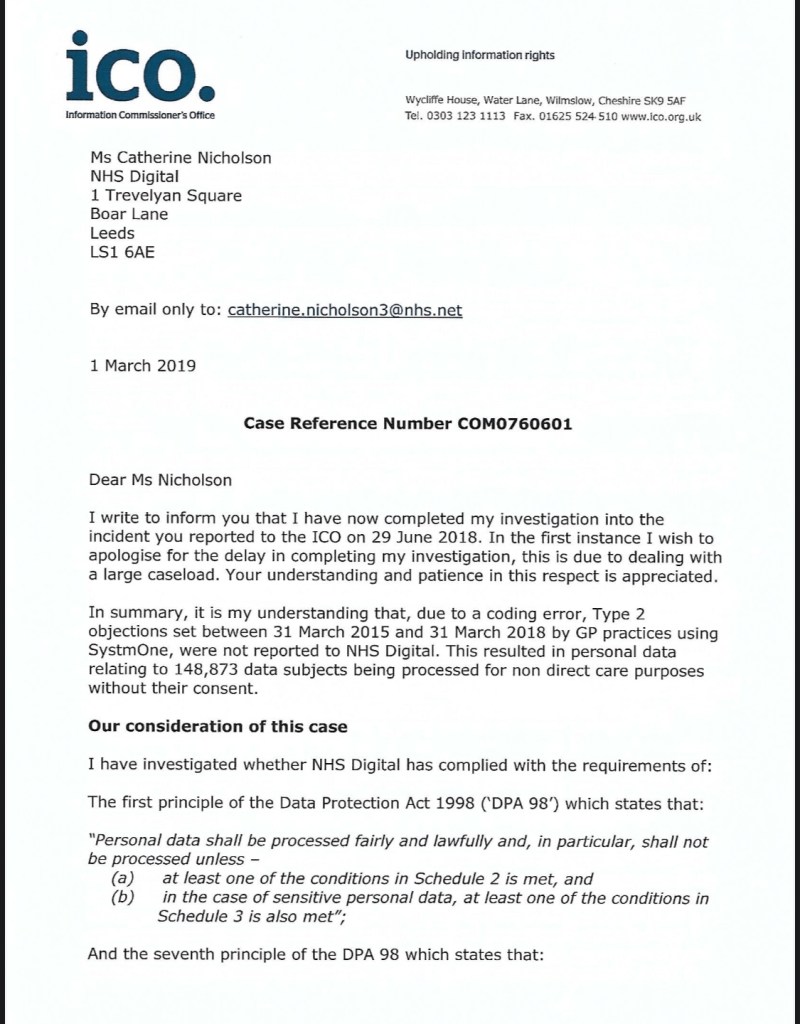
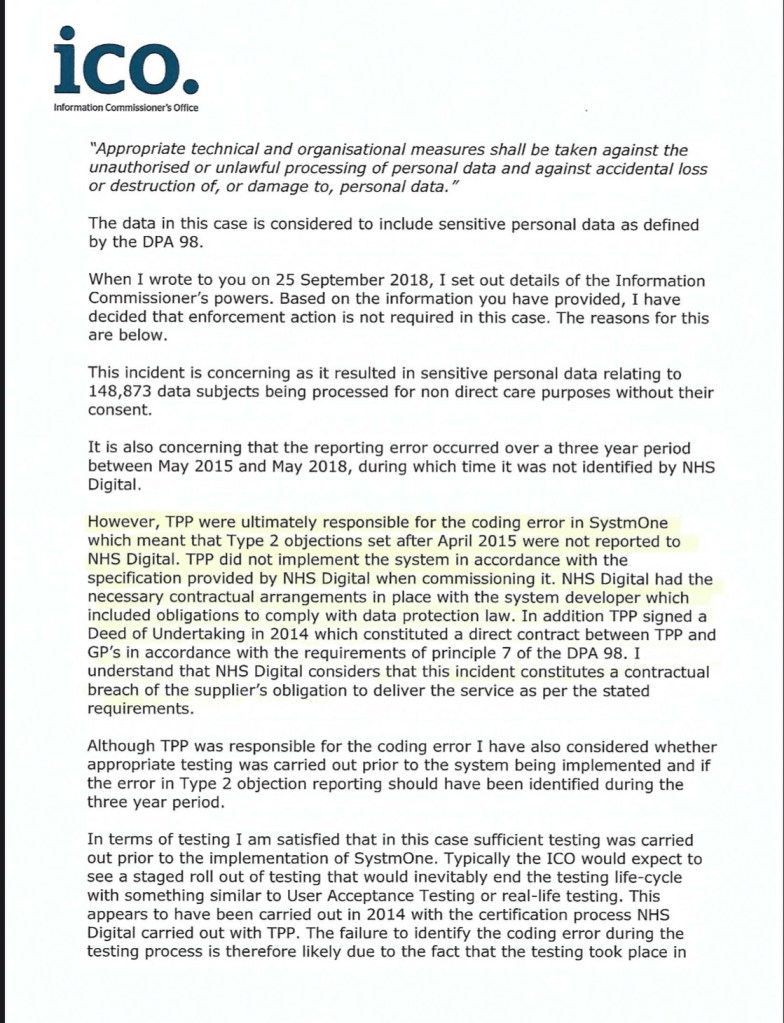
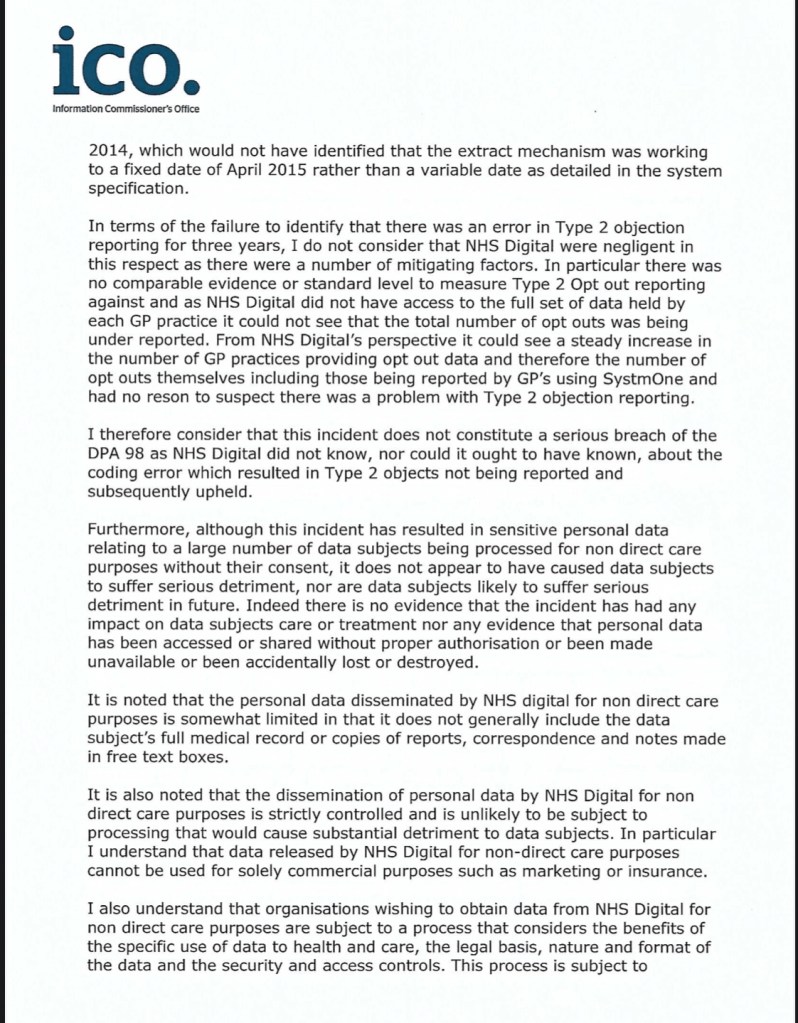
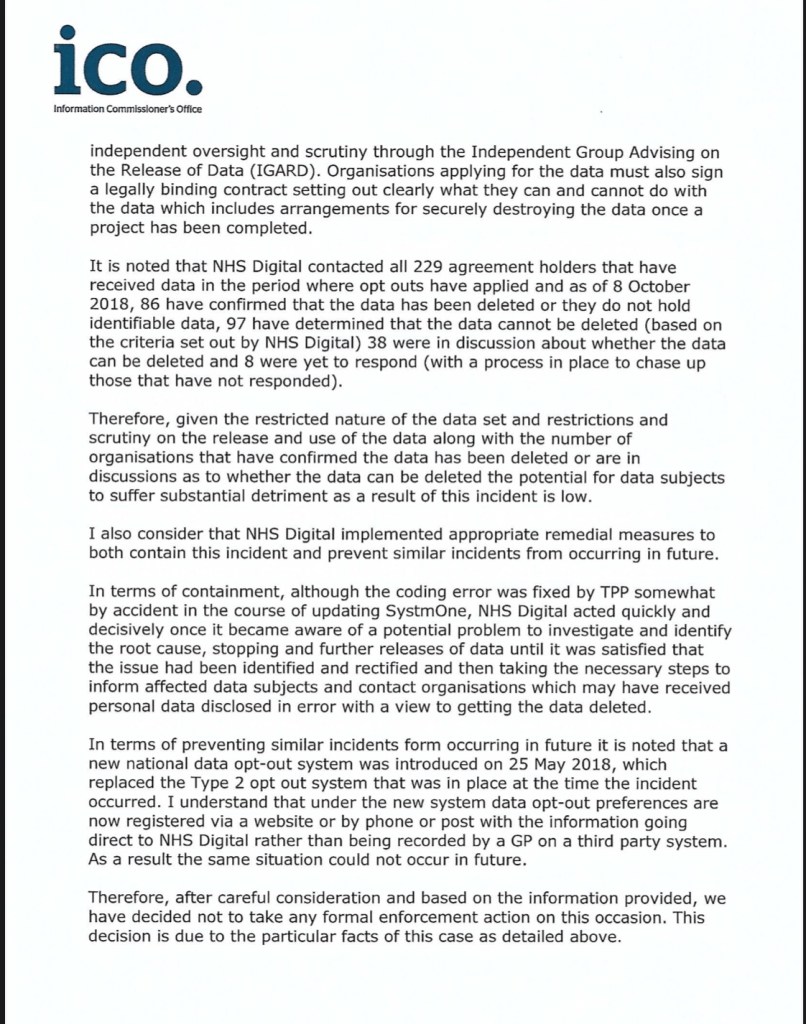
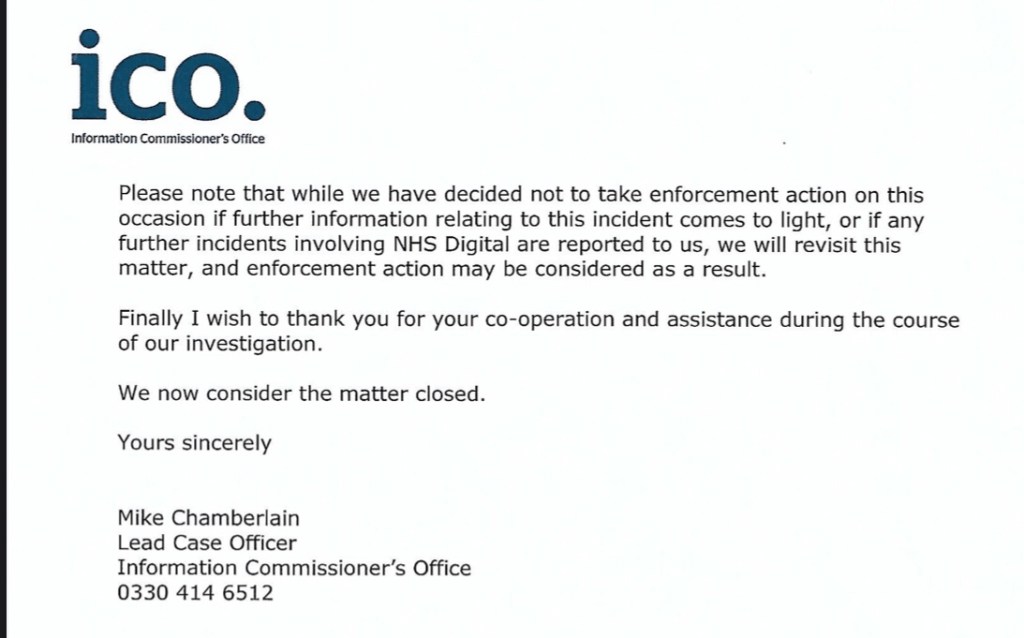
On discover of this – the largest data loss in NHS history – The Information Commissioner’s Office immediately sprang into action. And as expected did nothing. This is par for the course for ICO.
At present it is not known what the commercial relationship between TPP and NHS Digital may comprise. Therefore it cannot be said if one has indemnified the other from the consequences of data losses. This may be why ICO fails to act.
Look at the extracts below from a letter sent from ICO to NHS Digital. As far as I’m aware this is the first publication of this document in any media:
All of tale of failure is par for the course in modern Britain.
Shoddy companies such as TPP gain contracts for services to the public sector but produce shoddy work. When errors happen it’s a “learning experience” for all concerned rather than one in which heads roll. Supervisory organisations such as ICO fail to act as appropriate. And the gravy train keeps on running!














 Legal Babble