There’s a lot of talk at the moment about public money being wasted. Much of this revolves around issues such as PPE for healthcare workers or the Test and Trace app. It would seem that the Government have used emergency situations created by the coronavirus pandemic as a means to transfer public money into private hands. Often the people enriched appear to be friends and donors to the Conservative Party.
But hold on a moment!
If you wanted an object lesson in “spaffing” public money up the wall there’s few who do this better than The Ministry of Justice.
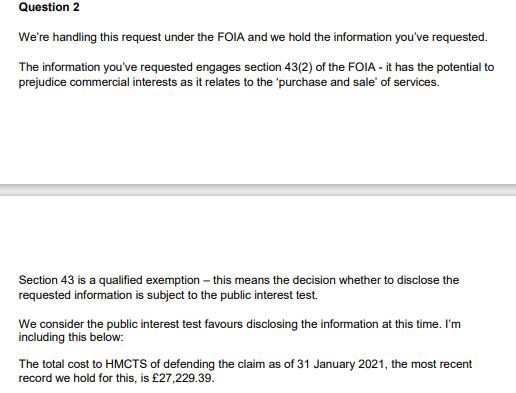
Take a look at the extract from a Freedom of Information Act request seen below.
So that’s £27K that the public purse isn’t going to get back! Note that this has been spent on defence of a case regarding The Ministry of Justice failing in its obligations to keep service users data safe and private.
It would actually have been easier for all concerned and considerably cheaper for MoJ to have ensured the safety and privacy of service users data to begin with. But this assumes that enough of a damn is given about the privacy of service users data by that department.
A request was made in August 2020 for data from a subdivision of The Ministry of Justice. The response (issued outside the time limits for such in law) stated:
This is actually a two-headed matter. A complaint of poor service thrown in with a data access request for the data which proves the grounds of the complaint are correct and that multiple errors occurred. Needless to say the subdivision ignored the complaint and requested I make the data access request to London, as seen above.
You will see how this letter refers me to Data Access office as being the correct source of the data required. So Data Access were contacted in late September 2020 and the data again requested from them.
Some five months later and several chase-ups by email and Data Access deny they are the source of the data. The data is apparently best obtained from the office I originally wrote to.
There is little that can be said for this game of piggy-in-the-middle except to say that I will not play it.
The source of the apparent information that they cannot fulfil this data access request are unnamed “senior managers” whose details I have requested. Odd how it’s always some unnamed person as the source of an instruction that sends the public on a wild goose chase.
The disclosure team for MoJ are ultimately responsible for the production of data access requests made to sub departments within MoJ. The requests made in mid-2020 are indeed data access requests. They seek specific data and this is clear from the requests themselves. It is the job of Disclosure Team to work with the sub department of MoJ I first communicated with to obtain the data from them and then relay it to me.
It looks very much like both offices are attempting to evade the production of data via a game of piggy-in-the-middle and delay. Unsurprisingly the subsidiary office originally contacted has failed to respond to the initial complaint linked to this data request.
This request has been before Data Access office since September 2020 and has only just received the response of “go back to the start”. Taking this delay in response alone as a single issue would render the handling of the request wholly unacceptable and a breach of the relevant law.
By seeking to frustrate the request in this way The Ministry of Justice has earned itself a referral to The Information Commissioner’s Office.
BEING the story of how a data access request led to a breach of the law by West Yorkshire Police.
Few people would argue against the notion that West Yorkshire Police has an international reputation for corruption and incompetence. One of the less enviable roles to have at the force is in the Data Management departments dubbed, rather imaginatively as Information Compliance and Right of Access. Those pesky members of the public requesting data they’re perfectly entitled to must grate! This in those departments you stand as gatekeeper for great swathes of your information that must not be released as it could show your brother officers out to be inept, lazy or actually corrupt.
Consequently the job of anyone in a data access role at West Yorkshire Police is more akin to a doorman at the gates of Hell stopping Desmond from escaping than the role suggested in legislation as a facilitator of access to information.
Consider Section 77 of the Freedom of Information Act which states that a person…
“is guilty of an offence if he alters, defaces, blocks, erases, destroys or conceals any record held by the public authority, with the intention of preventing the disclosure by that authority of all, or any part, of the information to the communication of which the applicant would have been entitled”.
…at West Yorkshire Police data access employees certainly consider this. Particularly the blocking and concealing aspects. And it probably keeps them awake at night.
A data access request was made to Right of Access department at West Yorkshire Police in early October 2020.
Eventually the data was provided (in February 2021) and as is par for the course this was considerably outside of the time limits allowed in law for the production of it and is thus is a breach of the law.
Additionally the mishandling of the original requests suggests misconduct in public office and willingness to commit a Section 77 offence on the part of a person or persons at Right of Access dept. It is for you, dear reader, to decide if this also constitutes a criminal offence of misconduct in public office.
A complaint was made to the (equally imaginatively named) Professional Standards Department (PSD) which they fudged. They were then instructed to re-investigate the complaint by The Office of the Police and Crime Commissioner (OPCC) for West Yorkshire.
Part of the re-investigation instructions relate to data that was clearly withheld by Right of Access Dept. from PSD in contravention of their duty of care and candour. That this withholding of data skewed the result of the PSD investigation resulting in the matter being referred to OPCC.
I’m willing to take a pretty safe bet that Right of Access did not inform PSD of the matters below in the original complaint investigation…
Eland Road Police Station, Leeds.
The original request for data made in October 2020 resulted in a letter of 4.11.20 from Right of Access dept. which stated that the request was rejected for 60 days as ROA had decided to impose an arbitrary and illegal ban on my making data access requests. The illegality of the ban was pointed out to ROA.
The pointing out that the ban was illegal appears to have generated a change of heart. A few days later (16.11.20) this ban was lifted and a further letter of 16.11.20 assigns the request a reference number. Great! It’s finally moving forwards! The letter of 16.11.20 claims the request is being processed.
However illogically the following day the request was then again refused in a letter from Right of Access dept. of 17.11.20.
This attracted an internal review request from me. The response from ROA to this was:
“internal reviews [has been set up]… an independent member of the team who was not involved in this decision will assess your requests and whether they should be processed.
The matter was also referred to the independent watchdog for data access rights, The Information Commissioner’s Office (ICO) as a formal complaint.
ICO considers that 40 days is sufficient for the production of an internal review. The internal review was of course not concluded after this time and so the reviews were both chased with ROA after 40 days on 12.1.21.
West Yorkshire Police staff hard at work.
The result of the internal reviews were inconclusive and weak in that they upheld the original failure to produce the data without giving sustainable grounds in law.
Now here’s a hot tip next time a police force refuses your data access rights:
In order to act as a check on Right of Access dept. at West Yorkshire Police (experience leads me to not believe a word they say) I occasionally request the same data as has been requested from ROA from another police force to check matters such as the right of access in law to the data and entitlement to the same. This is something I specifically do as in the case discussed here where there is an outright refusal to supply the data. Having an uninvolved second party check what you’ve been told is truthful is frequently invaluable.
A letter in response from Humberside Police from them confirmed the rights to the same type of data requested from West Yorkshire Police.
So I wrote back to ROA on 20.1.21:
I refer to the attached correspondence with Humberside Police in relation to [reference number given]. In this correspondence I requested from that force the same documentation that has been requested from West Yorkshire Police…
Following the usual game of silly bastards that police force’s like to play in their initial response letter the data was provided in accordance with the obligation on Humberside Police in law.
The same legal obligation that has compelled Humberside Police to provide a copy of the data also obliges West Yorkshire Police to provide the same to me. Your internal review of the matter and the provision of the same from a local force must mean that the law compelling disclosure of this data from Humberside also compels the disclosure from your force.
I await a copy of the data requested…
A copy of the covering letter from Humberside Police confirming the right of access to the data requested was also sent to ROA on 19.1.21.
ROA wrote back on 21.1.21 saying the matter is with the ICO but that I am not prevented from making further requests.
I request again on this date a copy of all the data originally requested in October 2020. This request is acknowledged on 22.1.21. The data was finally provided in February 2021.
After the original refusals and messing around by ROA it must have galled the that they’d been backed into a corner with no further escape route. If the data is obtainable from one force it must logically be obtainable from all.
The point of the lengthy backstory above is this: ROA habitually seek to retain data that the production of would prove embarrassing to West Yorkshire Police. This purposeful retention of data breaches the law as it activates both yours and my Section 77 rights under data access legislation and the illegal retention of it is an example of misconduct in public office as the law is habitually flouted to avoid the production of data access requests.
In the above matter once the entitlement to data had been established from another force ROA had no option than to provide the data requested, but of course prior to this the data had been subject to so much hand-wringing and wrangling to avoid its disclosure, including the illegal imposition of a ban on requests being made and the arbitrary refusal of a legal and legitimate data access request.
Conclusion
I should not have to fact-check the legal position with requests to other police forces when a request for data has been refused by West Yorkshire Police. But it does help! Equally I should not have to do this for the purpose of getting ROA department backed into a corner from which they cannot continue to refuse access to data. Again though this does help! This is wasting my time and public money simply because ROA sees its position as a gatekeeper for information rather than accepting its actual position in law as a facilitator.
Section 77 cited above is clear: it is an offence to attempt to block access to data that the public has a right to.
Recently The Office of the Police and Crime Commissioner for West Yorkshire Police has had a number of members of the public complain about the police’s Right of Access dept. Will this lead to a broader investigation of systemic and purposeful effort to block public access to data by delay, dithering and denial? Watch this space.
In a November 2020 report The Information Commissioner (or ICO) wrote the forward to a report and stated:
“It is my hope that police forces, and other organisations, will read this report, understand their current position and identify actions they can take to improve or maintain good performance. We will continue to work with the police to support their compliance with information rights laws.”
Some hope of that!
When the Commissioner wrote of “their current position” she was using soft-soap language for what would have been more accurately described as clear flouting of the law and institutional efforts to evade disclosure of information.
Let’s take a look at West Yorkshire Police as being a recent example of this failure to comply with both the law on data access requests, ICO guidance and their general obligations to maintain good relations with the public.
The Office of The Police and Crime Commissioner for West Yorkshire has for some months now been aware of suboptimal handling of data access requests by West Yorkshire Police. They have noted an increasing number of complaints from members of the public about poor service and inadequate provision of data by Information Access departments at that force.
A Professional Standards Department investigation into a complaint brought by a member of the public that subject access requests made had been delivered late, were missing data and had been purposefully frustrated by police was mishandled by Professional Standards Department. The Office of The Police and Crime Commissioner for West Yorkshire (the PCC) found that the investigation had been substandard in several areas.
As per usual for a police Professional Standards Department the conclusion to the investigation ran along the lines of “We have investigated ourselves and found nothing wrong”. This outcome is usually achieved by PSD adjusting the frame of reference to the complaint to disregard all that inconvenient evidence that proves the complaint is correct. This indeed appears to have been done in this instance.
Accordingly PCC wrote in their examination of the complaint handled by PSD:
“The decision I have reached is that the outcome of the complaint was not reasonable and proportionate… [that a proper complaint investigation involved] Full consideration of the Information Management Department’s handling of [the complainants] requests over the last year, including all the ones he brought to the complaint handler’s attention and the involvement of the ICO in those requests”
Which is as I stated: police complaints department ignoring evidence which proves the force has misconducted itself.
PCC wants a re-examination of major aspects of the complaint and also wants to see:
“Full consideration of the wider context concerning the timeliness of replies to Subject Access requests by West Yorkshire Police, including the engagement with the ICO. This should take into account the findings and recommendations from the ICO’s report from November 2020 “Timeliness of Responses to Information Access Requests by Police Forces in England, Wales and Northern Ireland”
…in other words the report I referenced above.
This is to say the least mildly inconvenient for police. An examination of the timelines for a dip-sample of data access requests made (but not fulfilled on time) is one of the easiest ways to see that police have broken the law in relation to these requests.
But of course if West Yorkshire Police were to investigate themselves and report to PCC the errors made in supplying data requested by members of the public then it would be impossible to hide the scale of information deliberately hidden.
So the response of Rene Prime, Reviewing Officer at Professional Standards Department to PCC states:
“Unfortunately, I do not agree with the actions you propose should be taken to resolve the complaint. I agree that full consideration should be given to [the complainant’s] contact and requests to Information Management over the last year and the issues that have arisen around those requests, however I do not consider that it is appropriate to consider the wider context of perceived issues within the Information Management Team.”
Which is as slippery a way as can be found to avoid PCC discovering the full extent of West Yorkshire Police’s efforts to evade the production of data requested by members of the public. This reply also in effect “cuffs off” (to use a West Yorkshire Police term) the recommendations of PCC which have been made in the light of the many other individual complaints from members of the public regarding failed data access requests.
The standard approach to data access requests made by police forces is not compatible with legislation allowing the public access to data.
Secretive, evasive and mendacious: police hate requests for information from the public.
Instead they seek to frustrate access requests, deny even the production of non-contentious materials and in most cases seek to delay the production of data beyond time limits in law so that the requester will be liable to forget all about the request and go away. At all stages the intention is to frustrate, vex and delay. This is often because the police operational mindset is focused towards evading any form of insight into their working practices or accountability. Ergo the more the public get to know about police methods and actions by data access requests the less the freedom for police to do more or less as they wish. An informed public is aware of the abuses of power and the bending of the law that the police perform daily.
The above correspondence gives you something of an insight into the attempts police make to avoid production of data which would make them accountable. This time last year the police complaints process was subtly changed to make the local PCC engage more with appeals into poorly handled complaints. It will be interesting in the light of the above to see if West Yorkshire Police’s PCC has the guts to challenge ongoing breaches of the law over data access requests to West Yorkshire Police.
Has someone ever asked you “Does my bum look big in this?”. Did you feel inclined to answer honestly or fib a little to offer some comfort and solace while still being truthful?
The simple fact is that lots of people lie on an almost daily basis. The majority of these are “white lies” which are popularly thought to do no harm, but despite this have a habit of coming back and affecting us in all sorts of ways.
However we used to expect more from people in public positions. The popular myth of the lying politician has of course been around for generations. But often this was more a matter of an MP having been caught out when circumstances rapidly change, or they were simply poor communicators, as opposed to them directly seeking to deceive. Once being caught out as a liar would end a political career either via resignation or sacking. Not any more.
I have dealt with public bodies for the best part of thirty years now and I have detected a drop in standards from state-run organisations which roughly parallels the drop in standards in public life generally.
Sorry to ruin your day by reminding you of these mendacious b******* (pt. 1)
Here’s my theory.
When Tony Blair’s New Labour came to power in 1997 and Blair walked into Downing Street for the first time there appeared to be – to the casual observer – a public demonstration of joy as people lined Downing Street cheering and waving flags. Hooray for the new dawn for Britain!
Except that this wasn’t the case. Those people were all Labour Party activists and not members of the public. But we were supposed to think these were happy Londoners expressing gratitude. Thus the New Labour Goverment of 1997 – 2010 started its term in office with a cynical little deception.
And so it continued. The rise of political spin and outright deception marred any beneficial policies New Labour brought. The 1997 cohort of MP’s still present in opposition continue to practice the same spin and evasion when caught out not doing their jobs that they’ve practiced for years. For more details of the long term effects of this spin and deception ask the average Iraqi citizen.
Some time past mistakes made by organisations such as HMCTS in handling claims were few and far between. Staff were trained, diligent and in a job more or less for life. When a mistake was made an apology was issued and a correction made quickly. Thus mistakes were learning experiences which made staff better employees and future errors less likely. However from 1997 onwards I remember I detected there was a shift: mistakes became something to be covered up like guilty family secrets. Court Managers became adept at avoiding addressing the key aspects of a complaint (“we have investigated ourselves and found nothing wrong”) in order to avoid blame.
This is entirely parallel to the New Labour age of spin and public relations managment style Government. Anyone remember “A good day to bury bad news”? That one was a big hit back in 2001.
Arguably in the last few years the efforts made to avoid admitting clear errors have mutated into something far more corrosive. Such as Court Managers and Area Directors now deny – in the face of clear documentary evidence – that an error in a claim has occured at all.
The rise of political lying has been very well documented in the last few years and started in ernest with Tory Chancellor George Osborne and Michael Gove who clearly sought to decieve and deployed mendacity as a deliberate political weapon. It seems we now have a Government who are happy to issue untruths on a daily basis secure in the knowledge that the world moves on so fast that by the time their comments have been fact-checked and the truth known that the public will largely have swallowed the lie.
So it is now with public bodies. In many cases the organisation – and I speak of such as MoJ and HMCTS etc. – as I have the majority experience of these two – are so chaotically run that more and more daily errors occur and it is impossible to catch all of these and correct them. For example case files are returned to storage incomplete and disordered as staff run around a a blind panic with no clear idea what they are tasked with.
Sorry to ruin your day by reminding you of these mendacious b******* (pt. 2)
The end result of all this is clear. Any trust remaining in public institutions vanishes. No learning from an error occurs and so it is repeated.
Management cannot address every error as it occurs and so they outright deny such a problem has happened, even when it is clear the whole system is close to collapse. The rise of political lying gives them an example to follow and once again sets the tone for how those employed by the state act. It’s Nelson putting the telescope to his eyepatch and saying “I see no ships”.
I write in relation to the Julian Assange extradition attempt by the US government. This has received a ruling today which has stated that Assange cannot be extradited to America on the basis of mental health concerns.
It is widely considered that the case against Assange has been cooked up as revenge against Wikileaks publication of atrocities by the US military in the Middle East. That such was designed to frighten any journalist in the future from exposure of similar state backed horrors.
As this post will detail The Ministry of Justice in the UK is quite prepared to commit abuse of process to also persecute those who publish material which exposes its wrongdoing and incompetence.
Assange in transit in a prison van from Belmarsh high security prison where he has been held.
The ruling in the case is that extradition cannot take place as America cannot guarantee the safety of Assange in a US prison in the light of his apparent suicidal ideations. These thoughts probably stem from his continued persecution for many years over Wikileaks publication of video footage of atrocities committed by the US military against civilians.
The points made regarding the safety of the US prison system of course apply equally – if not more so – to British prisons. Belmarsh was the choice of prison for Assange on the basis of the additional security given to inmates there.
The other thing that struck me about the judgment is that the extradition to America was refused not on grounds which assert and re-enforce the freedom of the press or the ability of such as Wikileaks to publish material which challenges authority but on the grounds of safety for the defendant.
The decision was made by a District Judge. Anyone familiar enough with the British legal system will likely be aware that the judge has chosen an anaemic third way in order to dismiss the case for extradition. No wonder the decision is likely to be appealed! Rather than outright confrontation of the prosecution case which was designed both as an act of revenge against Assange and a threat to any future journalists exposing official misconduct the judge chose a way which avoids these prosecution arguments being confronted and carefully debunked.
If a decision was made to extradite on the basis of the case put on behalf of the prosecution then the risk to press freedom in future would have been grave. As it is the case has been a warning shot to anyone thinking of publishing contentious material regarding state backed misconduct.
The judge has accepted the proposition advanced by Assange’s legal team that an American prison is not sufficiently safe for someone with suicidal thoughts.
Were he still alive Jeffrey Epstein would also likely agree that an American prison is an insufficiently safe environment for people who have – like Assange – embarrassed or risk embarrassing those who hold the levers of power in America.
We don’t have to look to a high-profile case such as this to see official misuse of power in an act of revenge against those who publish material which would embarrass authority, as our own Minisry of Justice in Britain are quite prepared to carry out misconduct in public office in this way.
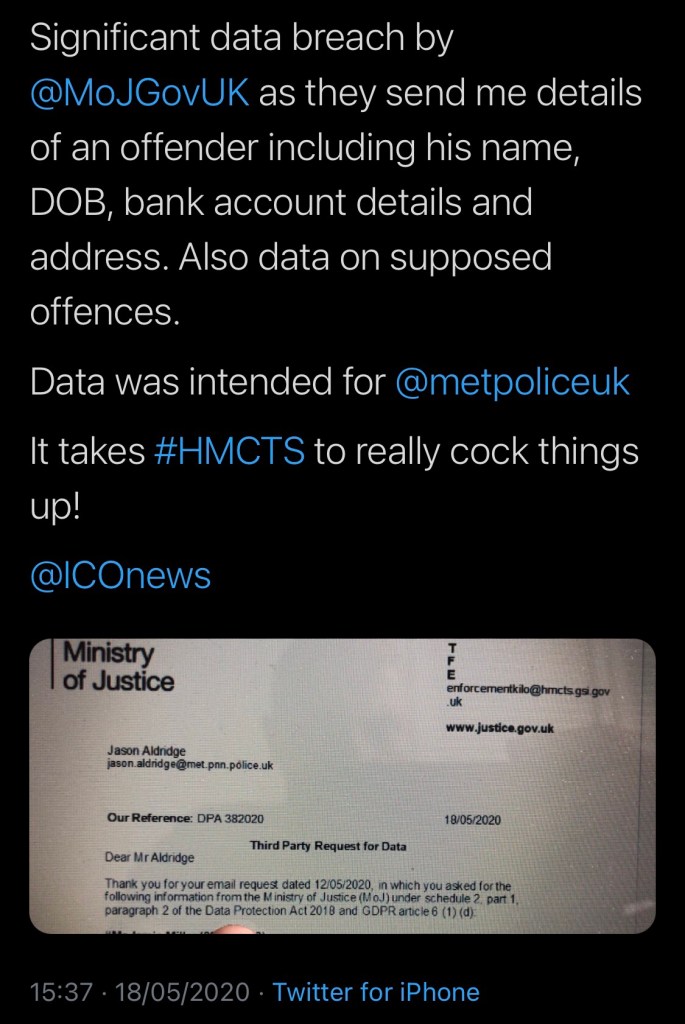
In May this year I was sent material in error by MoJ. This was a letter intended for the Metropolitan Police in relation to Proceeds of Crime Act proceedings against an individual in the Kent area.
The data sent to me in error constituted a considerable Data Protection Act breach and covered the name, address, date of birth and bank details of the individual and other compromising data. Such data in the wrong hands could have resulted in considerable fraud committed against the data subject by the misuse of his personal details. I informed both The Information Commissioner’s Office and the data subject about this.
I also posted – with no small amount of schadenfreude – the tweet seen below. No aspect of the content of this tweet breached revealed data on the data subject and thus was not actionable. It simply and quite rightly embarrassed MoJ as an organisation which is incompetent in the handling of personal data.
Despite the fact that MoJ were wholly in the wrong over this entire matter they decided to go on the offensive and instructed West Yorkshire Police to arrest me in relation to offences under The Data Protection Act.
Police, having seen no evidence of any offence committed in civil or criminal law, nevertheless took the word of MoJ as gospel and in so doing broke the law themselves not least by committing a wrongful arrest.
I was arrested and held in custody at the police station. It was relegated much later in an email chain from the Head of Security at MoJ that the purpose of this was “to give him a shock”. I’d embarrassed MoJ in public with the tweet and reported the data breech to ICO. Consequently MoJ wished to revenge itself and were prepared to commit misconduct in public office to do so.
Of course the other thing the emails between MoJ and West Yorkshire Police also reveal is the sudden loss of interest in the matter when I was arrested – the arrest being the short, sharp shock MoJ was aiming for. An internal investigation by police also admits there were no grounds for arrest and no offence had been committed.
The point of my explaining all this shabby behaviour and breach of duty of care from two shifty little organisations is clear. Just as Assange has been intimidated and subject to abuse of process because of what he published so have I.
Such actions from organisations such as MoJ and West Yorkshire Police serve to wholly undermine public confidence in the organisations themselves and damage their own reputation. Further it exposes the organisations as being comprised of the inept, the incompetent and the petty-minded.
If MoJ or West Yorkshire Police would like a right of reply to the content of this article then I am happy to publish any point of view they may give. I may equally produce further evidence in response which confirms the facts already stated above!
Police forces are notoriously bad at responding to subject access requests (those are requests for your own personal data) as well as requests for data overall from the force, especially if the request for access is made by the public.
The Information Commissioner’s Office has recently published a report (link seen below) outlining just what an absolute catastrophe police responses to these requests are.
As ever with such a report the real eye-opener are the recommendations made by ICO. In this instance these are nine points which show how UK police forces are failing to deal with data access requests in anything like an efficient and professional way. Often this is because the purpose of data access legislation clashes with police’s wish to keep information regarding errors in procedure and process wholly secret.
Title page of ICO’s report.
This report will cause consternation in particular at failing Humberside Police, a force subject to many eye-watering fines from ICO in the past for failures to comply with the law on data access by the public. The recommendations ICO suggest will likely be impossible for the force to implement.
West Yorkshire Police – as expected one of the forces most likely to break the law to try to avoid the production of data – said at a meeting convened by their Police and Crime Commissioner recently that they would be looking at increasing the staffing in the Information Management Department in the next year (budget permitting) to cope with the demands made upon it. “Looking at” and “budget permitting” is another way of saying that nothing will be done to address the problem.
I’ve written on here many times before about how Humberside Police are particularly useless, even in a hotly contested field of local forces.
However even I fell off my chair at the sheer incompetence of the subject access response provided by their Information Compliance department this week.
A subject access request provided by the force amounts to a nonfeasance as the response:
1. Fails to provide the data requested.
2. Is issued outside the legal time limit for a response to be provided.
3. Repeats back the same information put in the original request.
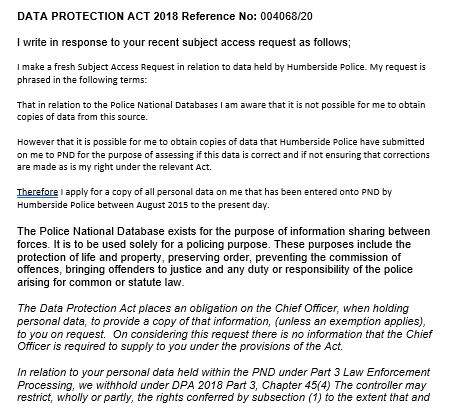
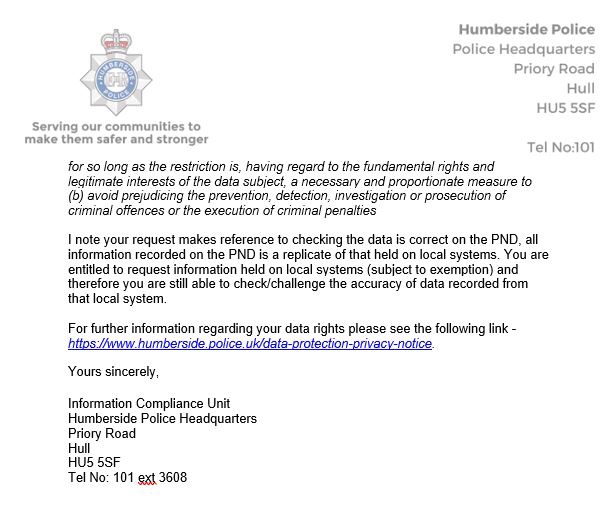
Here’s the letter in full. I have redacted the header.
The key sentences are in the fourth and fifth paragraphs seen above. These are reproduced from the original request. Data cannot be obtained from the Police National Computer – however data that has been entered into the PNC by a local force can be obtained from the same regional police force. Hence the request to Humberside Police.
The substantive reply is seen below:
Here we focus on the second paragraph. It essentially repeats the data I put to police in the first instance.
Consequently the force has failed to react correctly to the subject access request in every conceivable aspect.
This suggests that the intention is to continue frustrate any further request made for the data using the rights conferred in italics in the letter to do so as the response to any further requests that might be made.
The Information Commissioner’s Office has been informed.
This post details the extent to which HMCTS will seek to lie and mislead in order to avoid admitting a clear service level error made by court staff, particularly when such an error is serious enough to amount to a breach of a person’s right of access to justice or human rights.
Below is a copy of an email sent earlier today to Customer Investigations at HMCTS. They are the final stage of appeal in the event that court staff make serious errors in the handling of civil claims.
It follows two separate instances of the Court Manager at Leeds Combined Court, Joanne Town, seeking to deliberately mislead in her replies to a complaint. The original complaint was that court staff failed to notify me of a hearing taking place into two claims – they only informed me of a third taking place on the same date in November.
Joanne Town states that these two claims were not heard on the relevant date. All available evidence including an Order from the hearing proves her wrong but she maintains her position twice over.
This behaviour and the original error of the court failing to inform me of dates for two claims to be heard represents sufficiently shocking behaviour that I share the email I have sent to Customer Investigations in its entirety below.
The email begins…
I refer to the issue below as a formal complaint to Customer Investigations.
On 11.11.20 a hearing took place at Leeds Combined Court in [REDACTED]. I was unable to attend this hearing. Also in the same hearing two other claims were heard. These being [REDACTED] & [REDACTED]. I was not notified that these claims were to be heard on that date at the same time as [REDACTED]. A formal complaint was therefore made to Leeds Combined Court. It is a fundamental aspect of access to justice that a Claimant should be able to attend hearings in relation to claims he has brought. Indeed CPR enshrines such rights. Article 6 of The Human Rights Act states the right to be a fair and public trial or hearing at which I am allowed representation if a public authority is making a decision that has a impact upon my civil rights or obligations. The failure to notify in respect of two claims in which I was Claimant taking place on 11.11.20 thus activates my Article 6 rights. By failure to inform of hearings taking place on 11.11.20 HMCTS has breached my Article 6 rights.
Firstly as can be seen from the email below no communication was received as sent on 7.12.20 by Leeds Combined Court. A copy of a letter dated 7.12.20 has been sent to me by email today in relation to my query regarding a level two response.
The onus of the complaint to Customer Investigations is as follows:
The response provided on 23.11.20 and that dated 7.12.20 both state:
The court did not receive any applications or fees on [REDACTED] & [REDACTED] to set aside, vary or discharge the order of Mr. Justice Lavender dated 27th February 2020 and as such these cases were not listed on the 11th November 2020 these files were not forwarded to the Judge
Further that the position as outlined above is the same argument outlined by the Court in its defence in the 23.11.20 email. There has therefore been no review of the appeal to the first stage complaint response. It would additionally appear that no further investigations into the matter have taken place by Leeds. A simple check of the Order of 11.11.20 would have shown Joanne Town that the statements she has made are wholly factually wrong.
I attach further a copy of an Order made on 11.11.20 in the matters of [REDACTED], [REDACTED] & [REDACTED]. This clearly shows that the matters of G00LS437 & [REDACTED] WERE heard on 11.11.20. I attach also a Notice of Hearing in respect of the 11.11.20 which is the only Notice of Hearing received in relation to any proceedings on this date. I was therefore not informed of the hearing of two other claims on 11.11.20.
As a consequence of this both the email seen in the attached Word document from Joanne Town of November and the PDF of 7.12.20 also attached have deliberately and purposefully set out to misrepresent the facts, mislead and are a clear breach of the duty of care of the Court Manager to act with good faith in relation to service users. When you have a Court Manager who is prepared to mislead in such a way but is so easily caught out I would suggest that it’s pretty much the beginning of the end for HMCTS as an organisation. If you are incapable of honesty and integrity in your dealings with the public then any confidence in the organisation will vanish. The errors seen in the original complaint are compounded by the mendacity of the Court.
I have additionally noted that Joanne Town has acted to respond to both the first and second stage of the complaints and as such there has been no actual second-stage review of the issues raised: the PDF of 7.12.20 simply repeats the response put in the original of 23.11.20.
Consequently I appeal the second stage response on the basis that both that and the first stage response are wholly mendacious and fail to accept that a serious service level failure amounting to a breach of my Article 6 rights has occurred. The situation is no different to that of [REDACTED] in which the same Court Manager was aware that no action was taken in a claim for over a year but failed to respond to complaints in respect of that service level failure.
As a consequence of the error by court staff I have had to make an application in respect of [REDACTED] & [REDACTED] which has also cost me money.
In respect of this matter I seek a financial settlement appropriate to the breach of my rights by Leeds Combined Court in failing to notify of the hearings into [REDACTED] & [REDACTED] and the mendacious response of Court Manager Joanne Town. I have also lost time and amenity chasing this matter and have been vexed and harassed by the behaviour of the Court in respect of the original failure and the mendacious responses provided. I seek compensation in relation to these matters also.
The behaviour of the Court Manager is sufficiently shocking that I believe others should be aware of this and as such the content of communications in this matter thus far – including this email – will be published online.
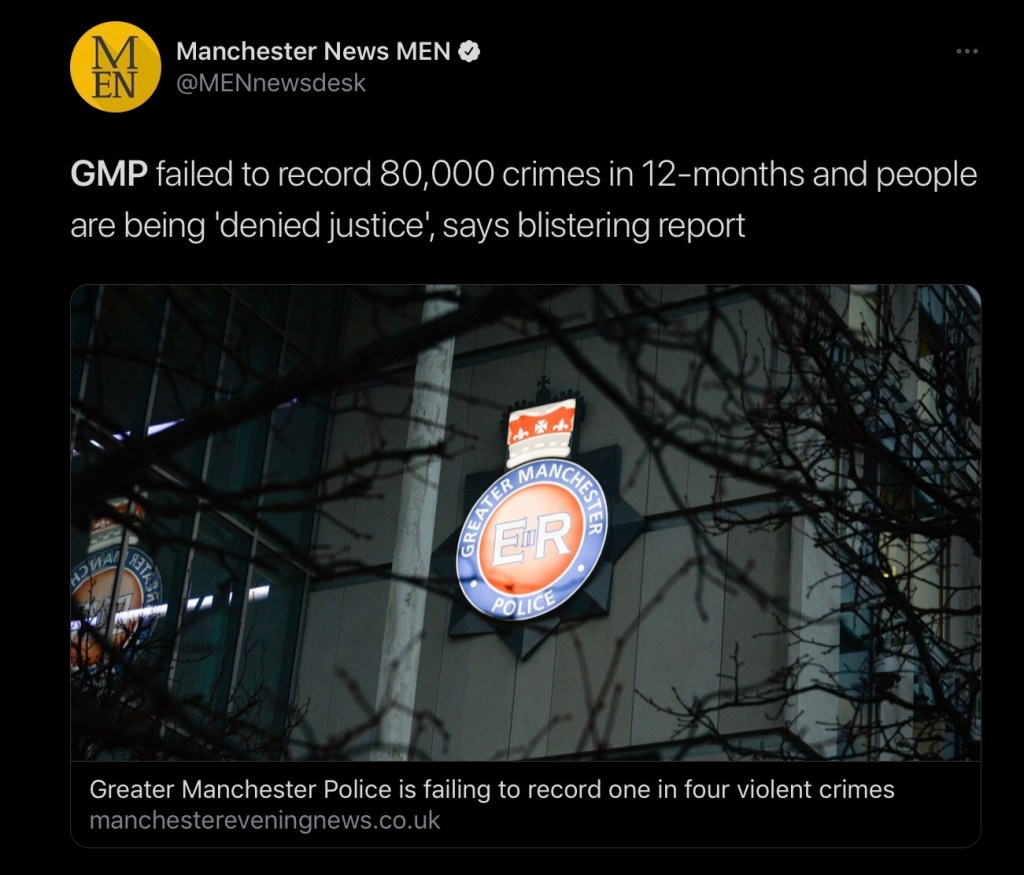
Flurry of activity at GMP in the last few days starting with this considerable shocker:
Overall GMP has been known to be a failing organisation for some time but no active intervention to stop the fall in service standards has been made by GMP itself, The Home Office or HM Inspectorate of Constabulary.
On Wednesday the Chief Constable, reckoned to be amongst the worst in a very competitive field, resigned citing “long term health issues”. None of these issues had been apparent or seemed to prevent him discharging his duties prior to Tuesday’s news regarding non-recording of crimes.
On Thursday the force was placed into special measures following Home Office intervention.
That’s a triple whammy of connected events.
Most interesting from my perspective is how GMP denied any failings in regards to service standards until the scandalous failure to record crimes became public. Like every British police force at present the effort made to hide errors and failures is tremendous. The mantra of the modern Chief Constable is that the professional reputation of the force must be maintained at all costs.
How many other forces will end up in special measures by the end of 2021? I’m willing to take bets on at least two.
















 Legal Babble