
Systemic Failures at ICO Exposed

The purpose of ICO – the Information Commissioner’s Office – is to stated on their website to be to…

…uphold information rights in the public interest, promoting openness by public bodies and data privacy for individuals.

However when ICO themselves are subject to a data access request they are prepared to break the law regarding such.

Given that ICO is charged with upholding the law in relation to data access requests this evasiveness ensures that they have lost the moral authority to be able to enforce data access legislation when things go wrong.

More damming though is that a recent investigation revealed ICO’s means of investigating disclosure breaches is so weak and inept as to render it futile to raise issues before them.

Put simply here’s what happened…

I made a data access request to Wakefield Council. The Council only provided four pages to begin with, then produced more but significantly failed to include the first 53 pages of data from the request, so ICO were informed after the Council had been given ample chance to correct matters.


The original matter put to ICO as a formal complaint was:


The final response is seen attached. Not only has the data requested not been provided but also the Council has directed me to the wrong agency to seek the answers / disclosure wanted. This is clear in the attached PDF. In fact the majority of the questions I am directed to seek answers to elsewhere comprise of information from Wakefield Council that only they have access to. The response of the Council is therefore misdirection as well as a breach of the relevant Act in failing to provide the data requested on 12.4.21.

Therefore I refer this matter to you for assessment on if the Council has fulfilled its obligations in respect of provision of data. The attached Word file contains all correspondence from April 2021 onwards.

Wakefield Council is the preferred workplace of people too inept to survive in a commercial environment.

ICO responded after some months and their Case Officer Rachel Webster stated:

In my view I have fully considered the data protection issues you have raised and in light of the Council’s response I do not believe there are any outstanding data protection issues that we would want to pursue further with the Council at this time. As I have explained in correspondence to you our role is not to necessarily resolve every aspect of an individual’s complaint to their satisfaction.

My reply to this was sent shortly after, on 30.3.22 and stated:  

There are 54 pages outstanding that have not been produced from a data access request. This is something I have been clear about across this process and the disclosures remain outstanding.  

What proof have the Council shown to ICO that the relevant data has been produced? 

Further that ICO tried to shuffle off responsibility for adjudicating on the data access failure by the Council. Outrageously Webster suggested:

I understanding you are currently taking legal action against the Council and it may be that these issues are resolved as part of that process.

Now here’s where things get funky.

In my email of 30.3.22 I requested:

It is for ICO to resolve the issues put before it: the Council has failed to produce data as the result of many requests to do so and was in breach of the law in repeated failures to disclose. ICO’s responsibility is to chase such matters and ensure compliance outside of any other process.

And of course I stated:

What proof have the Council shown to ICO that the relevant data has been produced?  

And ICO’s response to this on 7.4.22 was:

We take information provided by organisations in response to data protection complaints in good faith. As a decision by our office is only a view or an opinion rather than a final determination we do not have to request evidence/proof from organisations concerned. In this case the Council believe they have fully complied with your request however it is clear from your correspondence that you disagree that this is the case and the information is outstanding. We have raised your concerns with the Council and we’re satisfied with the Council’s response and that at this time there is no further action for us to take in relation to your case.

That’s right. You read that correctly.

ICO does not seek out or require proof from organisations that they have complied with their responsibilities. Indeed in a situation such as this where a member of the public asserts that they have not then ICO will accept the comments of the organisation that they have over and above any evidence that the public has provided.


ICO then attempted to fob me off with some data in response to a request I made. The data was not that which I requested.

I in fact requested all communication between Wakefield Council and ICO. My response to ICO was sent 9.4.22 and stated:

Further that the data supplied does not support comments made in your emails to me about information supplied by the Council to ICO.

ICO claim that the Council’s attempt at a get-out-of-gaol-free card in this matter was to state that they had a particular defence in law as to why the data had not been provided. The data produced by ICO between them and the Council did not contain this claim from the local authority. So where did it come from? A further data access request was made to ICO for proof that the Council had stated to ICO what ICO claimed the Council had stated.

Simple enough you would have thought. Especially in the light of ICO’s failure to produce the relevant data in copies of correspondence with the Council.

ICO failed to produce this data. I wrote back to state:

Given ICO’s stated position as regulator for data access / information rights issues this is simply not good enough. At a minimum I would expect fulfilment of the data access request made and chased 7.4.22. That such disclosure from ICO should show that ICO has interacted with the Council on the matter of IC-134978-B9K1 and that the Council has responded appropriately back to the matters raised in this complaint.  

ICO shot back with:

Thank you for your email below. I note your comments and can provide the following response. I can reassure you I have considered all the information provided by you and the Council in relation to this case.

This amounts to two failures to provide data requested. In the second instance ICO purposefully fail to address the renewed request for specific data from their office.

Given that the data I provided showed that the Council had clearly withheld disclosure for no legitimate reason it seems odd that ICO should prefer the Council’s response, especially in a situation in which they appear to have provided ICO with no supporting data.

It’s a relief to anyone who brings a data access complaint to ICO to learn that, as stated in theur response to me of 30.3.22:

…our role is not to necessarily resolve every aspect of an individual’s complaint to their satisfaction. Rather we consider data protection complaints that are brought to us partly in order to identify issues with an organisations information rights policies/procedures.

Which in practical terms means that ICO will ignore issues in complaints brought by the public which it finds irksome to deal with. This may mean that if enquiries with a misconducting organisation are going to be long and drawn-out that ICO will ignore complex aspects of the complaint made. Historically even in matters where there is a significant breach of the law by an organisation ICO also fails to act punitively and instead builds up a file of data on the organisation’s failings.

A case review was requested and completed 22.4.22 by Lead Case Officer Alison Fletcher.

Again this failed to address the issue of the data requested from Wakefield Council to ICO which supported the comments made by ICO, as had all the prior responses from Rachel Webster. A further response from Alison Fletcher also failed to address the issue of the data not being supplied

Does ICO have a specific reason for withholding the data requested? Likely this is a matter of professional reputation. That a full disclosure of the data I requested would show that ICO failed to investigate this matter to a reasonable standard and perhaps that the Council did not provide them with the data ICO claimed they did. This has to be the case since I provided sufficient evidence to show Wakefield Council had breached its responsibility in law to provide all the data I originally requested from them. The sign of a weak investigation is in the reply provided by ICO which stated:

We take information provided by organisations in response to data protection complaints in good faith. As a decision by our office is only a view or an opinion rather than a final determination we do not have to request evidence/proof from organisations concerned

As I mentioned the practical effect of this is that if an organisation claims not to have breached the law then ICO simply accept what the organisation have said without evidence and contrary to any evidence provided by the public, however strong.

This is indicative of ICO being an organisation that is unfit for purpose. You might of course argue that they are functioning perfectly: that one part of the State has acted to deflect and cover the illegality of another.

However it is ICO’s careful avoidance of producing data requested showing what the Council stated to them which suggests most strongly that they are unable to properly police the wild west of data legislation.

Just to recap in relation to the seriousness of the malfeasance from ICO. When data was produced showing correspondence from the Council to ICO nothing supporting the comments claimed to have been made by the Council had been sent to ICO, who then went on to be unable to produce the info from the Council supporting what they say the Council had said.

When the body charged with taking others to task for failure to observe information rights law believes itself to be exempt from such laws – and likely making up excuses for organisation’s failures – can there be any doubt that ICO cannot remain much longer in its present form?


Service standards from The Information Commissioner’s Office are frankly not very good!

In It Together? Is ICO Incapable of Holding Certain Bodies to Account?

Introduction

This blog entry gives a glimpse into how The Information Commissioner’s Office (ICO) operates. ICO is charged with supervision of information rights in the UK and acting to assist when things go wrong.

Much anecdotal evidence suggests ICO may act to shield certain favoured organisations.

On 5.7.21 I contacted The Information Commissioner’s Office with a complaint. This stated:

For a civil hearing on 9.6.21 a copy of any criminal record regarding me was requested. CPS supplied erroneous data to the Court. The error was a serious and significant one… This is not only offensive but also a matter to cause exceptional damage within the hearing. Such [the retention and supply of incorrect data] being an exceptionally serious offence.

In 2019 I had been made aware that this incorrect offence was recorded against me and had requested a correction. It appears CPS [The Crown Prosecution Service] did not correct the error, as they admitted only after the hearing.

The incorrect data was supplied to The High Court sitting at Leeds County Court for a hearing on 9.6.21. This caused embarrassment, distress and actual loss.

CPS were informed of the error prior to the hearing. They failed to correct the record prior to the hearing and failed to inform the Court prior to the hearing also.

CPS did not correct the error for the hearing as the transcript of the hearing also shows: the matter of them providing incorrect data to the Court became a significant issue within the proceedings and I was left unable to prove that this record of this offence was wrong. Since the record however came from an official source the Court will have been inclined to believe it.

Accordingly I looked to ICO on this matter to enforce my right to be protected from the incompetence clearly shown by CPS on this matter and the effects that this has had on me.

I sought from ICO first a detailed ruling in relation to this matter that CPS has breached the law. I sought also that CPS should be subject of a fine or other action from ICO in relation to the significance of the error made. Especially when they failed to correct a prior record showing the data to be in error and failed to act to correct the record when informed of the error prior to proceedings.

Finally I required assistance from ICO to correct the records of CPS.
CPS have previously stated in 2019 that the error has been corrected only for it to be repeated again in June 2021: this shows that they cannot be trusted to hold correct data or act properly in line with their legal obligations. Spoiler alert: neither can ICO!

One thing in their credit it that CPS admitted to ICO the error in a letter sent to me. However account details a series of errors that should not have been made had CPS been compliant with and following the law.

CPS Legal Services claimed to ICO that the record was corrected with the Court. What they failed to state was that the record was only corrected a substantial time after the hearing had concluded. A data request to the Court showed this and caught CPS out. It might be thought that ICO would look more severely on this matter for this. They failed to even properly consider all of the data put in front of them.

This blog entry therefore details how and why ICO are unwilling or unable to hold CPS to account even in a situation in which there has been a clear and catastrophic data mishandling.


What Went Wrong

CPS failed to correct data held on me in error in 2019. ICO were aware of this matter at the time. Art. 16 of GDPR relates to the right to rectification. Data was held on me in error by CPS showing a supposed offence had been committed when in fact it had not. The nature of this offence was exceptionally serious and so the onus was on CPS to create and maintain correct records even more strongly than normal due to the exceptional damage such incorrect data could create if released to a third party. CPS previously claimed to have corrected the record in January 2019 but it subsequently emerged that this was not done, breaching my relevant rights (Article 16) and CPS’ legal obligations in the process.

In a matter at The High Court sitting at Leeds in June 2021 however a copy of this incorrect data on me was produced. I contacted CPS prior to the hearing to inform that an urgent correction was required. They failed to make this correction prior to the hearing. This amounts to an exceptionally serious data error and is the cause of loss and embarrassment.

On 5.7.21 I wrote to ICO and made the following complaint regarding CPS:

I refer also to the email to CPS in respect of their illegal retention of incorrect data on me and their sharing of this to third parties in June 2021.

A series of questions are asked of CPS in the email from me below of 3.8.21. I also request additional data from them. I exercise my Article 16 GDPR rights also. CPS’s response to this of 11.8.21 is to ignore all these matters and refuse further correspondence. I consider this to be the criminal office of attempting to conceal, destroy or hide data from disclosure.

The consequences of CPS getting an individual’s data wrong are serious, significant and occur more often than expected.


On 23.12.21, some five months after alerting ICO of this matter they wrote back to me to request further information. The Case Officer for ICO was Ian Sangan.

By the end of January 2022 there had been no movement in the complaint made to ICO and so I chased the matter up. This produced a response one day later which stated:

We have considered the information available in this case, and we are of the view that CPS have presently complied with their obligations under data protection law. We will now outline the reasons why we believe this to be the case.

We can see that the last meaningful correspondence received from the CPS was July 2021. Our view is that the CPS addressed the issues surrounding the erroneous data still held on record, and advised this has been rectified and removed. The CPS have also advised that the relevant court appear to have been notified of the rectification, and were made aware of the lack of reliability of this data. The CPS have clarified to you that this was rectified prior to the hearing itself.

We can see that the organisation historically received a rectification request in 2018, and that some of the erroneous data remained on your record. Ultimately this is not something that the ICO can reasonably ignore. As such, we have today contacted the organisation and provided them with some best practice advice going forward.


In other words for a matter of a major data error with that data released to a third party, and data which the Data Controller claimed had been corrected in 2019 ICO chose to take no action bar some advice to CPS. It is difficult to imagine a more serious breach of GDPR and the obligation to retain correct data on a person than the failure to correct information pointed out to be in error in 2018 and yet retained until 2021, then supplied to a civil court in proceedings. This is what has happened here. That this matter is not treated with the seriousness it so clearly merits forms the initial issue in a complaint of poor service to ICO.

It is of course clear that the data provided by the Court showed that CPS only corrected the record with the Court AFTER the hearing had taken place, and this data was provided to CPS which makes their comment that The CPS have also advised that the relevant court appear to have been notified of the rectification, and were made aware of the lack of reliability of this data even more puzzling. 


I appealed the decision of ICO on that basis and also that:

The ICO findings admit that you are aware that data was not corrected in 2018 and CPS admit this also. ICO has not concluded that CPS breached GDPR in the retention and supply of data in error. This is the minimum that can be expected in this matter in respect of an adjudication from CPS’ professional regulator for data issues. The original issue is the creation and retention of incorrect data in 2017 – 2018 which ICO ruled on in 2018. The seriousness of the matter is increased by the failure to correct under Article 16 in 2018 following the ICO ruling then.  

ICO in effect failed to assess if my Article 16 rights were breached by failure to correct the record acknowledged by CPS to be held in error in 2019.  

ICO’s response was to refer the matter to a reviewing officer. The response was:

In this case the CPS acknowledge their mistake in their letter of 02 July 2021 when they stated that they had retained a reference to a conviction… which was incorrect. In their letter of 02 August 2021 they stated; ‘This file has now been rectified and the information removed as soon as the error was noted’.


No interest in the significance of such an error or the consequences of it. The creation and retention of incorrect data is ignored by ICO as is the continued retention of it past 2019 despite CPS being aware of the error from that point. In effect ICO fail to reach the obvious conclusion suggested by the data supplied to them that CPS failed in their key duties and then attempted to cover the error up by lying that the record had been corrected with the suggestion this was done in time for the hearing.

It is my view that historically the CPS retained incorrect personal data about you which they went on to share with Leeds County Court and at that time it appears that this would have infringed data protection legislation. However when Ian Sangan assessed your case he was doing so based upon the knowledge that the CPS had rectified the inaccurate information in 2018. On this basis he reached his view in January 2022 that the CPS were complying with data protection legislation. With regards to the erroneous data that was held on your record prior to 2018; the actions of the CPS in sharing inaccurate information with Leeds County Court appear not to have been compliant with data protection law, at that time.

Clearly CPS failed to correct the data in 2018 / 2019! Apart from the judgment that inaccurate data was shared with the Court no action was taken by ICO. Truly a toothless watchdog!  

ICO’s John Turner wrote to me on 16.2.22 to state:
If you would like to complain about the service you have received from us I would remind you that you may be able to complain to the Parliamentary and Health Service Ombudsman via your MP.

He of course failed to mention that the matter could be put to the First Tier Tribunal who deal with matters related to information rights issues and complaints about ICO handling of matters. Possibly this was deliberate to avoid such clear evasions of responsibility by ICO being adjudicated against.  

Evidence of an inability or unwillingness on the part of ICO to properly hold organisations to account is growing.


On 12.8.22 I wrote to CPS again to state:

In your response of 11.8.21 you fail to take action in respect of the request at c) to show that the records have been corrected. This is a second breach of my Article 16 rights. I have strong grounds to believe that you continue to retain wrong data on me with the potential to cause significant damage if this is released to third parties.

I believe CPS continue to hold incorrect data and that ICO has failed to take action to assist

Following all this two data access requests made of CPS on 16.2.22 and 2.3.22.

Neither of these requests has received a response or acknowledgment from CPS who are again in breach of the law. The time period given under law has now lapsed and the Data Controller has now broken the law by failure to respond. The matter was referred to ICO.

You will likely not be surprised to hear that the response came from ICO’s master of deflection John Turner who stated:
I can concur that there has been no communication between ICO and CPS since 28 January 2022. The only communications on the case since that date have been between the ICO and you.

Following your request for a case review this was conducted on 14 February 2022 and you were sent a copy. There was no purpose to involve the CPS in the review and they were not contacted. 

I re-iterate your case is now closed and the ICO will not be taking further action  

…in other words the issue raised of two further breaches of information rights law by CPS has been cuffed off and ignored by ICO.


Conclusions

A significant series of breaches of the law have been committed by CPS and yet ICO’s investigation into these has been weak, evasive and failed to consider key evidence which shows that CPS sought to mislead ICO.


A more recent data access request to CPS has again breached the law by their failure to reply or disclose the data. Again in this matter the response of ICO is exceptionally weak and evasive. They are taking exceptional steps to avoid action to enforce the law.

ICO appears to have a “special relationship” with certain other organisations. For example it is exceptionally unlikely that they will hold such as NHS Digital to account for even very significant errors with patient records. It appears that they hold the same relationship with CPS and there must be some form of agreement for ICO not to take regulatory action equivalent to the errors these organisations commit. Instead ICO performs a series of twists and turns to avoid assessment of relevant data showing significant misconduct has taken place.

This has the effect of weakening trust in ICO’s ability to hold organisations which misconduct their data handling responsibilities to account and will eventually result in ICO being closed down as unfit for purpose. Unless of course the purpose is to assist state-run bodies in evading accountability.

HMCTS Under Fire From The Information Commissioner’s Office. Again!

Hard to think of two more poorly run institution than HMCTS and it’s parent
organisation The Ministry of Justice.

This is a very simple post detailing a simple but significant error. So no lengthy explanation as to what’s happened on this occasion!

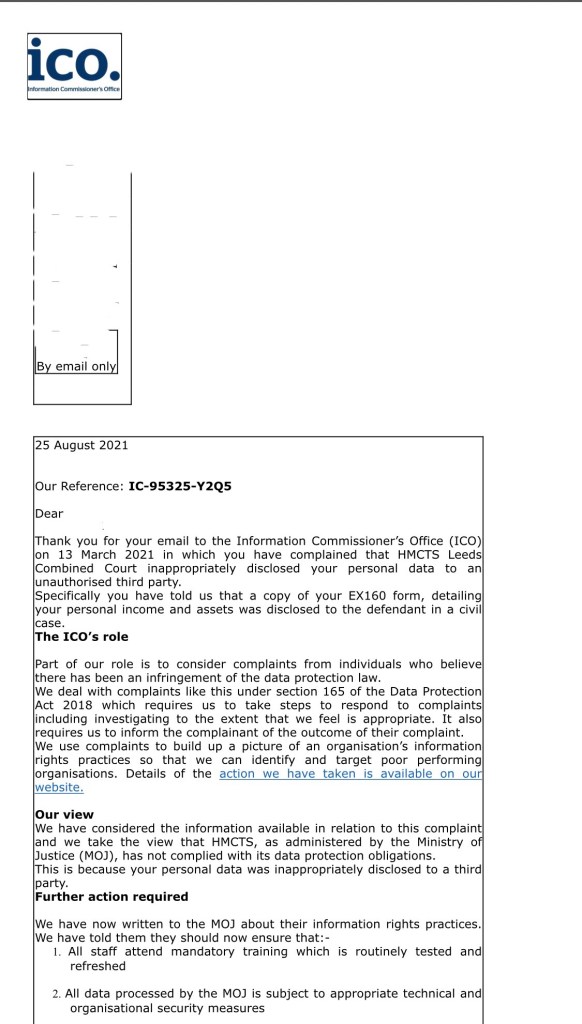
HMCTS shared my personal financial details with a third party.

That’s it. That’s basically all that can be said in the post.

But wait!

Stop and think for a few moments and we can see this is matter is actually considerably more significant and serious than it first looks.

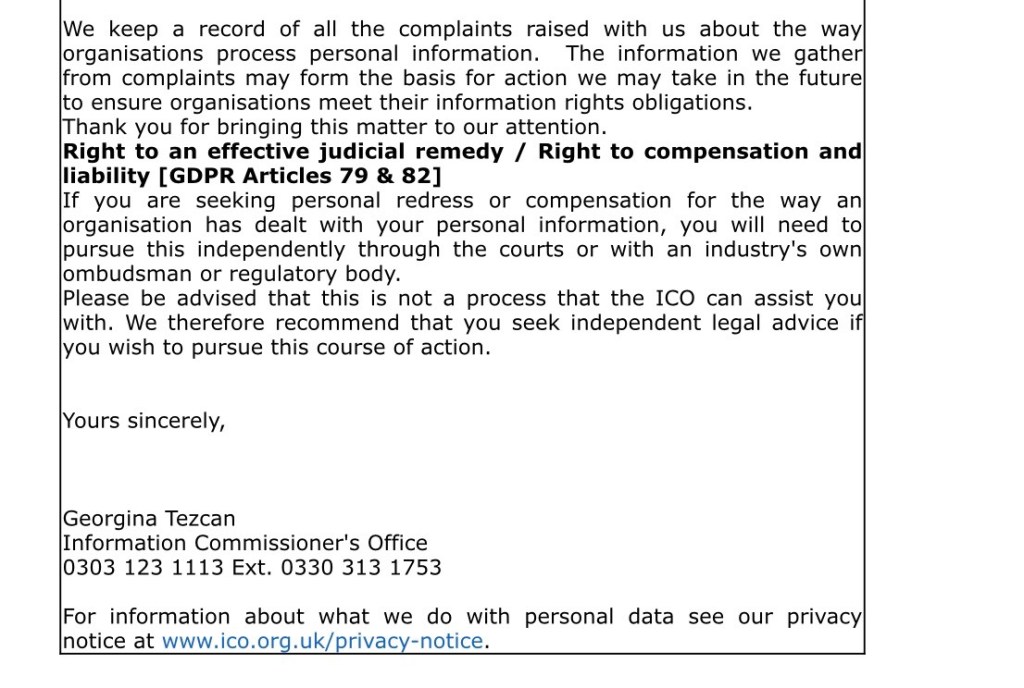
The letter from The Information Commissioner’s Office (ICO) finding against HMCTS can be seen below.

But the operative paragraph from it is simple and plain:

The nub of the issue.

Why should this matter?

Personal data in the care of such as HMCTS and MoJ has the potential to cause significant damage if released inappropriately. Release to a third party with no requirement for or rights to such data can and does cause significant issues.

The simple fact is that the incompetence of County Court staff knows no bounds.

Indeed the vindictiveness of their management towards anyone who has received appalling service from HMCTS also knows no bounds. In this matter an out-of-court settlement was agreed upon to be paid fourteen days from the agreement. Some three months after this agreement I was still awaiting payout.

HMCTS and MoJ are simply two organisations which have ceased to function in any meaningful way and the amount of time spent on damage limitation, denying errors have occurred and attempting to maintain an image of professionalism would be better spent actually running courts efficiently in the first instance.


CPS Caught Out Lying. Again!

There’s few more enjoyable things in life than catching out a liar.

Senior CPS official and CPS Civil Legal caught out lying to the court and the public.

And with such as The Crown Prosecution Service you won’t have to wait long to do this. In the same way as Boris Johnson is capable of three lies before breakfast the CPS loves to try to mislead to cover up the incompetent and vindictive behaviour of its staff.

It’s all about maintaining a sense of professional reputation of course. This is the aim above all else. It comes below proving a professional, effective and efficient service and it leads CPS to try to bend the truth when they’ve been caught out. As happens here.

The joy of this is that they’ve been caught out twice over basically the same thing.

Here’s how this took place.

In a case in which I was involved at The High Court sitting at Leeds the CPS provided data for the Court and a copy was sent to me. The data supplied was factually inaccurate and highly damaging. CPS knew that the data was factually wrong but went ahead anyway on the basis that it would provide them with a tactical advantage in proceedings.

The data was supplied by a Tracy Wareham of CPS Yorkshire and Humberside. Oddly the wife of Gerry Wareham, the head of that division. If her relationship status has anything to do with her continued employment or not given the things she gets up to I couldn’t say.

Wareham supplied a copy of this data to me in advance of the hearing & was warned some weeks prior that the data was factually wrong, damaging, libellous and in need of urgent correction. She failed to make any effort to correct this in advance of the hearing or to research why the data was wrong in response to my emails.

Her actions amount to a breach of GDPR and The Data Protection Act.

The wrong data supplied was sufficiently damaging and serious to cause significant loss to me. The lie put before the Court was of epic proportions.

Nor was this a consequence-free lie. CPS misled the Court in order to gain tactical material advantage.

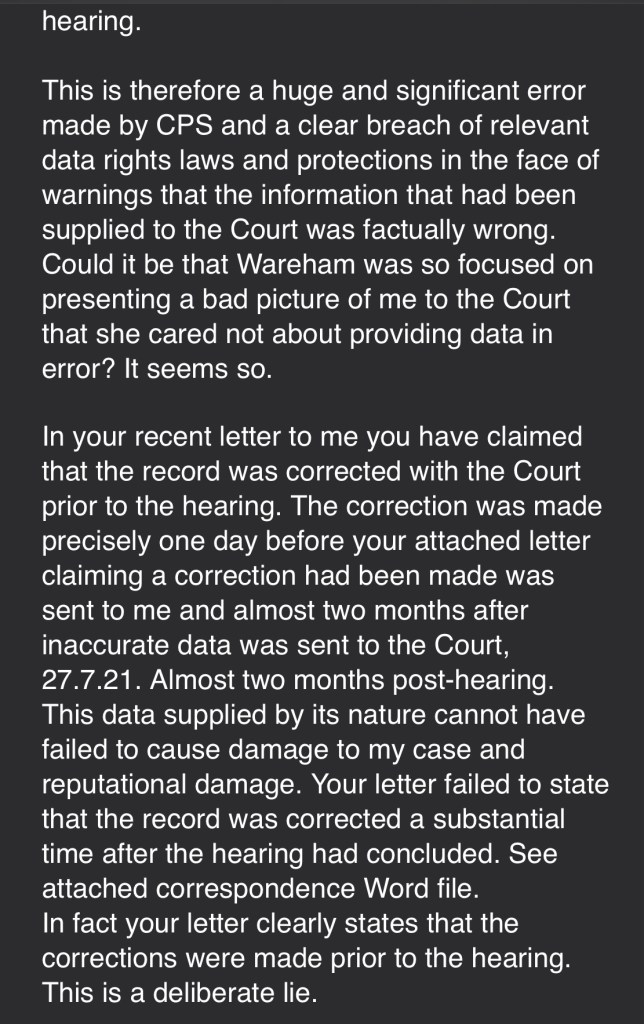
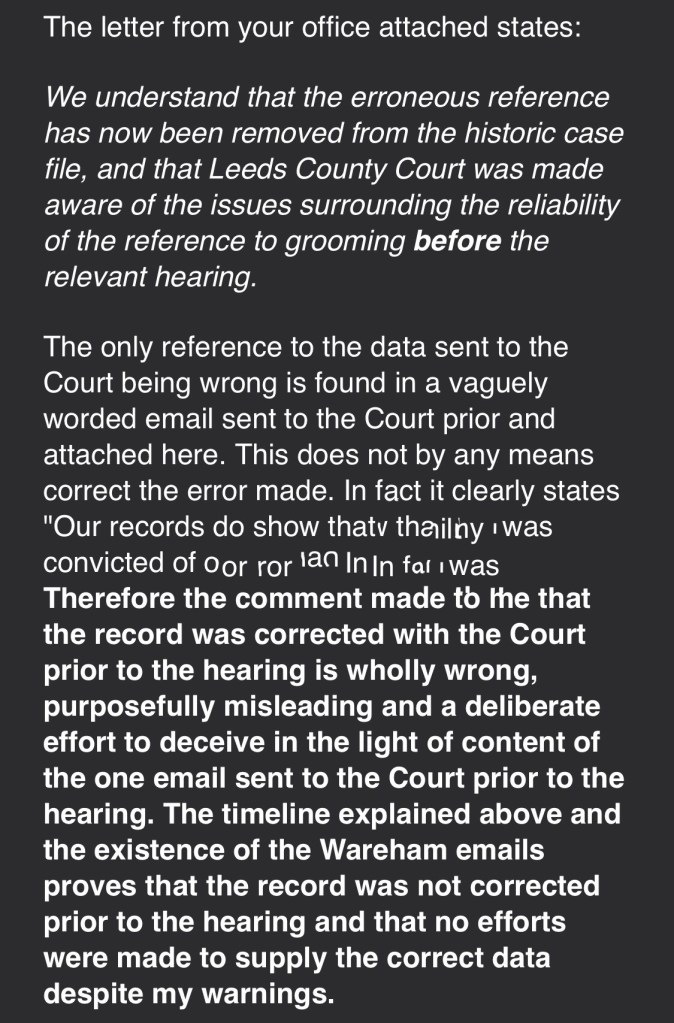
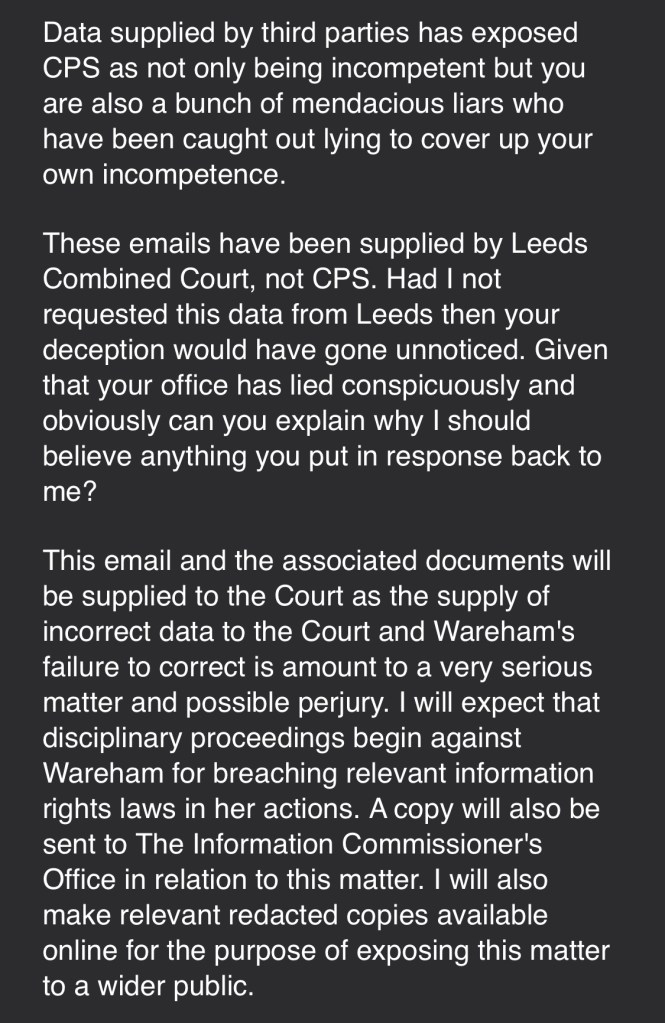
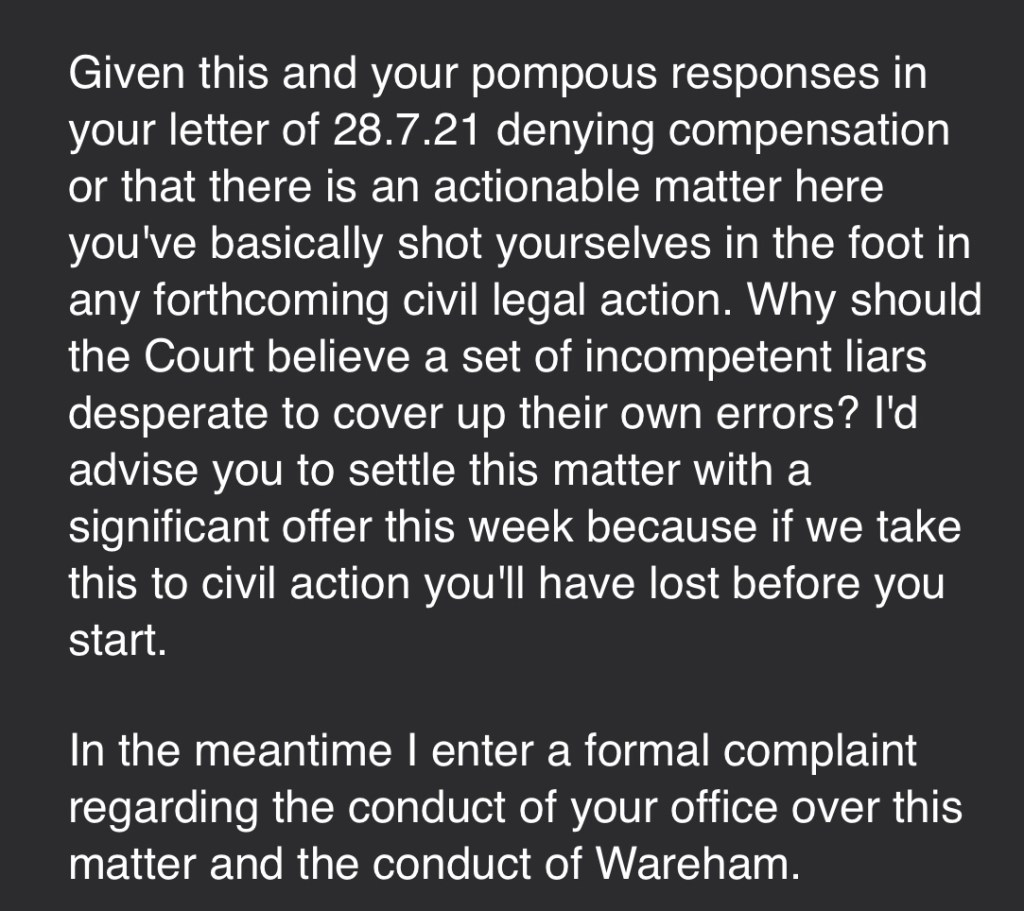
CPS Civil Legal dept. created an arguably bigger mistake when they tried to cover this up a few weeks later. In an email to me they claimed that the error was corrected pre-hearing and that this limited the damage caused.

This is of course another lie!

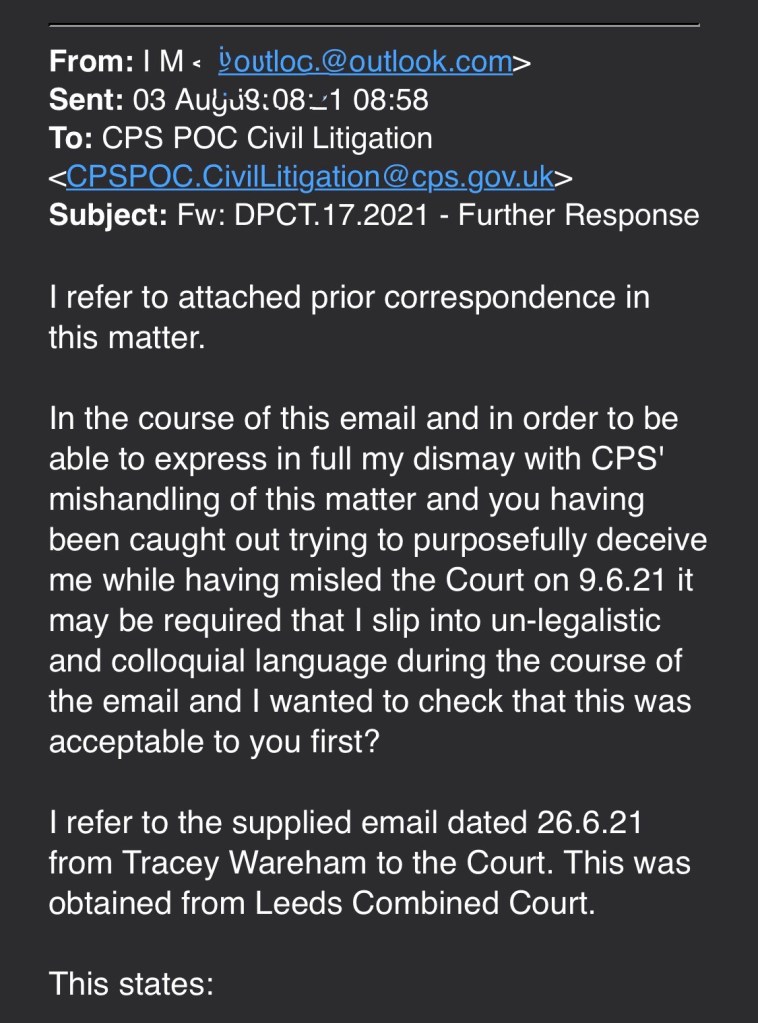
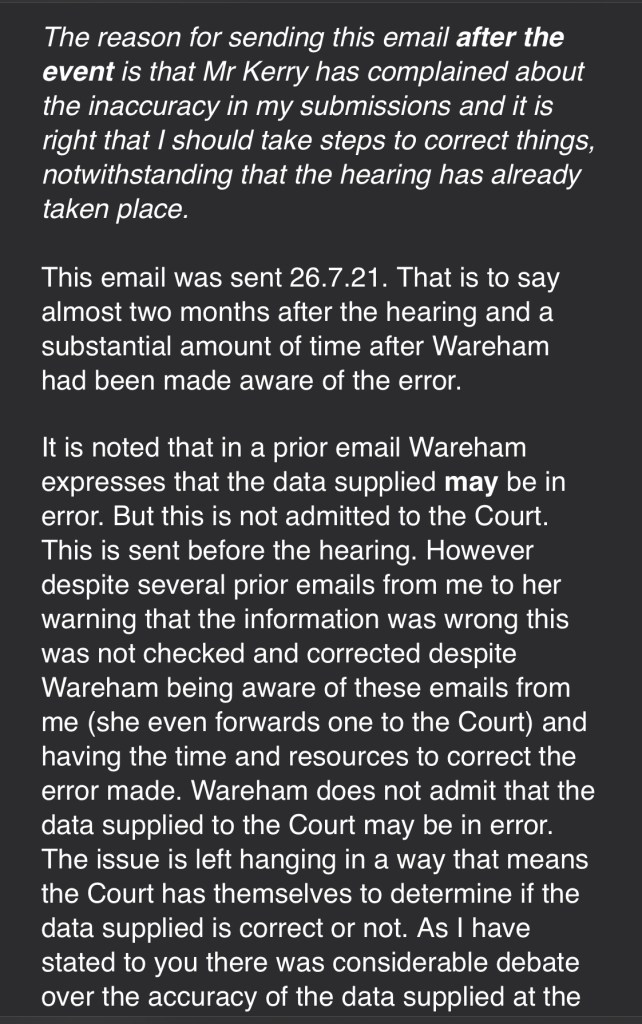
Copies of the emails between Wareham and the Court were supplied to me by Leeds Combined Court and show that no such efforts to correct the data in time were made.

Therefore CPS Civil Legal Services have lied to try to cover up the actions of a senior employee who breached GDPR and The Data Protection Act to try to gain material advantage within a civil hearing by misleading the Court.

Seen below is the email to CPS Civil Legal Dept. exposing their lie. Slight edits made to some lines of text to remove personal details.

Don’t assume that The Crown Prosecution Service is out to tell the truth, be open or is even competent enough to get the basics right. If the opportunity’s there to gain advantage in any situation staff will behave mendaciously and allow their internal departments to try cover up for their behaviour. In this instance both the original person and the department have been significantly caught out. The court has been invited to take action in relation to the supply of a misleading statement in proceedings and The Information Commissioner’s Office has been informed.


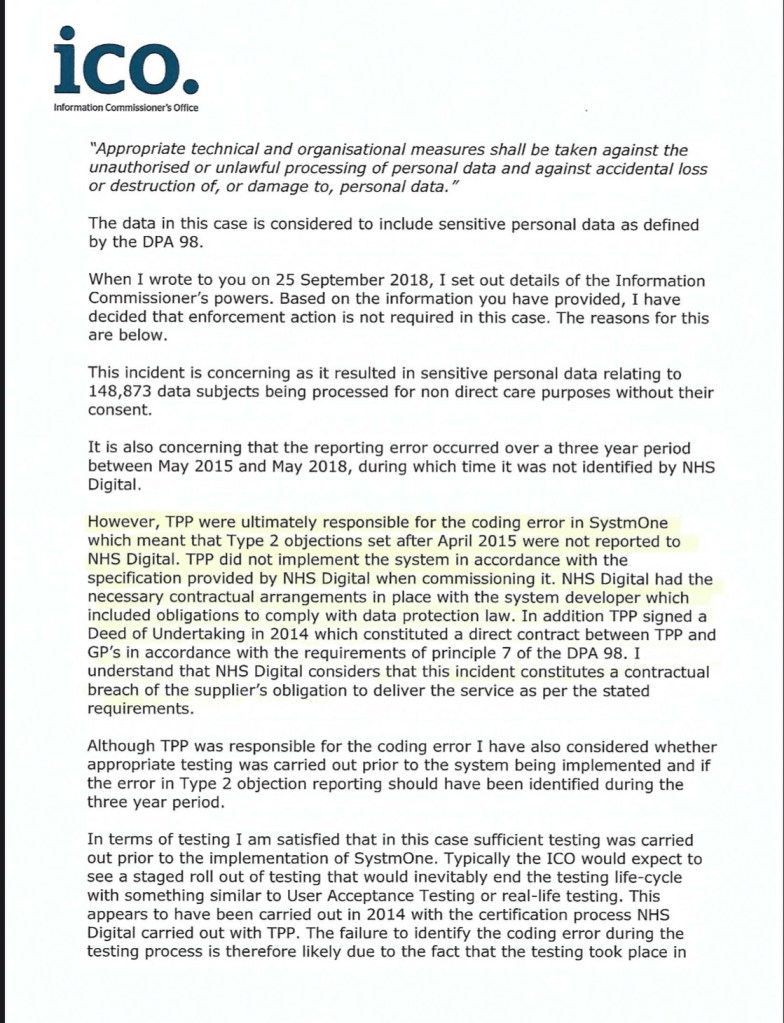
The Biggest Sensitive Personal Data Loss in NHS History.

Currently the scandal around COVID-19 and the supply of contracts for PPE to friends of Conservative Party MP’s and Tory party donors hangs over Britain like an unpleasant smell.

But there’s a similar NHS procurement scandal with a somewhat longer history. This shows that – if anything – lessons are never learned which it comes to NHS outsourcing. The fast and cheap route is often the chosen path and this leads to incalculable consequences for individual patients.

TPP – or The Phoenix Partnership as they are otherwise styled – are a company based in Horsforth, Leeds and provide computer systems and software for GP’s surgeries in the British NHS.

Their website claims that their systems assist in:

increasing efficiency, driving innovation and empowering patients.

…all of which is the usual marketing hot air.

The standard package sold to surgeries is an error-riddled piece of software called SystmOne. This is used by about a third of GP practices in England and holds the records of million of patients.

The present incarnation of this software was introduced in 2012 The Information Commissioner’s Office, the public body concerned with protection of individuals data, has long had concerns about the quality of the software and its ability to protect the sensitive personal data of patients.

A series of coding errors on SystmOne caused – from 2017 onwards – an incredibly significant and serious data loss.

Pictured is TPP founder Frank Hester with former PM David Cameron. Hester has been a part of trade missions led by Cameron and former MP Kenneth Clarke. Hester himself was awarded an OBE – tellingly at about the same time his company was managing to loose the sensitive personal data of some 140,000 people. Tellingly following the revelation of the scandal he has not seen fit to hand this OBE back.

TPP’s parent company made £9.1m operating profit on £48.5m sales in 2015-16. This was concurrent with the data error discussed in this article and the company has more than £56.2m net assets making it easily worth £100m. That the company cannot summon the resources to then produce software which enables GP’s surgeries to keep patient data confidential is quite astonishing.

There have been concerns with the security of data from TPP software even before the knowledge of 140,000 patient’s records being shared became public.

Here’s an extract from an article from Digital Health, dated May 2017. This is around a year before TPP saw fit to inform NHS Digital of the poor quality of its product and the consequences of this. The full article can be seen at www.digitalhealth.net/2017/03/hester-hits-back-over-tpp-data-security-concerns

It states:

“…it comes as the BMA wades into the increasingly murky debate over who controls access to the GP records of millions of patients.”

“The doctor’s trade union is now calling on the thousands of GPs using TPP’s SystmOne electronic record to “urgently consider any action they need to take”, including switching off the system’s “enhanced data sharing function”.
“It has become clear that if patient records are being shared through TPP… GPs are unable to specify which other organisations can have access to their patients’ records”

“Some media have reported [www.telegraph.co.uk/news/2017/03/17/security-breach-fears-26-million-nhs-patients/] that it allowed patient records to be viewed by “thousands of strangers” not involved in their care. TPP has disputed these claims, stating that patients records cannot be accessed without their permission, except in emergencies.

Around 12 months later the errors caused by TPP failing to construct their software correctly led to some 140,000 persons having their personal medical data shared without their consent. This amounted to the biggest data loss in NHS history.

Not that it takes a coding error alone for SystmOne to share your data. If you do not explicitly opt out of having your data shared then the software will enable potentially thousands of third parties to be able to access your patient records.

Often this means that such data is shared with American organisations who pay the NHS for bulk healthcare data. In short then unless you explicitly tell your surgery not to share your data then SystmOne will automatically monetise your data to share with third parties for which the NHS will be paid. It takes an enquiry with NHS Digital to discover exactly who has had access to your data. No doubt your surgery and the NHS overall would rather you didn’t know about the monetisation of your sensitive personal data.

No wonder that in the 2017 article in Digital Health we can see Hester fighting tooth and nail to prevent any restrictions on TPP products being able to share patient data with third parties!


Now to focus back on the issue of the major data loss.

In respect of the 140,000 persons whose data was share against their express wishes the following was said in The House of Commons on 2 July 2018 by the Parliamentary Under-Secretary of State for Health who issued a statement to Parliament in which she said:

“NHS Digital recently identified a supplier defect in the processing of historical patient objections to the sharing of their confidential health data. An error occurred when 150,000 Type 2 objections set between March 2015 and June 2018 in GP practices running TPP’s system were not sent to NHS Digital. As a result, these objections were not upheld by NHS Digital in its data disseminations between April 2016, when the NHS Digital process for enabling them to be upheld was introduced, and 26 June 2018. This means that data for these patients has been used in clinical audit and research that helps drive improvements in outcomes for patients.”

“Since being informed of the error by TPP, NHS Digital acted swiftly and it has now been rectified. NHS Digital made the Department of Health and Social Care aware of the error on 28 June. NHS Digital manages the contract for GP Systems of Choice on behalf of the Department of Health and Social Care.”

She went on to say…

“TPP has apologised unreservedly for its role in this matter and has committed to work with NHS Digital so that errors of this nature do not occur again. This will ensure that patients’ wishes on how their data is used are always respected and acted upon.”

“NHS Digital will write to all TPP GP practices today to make sure that they are aware of the issue and can provide reassurance to any affected patients. NHS Digital will also write to every affected patient. Patients need to take no action and their objections are now being upheld.”

“There is not, and has never been, any risk to patient care as a result of this error. NHS Digital has made the Information Commissioner’s Office and the National Data Guardian for Health and Care aware.”

The full text of the statement can be found at:

www.parliament.uk/business/publications/written-questions-answers-statements/written-statement/Commons/2018-07-02/HCWS813

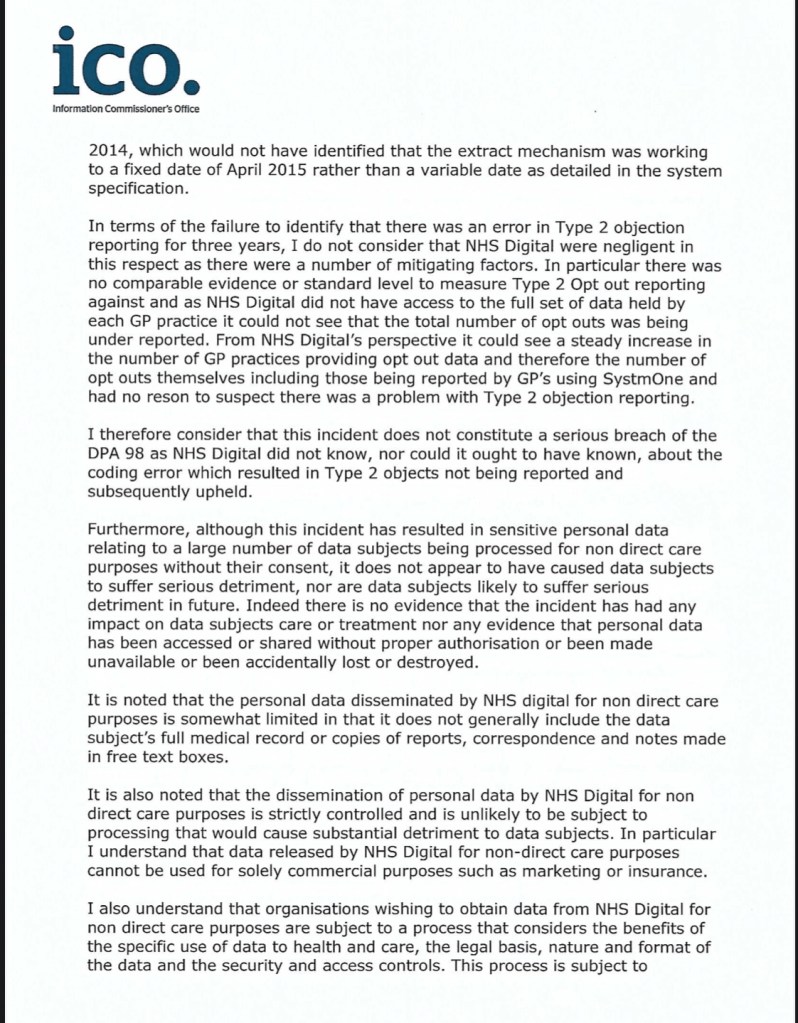
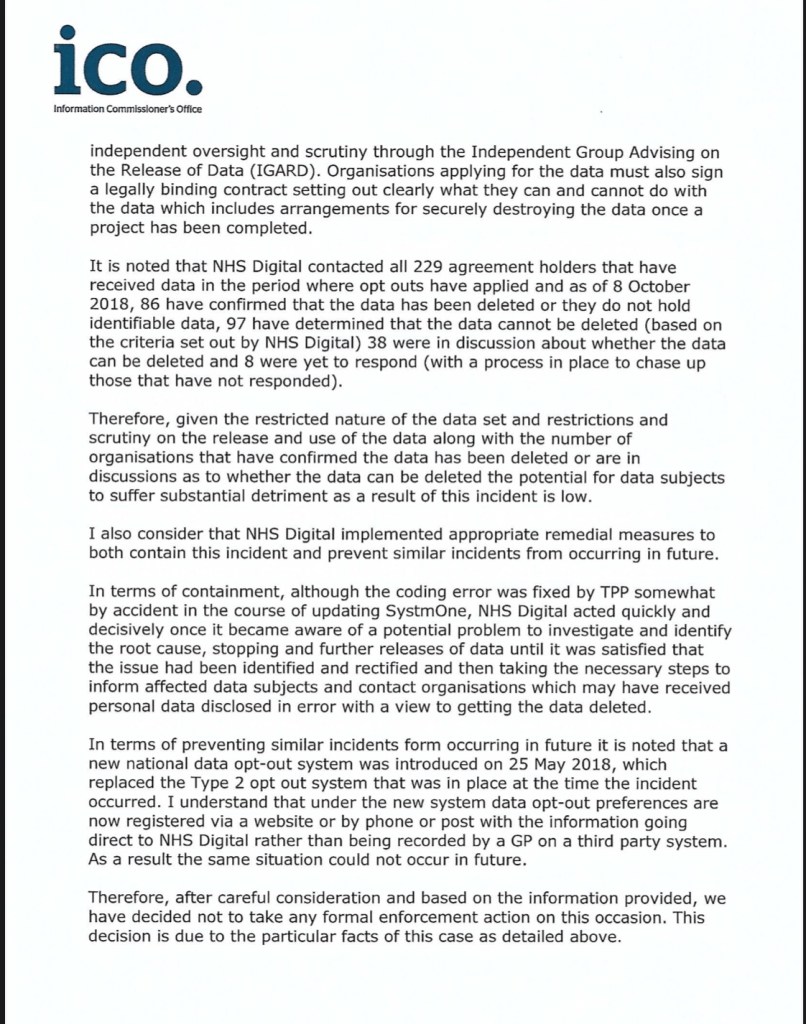
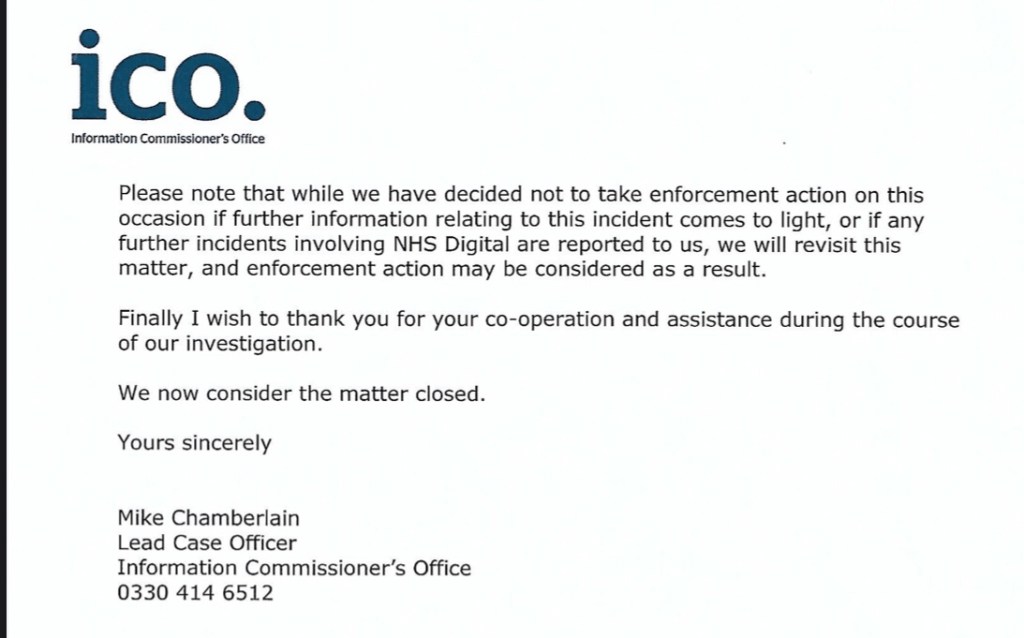
On discover of this – the largest data loss in NHS history – The Information Commissioner’s Office immediately sprang into action. And as expected did nothing. This is par for the course for ICO.

At present it is not known what the commercial relationship between TPP and NHS Digital may comprise. Therefore it cannot be said if one has indemnified the other from the consequences of data losses. This may be why ICO fails to act.

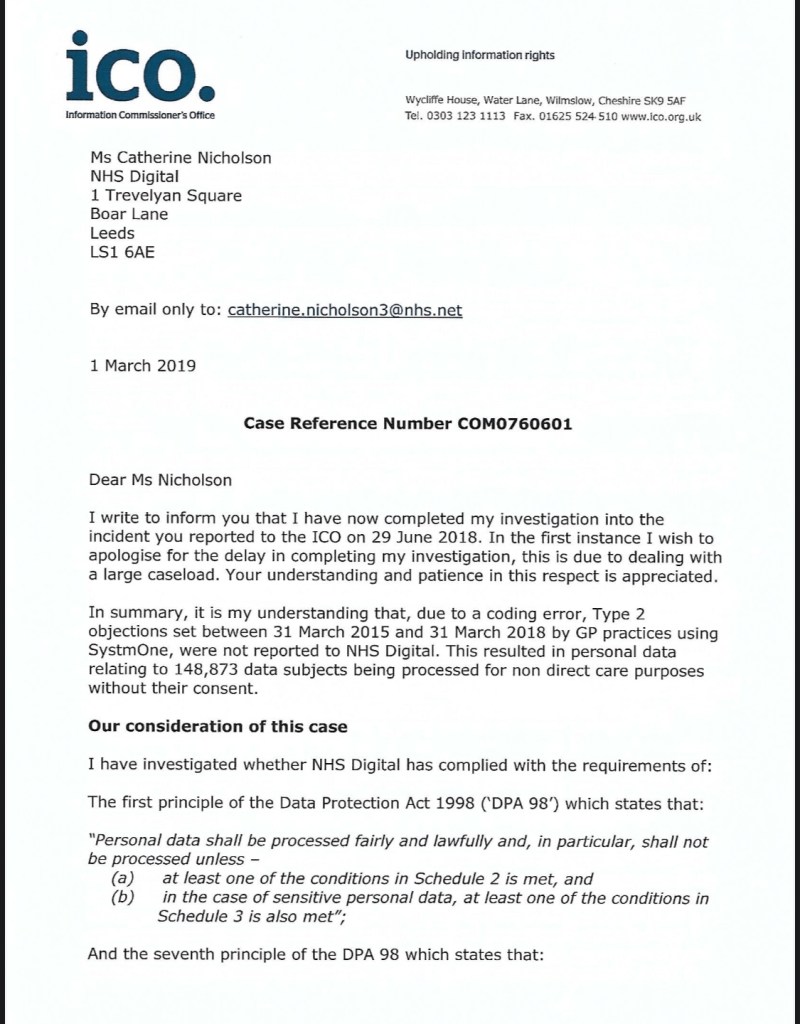
Look at the extracts below from a letter sent from ICO to NHS Digital. As far as I’m aware this is the first publication of this document in any media:

All of tale of failure is par for the course in modern Britain.

Shoddy companies such as TPP gain contracts for services to the public sector but produce shoddy work. When errors happen it’s a “learning experience” for all concerned rather than one in which heads roll. Supervisory organisations such as ICO fail to act as appropriate. And the gravy train keeps on running!

ICO Address Police Breaches of the Law on GDPR

Police forces are notoriously bad at responding to subject access requests (those are requests for your own personal data) as well as requests for data overall from the force, especially if the request for access is made by the public.

The Information Commissioner’s Office has recently published a report (link seen below) outlining just what an absolute catastrophe police responses to these requests are.

Click to access timeliness-of-responses-to-information-access-requests.pdf

As ever with such a report the real eye-opener are the recommendations made by ICO. In this instance these are nine points which show how UK police forces are failing to deal with data access requests in anything like an efficient and professional way. Often this is because the purpose of data access legislation clashes with police’s wish to keep information regarding errors in procedure and process wholly secret.

Title page of ICO’s report.

This report will cause consternation in particular at failing Humberside Police, a force subject to many eye-watering fines from ICO in the past for failures to comply with the law on data access by the public. The recommendations ICO suggest will likely be impossible for the force to implement.

West Yorkshire Police – as expected one of the forces most likely to break the law to try to avoid the production of data – said at a meeting convened by their Police and Crime Commissioner recently that they would be looking at increasing the staffing in the Information Management Department in the next year (budget permitting) to cope with the demands made upon it. “Looking at” and “budget permitting” is another way of saying that nothing will be done to address the problem.


A Christmas Card from Humberside Police!

I’ve written on here many times before about how Humberside Police are particularly useless, even in a hotly contested field of local forces.

However even I fell off my chair at the sheer incompetence of the subject access response provided by their Information Compliance department this week.

A subject access request provided by the force amounts to a nonfeasance as the response:

1. Fails to provide the data requested.

2. Is issued outside the legal time limit for a response to be provided.

3. Repeats back the same information put in the original request.

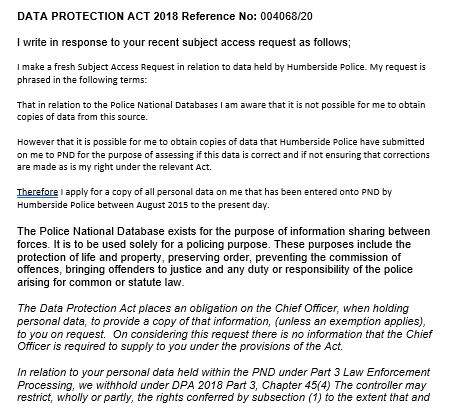
Here’s the letter in full. I have redacted the header.

The key sentences are in the fourth and fifth paragraphs seen above. These are reproduced from the original request. Data cannot be obtained from the Police National Computer – however data that has been entered into the PNC by a local force can be obtained from the same regional police force. Hence the request to Humberside Police.

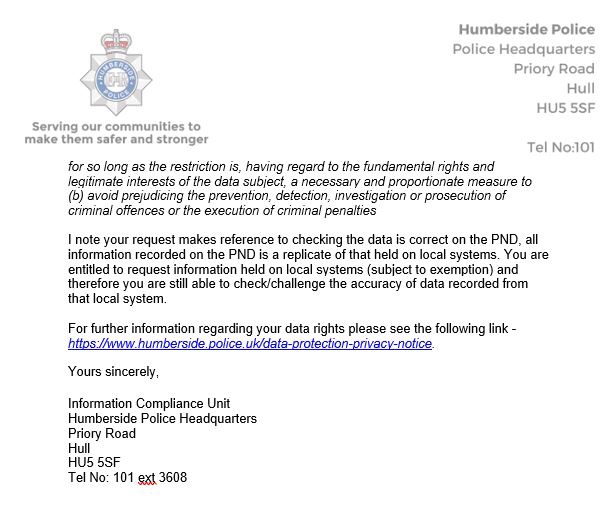
The substantive reply is seen below:

Here we focus on the second paragraph. It essentially repeats the data I put to police in the first instance.

Consequently the force has failed to react correctly to the subject access request in every conceivable aspect.

This suggests that the intention is to continue frustrate any further request made for the data using the rights conferred in italics in the letter to do so as the response to any further requests that might be made.

The Information Commissioner’s Office has been informed.


The Information Commissioner’s Office: Mark Your Own Homework

The rights of the public in the UK to access data held by state-run organisations are enforced by The Information Commissioner’s Office. I say enforced but effectively unless there’s a very significant series of large-scale errors or deliberate mischief ICO chooses to look the other way.

They’ll more often choose to look the other way in the event that the miscreant organisation is a public body: a large-scale data breach by the NHS in 2017 / 2018 attracted only a note from ICO to NHS Digital gently chiding their error.

Some of the means of looking the other way include ICO issuing a “finding” that the organisation you’ve requested data from has failed to comply with the law, or a “recommendation” that that misconducting organisation complies with the law. Neither of these two results has sufficient force to compel a turnaround from the data controller if they’re determined to dig in their heels. None of these weak regulatory methods described above actually produce the data you’ve requested: if the organisation is sufficiently obstreperous you’ll need to enforce your right of access to the data via civil legal action.

Yes, folks. You’ve guessed it! Another supposed “watchdog” that turns out to be toothless, doddering and tame.

At the beginning of the pandemic hitting the UK in March 2020 ICO issued guidance to organisations over handling data access requests which effectively boiled down to “don’t misuse the fact that there’s a national emergency to get around your statutory obligations”.

Eight months on and the initial finger-wagging approach has been replaced with a new edict from ICO: mark your own homework.

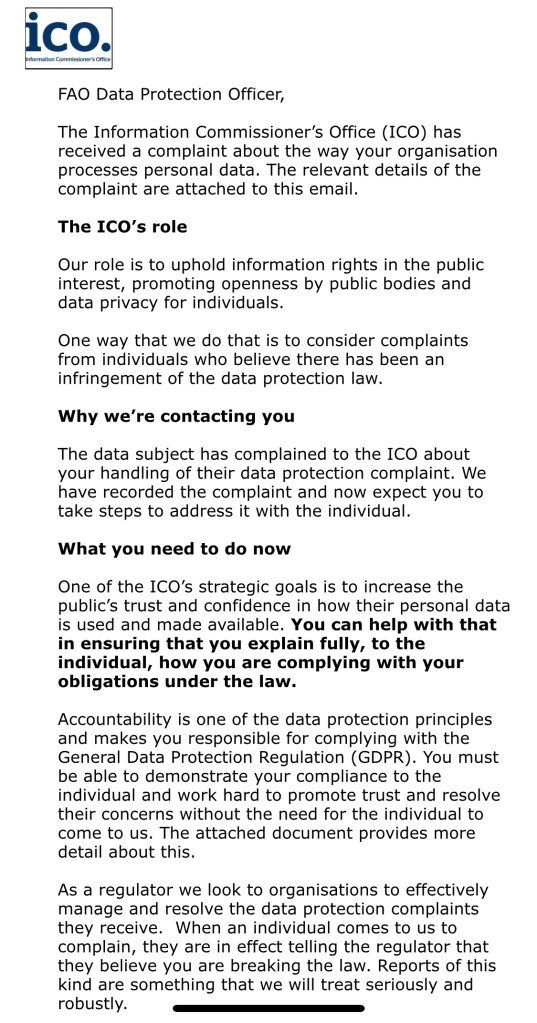
Organisations that infringe the law on data access issues are now routinely in receipt of this standard form letter the first page of which appears below:

Easier than enforcing the law: ICO states the bleeding obvious to data controllers breaching the law.

The “seriously and robustly” in the above extract doesn’t apply to any actions ICO have taken in my experience of the organisation. Even in the face of large scale data breaches for which ample evidence of a data subject’s Section 173 rights being infringed exists ICO still takes the lethargic approaches mentioned above.

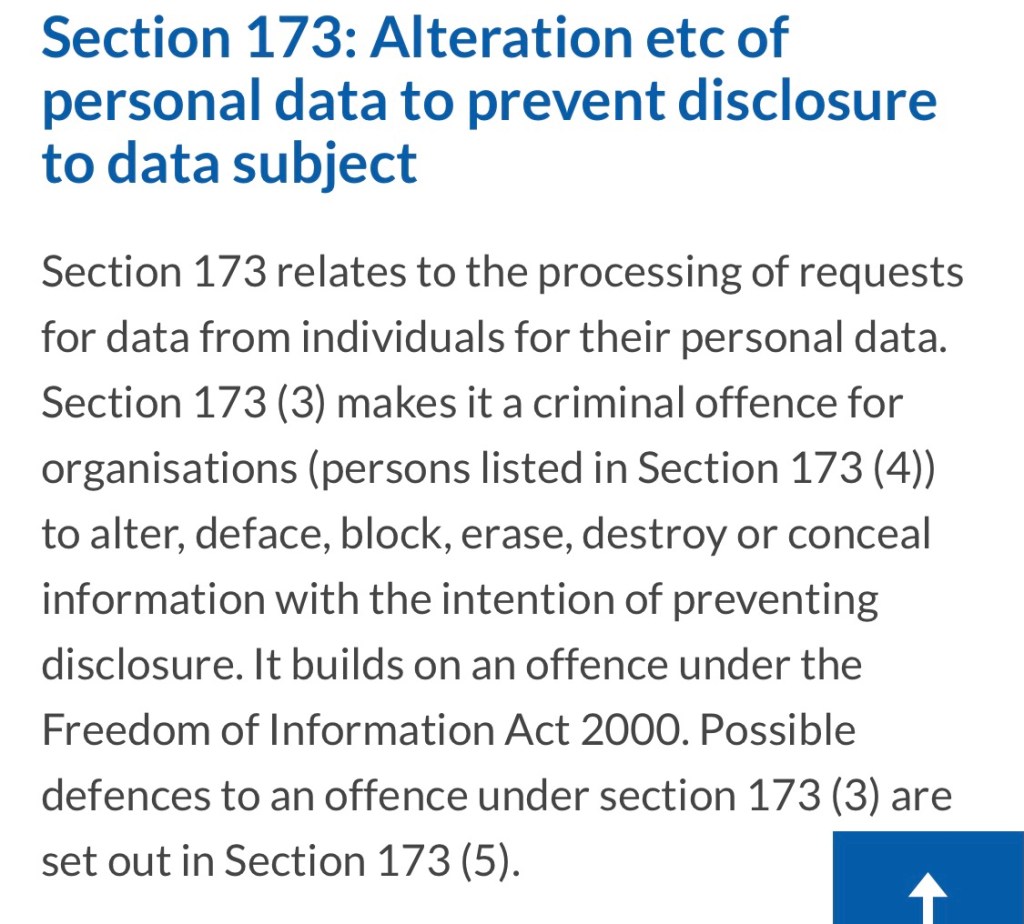
Briefly yours and my Section 173 rights are this:

Extract from CPS website.

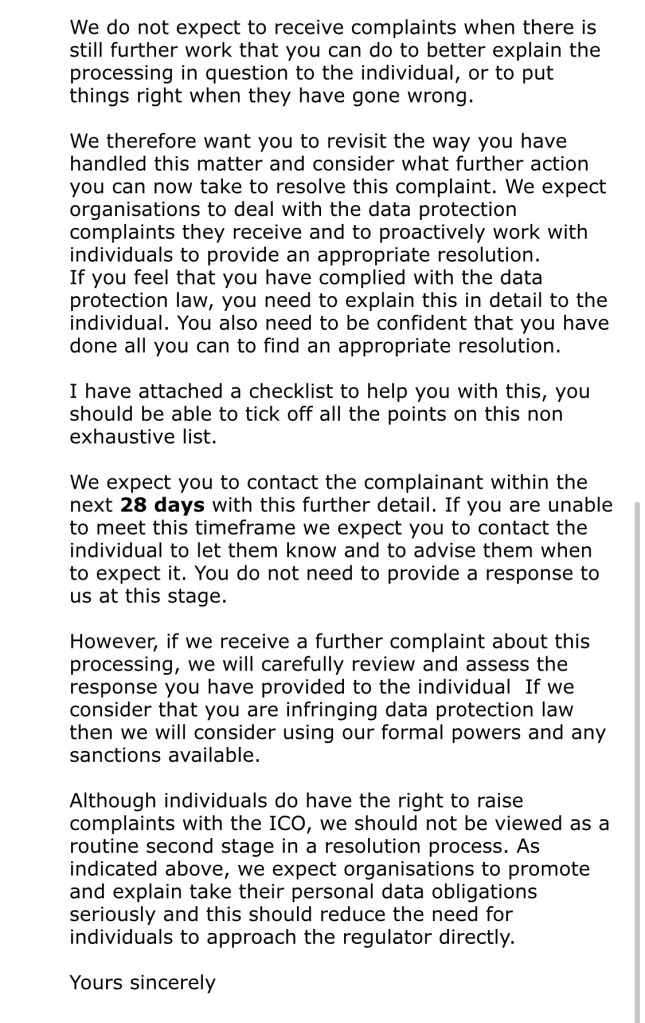
The letter sent out by ICO continues:

…all of which explains the obligations on an organisation that they are already / should already be aware of.

One wonders what the point is of informing an organisation that’s already purposefully screwed up such as a subject access request what their obligations are. If the body is determined to withhold data for the purpose of – for example – preventing revelation of their own misconduct then a weakly worded letter from ICO will not make them correct their ways.

Misconducting organisations must be quaking in their boots regarding the powers and sanctions bit in the second to last paragraph, knowing ICO is notoriously weak on enforcement.

Thus the Merry-Go-Round of the UK’s weak regulatory and enforcement structure rumbles on.

The ICO: Keeping Your Personal Data Safe?

Brief post for today. Well a brief post by the standards of this blog!

In yesterday’s blog post one of the themes touched upon was how The Ministry of Justice had sent data in error to a third party. This was a serious breach of the data subject’s rights and potentially quite dangerous to the data subject as MoJ shared the subject’s name, address, date of birth and financial details.

The post discussed the attempts The Ministry of Justice made to get back at the accidental recipient of this data which included a false complaint to police to ensure he was arrested, although fully aware police would not be able to bring charges as no offence had taken place.


Elizabeth Denham, UK Information Commissioner

The Information Commissioner’s Office (ICO) is a quasi-Governmental organisation reliant on public funding. Their stated aim is to enforce data access rights of people in the UK and also to adjudicate on data protection issues: in other words to monitor that your personal data held by companies and Government organisations is kept safe.

So we can naturally expect ICO to fully comply with data protection legislation and be extra specially careful with their own handling of other people’s data.

Can’t we?


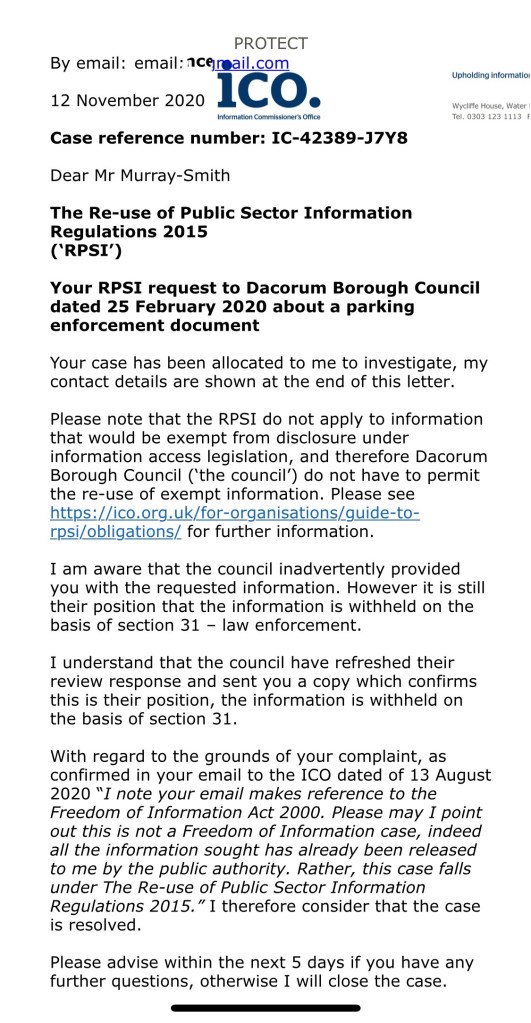
In a delicious piece of timing just after I’d written yesterday’s blog post about The Ministry of Justice emailing data to the wrong person ICO go and do the same by sending a letter in error to me which was intended for a third party, just like the error MoJ made!

I have of course deleted the email address of the intended recipient of this letter.

It seems that Dacorum Borough Council also suffers from the problem of email incontinence as they appear to have sent the intended recipient of the ICO letter some information despite claiming an apparent exemption over the data sent!

The ICO letter states:

I am aware that the council inadvertently provided you with the requested information.

Significantly the letter also states the grounds for the council attempting to withhold this data (but clearly not managing to) were under section 31 – that is a claimed exemption from disclosure as the data is related to law enforcement.

One might hope the ICO takes appropriate action against itself for this data breach.

In all honesty I wouldn’t hold my breath.

ICO’s present logo. Strange use of lower case letters and an inappropriate full stop.

Like many of the UK’s regulatory bodies such as The Parliamentary and Health Service Ombudsman or The Local Government Ombudsman the ICO has selective blindness in relation to even large scale and ongoing breaches of GDPR and The Data Protection Act.

Ultimately the best most complainants can hope for is a letter from the ICO informing them that their complaint has been upheld and that ICO will keep a record of the data protection concerns logged regarding the data controller complained of. This does not of course produce the data that has been requested! Occasionally ICO will assist by instructing the data controller to supply data if it is being clearly withheld. However if the data controller is sufficiently obstreperous there exists enough “trapdoors” in the relevant legislation that a (often misapplied) exemption will be used to avoid supply of the data.

The efforts organisations used to evade production of data include the mishandling of applications such as considering a subject access request for personal data as if it were a Data Protection Act request and so rejecting it without giving sufficient grounds to the requester. A further trick is to label everything as the personal data of a third party and thus exempt from disclosure: on this basis large scale parts of any data disclosed can be redacted (meaning blanked out).

In these circumstances ICO becomes like a turtle placed on its back: it spins around to no real effect.

Let’s look at the wider picture. A key thing to recall about most of the non-departmental public bodies supposed to supervise how the law or organisations work in Britain is that they rarely do. These supervisory bodies often exist instead to confirm the decisions made by the lower organisation or as a way to diffuse complaints safely and without litigation. Having said this ICO is better than most and does occasionally pursue misconducting organisations through the courts. But due to the pressure of time and resources they also habitually pursue only those organisations who have committed a blatant breach of the law which has been made public, or who would be less likely to defend themselves in court and thus drive up ICO’s expenses. The majority of the fines issued in successful judgments are not paid.

One example of this willingness to turn a blind eye on the part of ICO: a 2017 significant data breach by the NHS involving some 50,000 patients medical records – the largest loss of data in NHS history – was not prosecuted by ICO. This is a matter I will comment on in detail in a blog another day.

Design a site like this with WordPress.com
Get started