

West Yorkshire Police Caught Out Over Serious Misconduct Issue

When caught out the first reaction of many police officers is to lie.

The blog entry below relates to an illegal arrest and breach of PACE by West Yorkshire Police. Even by the low standards of that force this is a shocker.

This blog entry also relates to a effort to hide information by Plodโ€™s Right of Access dept. and a clear effort to deceive by West Yorkshire Police Professional Standards dept.

The last two offences were exposed by the active intervention of The Information Commissioner’s Office (ICO) who have forced police to produce documents Plod has spent the best part of a year trying to hide precisely because they prove misconduct in public office.

The background to the complaint is related to an ultra vires arrest of myself on 22nd of May 2020 without legal justification or reasonable grounds. Hereโ€™s a little background:

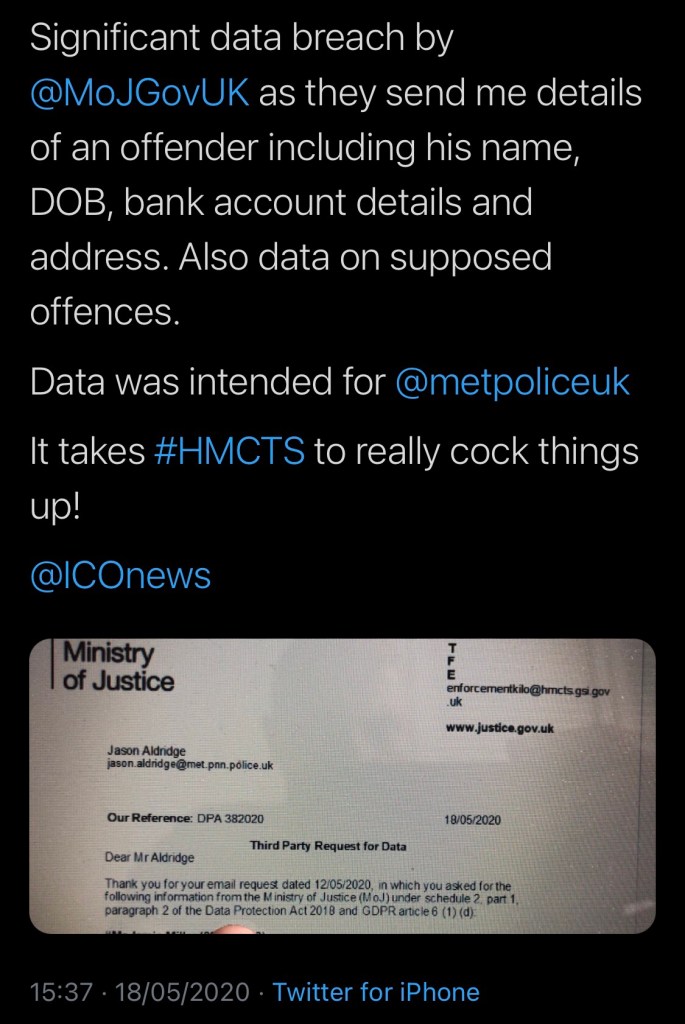
In May 2020 I was sent in error documents and data intended for the Metropolitan Police. This data concerned Proceeds of Crime Act proceedings against an individual living in Kent and was sent to me accidentally by The Ministry of Justice.

The data amounted to a significant data breach containing as it did many personal and financial details for this man. Given the seriousness of this I informed The Information Commissioner’s Office that a significant data breach had taken place.

Four days later I was arrested by West Yorkshire Police on the request of The Ministry of Justice under allegations that I myself had breached The Data Protection Act.

This is of course not true. Emails obtained from the Data Security Manager at HMCTS Liverpool state that they intend to have me arrested โ€œto give him a shockโ€ following my referral of this matter to ICO. And of course the matter was not pursued beyond the inconvenience of arrest.

This arrest also resulted in the removal of electronic devices from my home containing legally privileged, legally professionally privileged and litigation privileged materials stored electronically on those devices. This is a breach of PACE 19.6. The subsequent examination of the contents of these devices by digital forensics officers at West Yorkshire Police without triage of the privileged contents amounts to a breach of common law, which Plod then tried to hide.

As you might expect from the generally inept nature of this force the efforts to hide the data on this illegal examination resulted in the eventual revelation of misconduct in public office.

A complaint about the illegal arrest was made to West Yorkshire Police Professional Standards (PSD) in June 2020.

Part of the response to this dated 14.8.21 from the reliably evasive PC Vicky Silver at West Yorkshire Police PSD states:

The devices which were seized from your home were booked into property stores under crime reference 13200256161 and itemised to be โ€˜Nokia Mobile phoneโ€™ Exhibit reference DMW1 and a โ€˜HP Laptopโ€™ Exhibit reference DMW2, seized devices were booked into property with the intention for these to be examined, upon the MoJ being informed of the process and timescales involved they requested no further action be taken and for your devices to be returned. PS Shand confirmed no examination took place on your devices and they were not examined, nor switched on whilst in Police possession. The records held show the devices were only removed from property stores in order to affect their return to yourself. 

Much of the above was a lie. The most significant elements of which West Yorkshire Police have now been caught out on. 

PS Shand refers to Police Sgt. Anthony (Tony) Shand. The disclosures forced by ICO show that his testimony to PSD regarding the devices not being digitally examined was a lie.

The Information Commissioner’s Office has been involved in a data access request made to Right of Access at West Yorkshire Police from August 2020. This request was originally made 27.8.20.

West Yorkshire Police Right of Access dept. has ever since been attempting to withhold evidence such as radio traffic, CCTV footage and the record of what happened to the electronic devices when in police custody.

The below is an extract from a Right of Access dept. letter to me dated 5.3.21. It can be seen that both the image showing the property record is cropped and they also deny the items were taken out of the property store for digital examination.
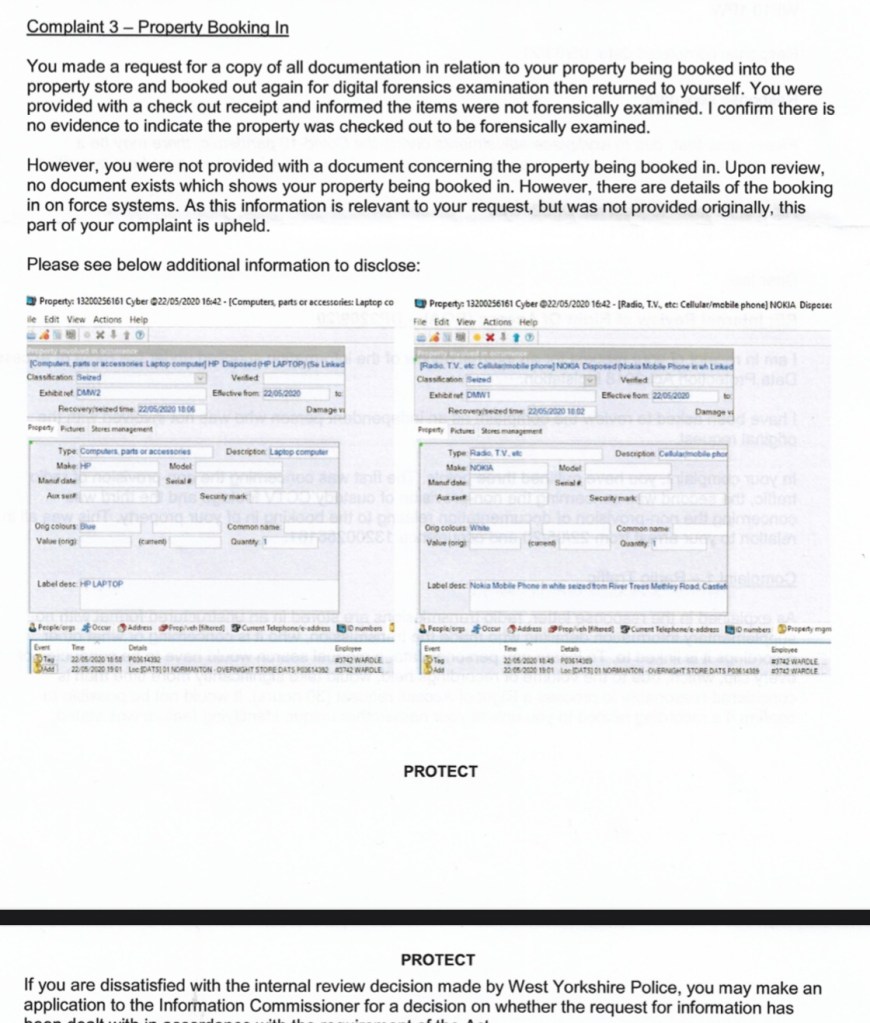
Cropped at the point of items being booked in. ICO later compelled the release of the unedited data.

ICO as Right of Access departmentโ€™s professional regulator has made an active intervention and compelled the release of documents from West Yorkshire Police which were previously withheld.

These documents show the booking out of the electronic devices when in the property store for digital forensic examination, thus breaching common law, as of course legally privileged materials were stored on them. The version seen above was cropped to hide the removal of the devices for examination, breaching common law in so doing.

A copy of the most recent disclosure showing the data which ICO forced police to disclose is below. This shows data wholly contrary to what was stated in the PSD complaint response, seen above, of August 2020 and Right of Access departmentโ€™s response of March 2021. The devices clearly were removed on the dates shown for digital forensic examination. Below is seen the unedited version of the property record – that shown above was edited by Right of Access dept. to remove incriminating data.
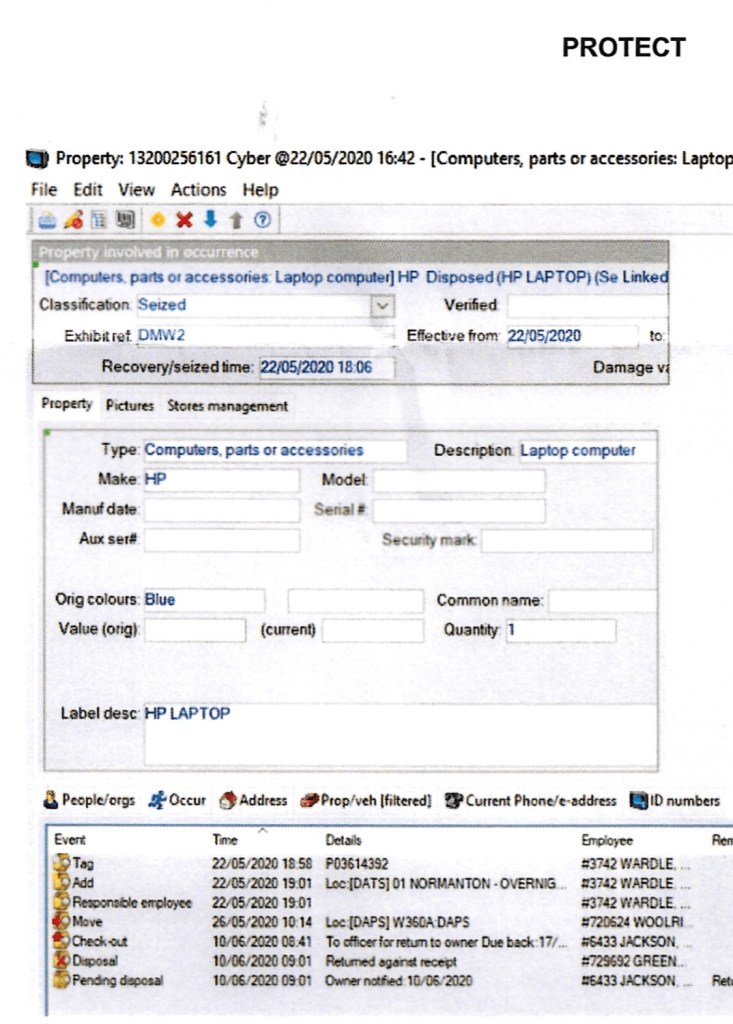
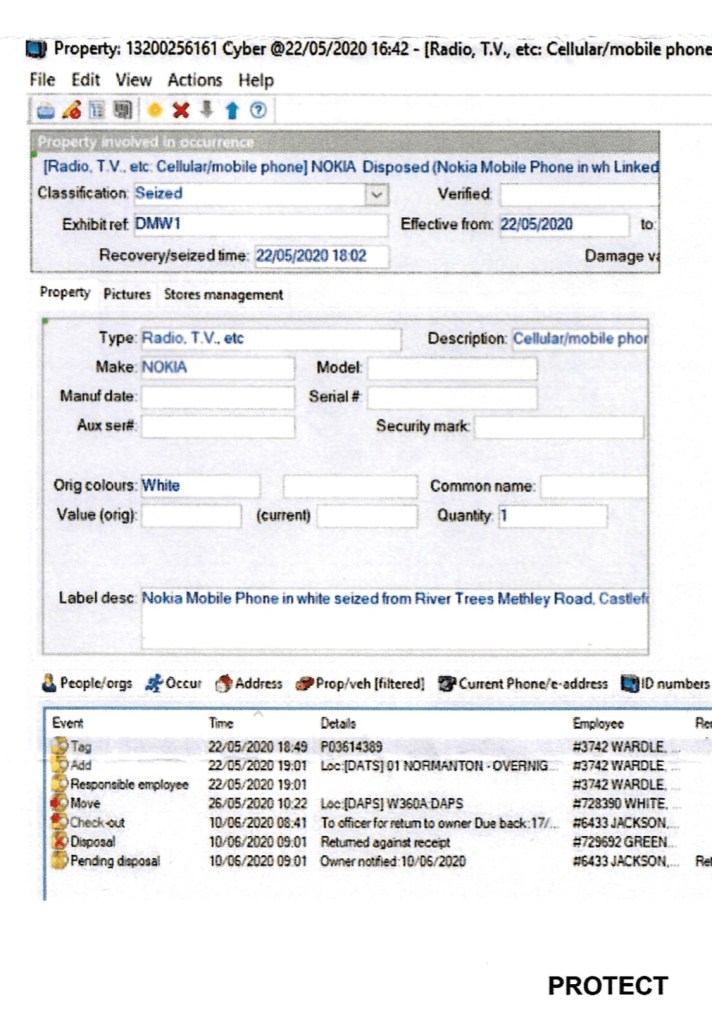
Laptop booked out for forensic examination 26.5.20 and returned to property store 10.6.21.
Likewise phone booked out on same date and later returned when examined.

On this basis PS Tony Shand in his testimony to PSD and PC Vicky Silver both sought to purposefully mislead in the response to the complaint made.

Right of Access dept. also sought to mislead in their response to me of March 2021 and further edited the property record by cropping out the incriminating data.

Both departments and individuals at West Yorkshire Police have stated things that they know to be untrue in an effort to avoid professional embarrassment, an allegation of misconduct in public office and the breaching of Common Law in relation to privileged material on the electronic devices. There is also the breach of PACE 19.6 in the removal of the devices from my home.

Right of Access dept. attempted to withhold the relevant document until instructed by their professional regulator ICO to release the information. Indeed an examination of the images on this page shows that they deliberately cropped the first disclosure sent to me in March 2020 to hide data. This amounts to a breach of S.77 of FOI 2000 by West Yorkshire Police as there has been a purposeful effort to hide relevant data. This is a criminal offence under the relevant Act.

That there existed significant opportunity for WYP to produce the relevant data prior to ICO intervention but they avoided doing so to try to hide misconduct in relation to the electronic devices.

The purpose of withholding the data was to avoid professional embarrassment to West Yorkshire Police over a breach of Common Law in the retention and examination of legally privileged material contrary PACE 19.6 and the seizure and retention of the same without a warrant.

It is now clear from the disclosure made as the result of pressure from ICO that West Yorkshire Police has not only committed purposeful misconduct in public office over the seizure, retention and examination of legally privileged material without a warrant but also that they have attempted to cover this up by wholly misleading statements in the complaint response and the subsequent effort made to hide disclosure requested.

Had ICO not forcibly intervened in this matter then the degree of misconduct and breach of legally privileged material would have remained hidden.

Given that they lie so glibly over such a serious matter none of the other assertions made by West Yorkshire Police Professional Standards dept. in any complaint response can be trusted to be factual and truthful.

As anyone who has ever dealt with that department will be aware!

The case of Julian Assange & Press Freedom

I write in relation to the Julian Assange extradition attempt by the US government. This has received a ruling today which has stated that Assange cannot be extradited to America on the basis of mental health concerns.

It is widely considered that the case against Assange has been cooked up as revenge against Wikileaks publication of atrocities by the US military in the Middle East. That such was designed to frighten any journalist in the future from exposure of similar state backed horrors.

As this post will detail The Ministry of Justice in the UK is quite prepared to commit abuse of process to also persecute those who publish material which exposes its wrongdoing and incompetence.

Assange in transit in a prison van from Belmarsh high security prison where he has been held.

The ruling in the case is that extradition cannot take place as America cannot guarantee the safety of Assange in a US prison in the light of his apparent suicidal ideations. These thoughts probably stem from his continued persecution for many years over Wikileaks publication of video footage of atrocities committed by the US military against civilians.

The points made regarding the safety of the US prison system of course apply equally – if not more so – to British prisons. Belmarsh was the choice of prison for Assange on the basis of the additional security given to inmates there.

The other thing that struck me about the judgment is that the extradition to America was refused not on grounds which assert and re-enforce the freedom of the press or the ability of such as Wikileaks to publish material which challenges authority but on the grounds of safety for the defendant.

The decision was made by a District Judge. Anyone familiar enough with the British legal system will likely be aware that the judge has chosen an anaemic third way in order to dismiss the case for extradition. No wonder the decision is likely to be appealed! Rather than outright confrontation of the prosecution case which was designed both as an act of revenge against Assange and a threat to any future journalists exposing official misconduct the judge chose a way which avoids these prosecution arguments being confronted and carefully debunked.

If a decision was made to extradite on the basis of the case put on behalf of the prosecution then the risk to press freedom in future would have been grave. As it is the case has been a warning shot to anyone thinking of publishing contentious material regarding state backed misconduct.

The judge has accepted the proposition advanced by Assangeโ€™s legal team that an American prison is not sufficiently safe for someone with suicidal thoughts.

Were he still alive Jeffrey Epstein would also likely agree that an American prison is an insufficiently safe environment for people who have – like Assange – embarrassed or risk embarrassing those who hold the levers of power in America.


We donโ€™t have to look to a high-profile case such as this to see official misuse of power in an act of revenge against those who publish material which would embarrass authority, as our own Minisry of Justice in Britain are quite prepared to carry out misconduct in public office in this way.

In May this year I was sent material in error by MoJ. This was a letter intended for the Metropolitan Police in relation to Proceeds of Crime Act proceedings against an individual in the Kent area.

The data sent to me in error constituted a considerable Data Protection Act breach and covered the name, address, date of birth and bank details of the individual and other compromising data. Such data in the wrong hands could have resulted in considerable fraud committed against the data subject by the misuse of his personal details. I informed both The Information Commissionerโ€™s Office and the data subject about this.

I also posted – with no small amount of schadenfreude – the tweet seen below. No aspect of the content of this tweet breached revealed data on the data subject and thus was not actionable. It simply and quite rightly embarrassed MoJ as an organisation which is incompetent in the handling of personal data.

Despite the fact that MoJ were wholly in the wrong over this entire matter they decided to go on the offensive and instructed West Yorkshire Police to arrest me in relation to offences under The Data Protection Act.

Police, having seen no evidence of any offence committed in civil or criminal law, nevertheless took the word of MoJ as gospel and in so doing broke the law themselves not least by committing a wrongful arrest.

I was arrested and held in custody at the police station. It was relegated much later in an email chain from the Head of Security at MoJ that the purpose of this was โ€œto give him a shockโ€. Iโ€™d embarrassed MoJ in public with the tweet and reported the data breech to ICO. Consequently MoJ wished to revenge itself and were prepared to commit misconduct in public office to do so.

Of course the other thing the emails between MoJ and West Yorkshire Police also reveal is the sudden loss of interest in the matter when I was arrested – the arrest being the short, sharp shock MoJ was aiming for. An internal investigation by police also admits there were no grounds for arrest and no offence had been committed.

The point of my explaining all this shabby behaviour and breach of duty of care from two shifty little organisations is clear. Just as Assange has been intimidated and subject to abuse of process because of what he published so have I.

Such actions from organisations such as MoJ and West Yorkshire Police serve to wholly undermine public confidence in the organisations themselves and damage their own reputation. Further it exposes the organisations as being comprised of the inept, the incompetent and the petty-minded.

If MoJ or West Yorkshire Police would like a right of reply to the content of this article then I am happy to publish any point of view they may give. I may equally produce further evidence in response which confirms the facts already stated above!

Malfeasance at the Office of West Yorkshire Police and Crime Commissioner

The West Yorkshire Police and Crime Commissioner is Mark Burns-Williamson, a largely gaff-prone failed politician. Heaven knows thereโ€™s sufficient data out there in the public domain to show that by any stretch of the imagination the man is unsuited to any role requiring public trust.

My favourite one details how he sent an inadvisable letter in a โ€œlove triangleโ€ which would ordinarily have rendered him open to criminal prosecution. This was however covered up by West Yorkshire Policeโ€™s (then) DCI Simon Bottomley leading to the eternal gratitude of Burns-Williamson to the force he is supposed to scrutinise.

It also appears his office is prepared to manipulate and ignore facts to protect the very organisation it should be holding to scrutiny.

This blog entry tells the story of one such incident.

Burns-Williamson demonstrates the degree to which he hold the local force to scrutiny.

In May 2020 The Ministry of Justiceโ€™s Data Access Office sent data to a person (who we will call the recipient) in error.

This data was information on a third party who lived in the London area. This amounted to a serious data breach as the disclosure included the subjects name, address, date of birth and bank account details etc. as well as other disclosures regarding a series Proceeds of Crime Act proceedings against the data subject.

The recipient of the data informed The Information Commissionerโ€™s Office and The Ministry of Justice as well as the data subject whose information had been disclosed. He also posted regarding this on Twitter but did not reveal any confidential information in so doing.

Data Access at MoJ requested the recipient remove the mocking tweet. The recipient of the data refused citing his freedom of expression under The Human Rights Act and that no offence in civil or criminal law had been committed by the tweet.

Three days later the recipient of the data was arrested at his home by West Yorkshire Police on the basis that he had breached The Data Protection Act. The allegation being that he had shared the confidential data sent to him in error on Twitter.

This was palpably untrue as an examination of the tweet would have confirmed. However police did not examine the tweet for themselves but took it โ€œon trustโ€ from MoJ that a supposed offence had taken place. Of course it hadnโ€™t but MoJ were burning with indignation that a serious data security error had been made public and to their official regulator on data matters the ICO.

Police were aware that no offence had occurred.

The bar for arrest for any offence is set very high as recent cases such as Rachid v. The Chief Constable of West Yorkshire Police (2020) show. Instead police took it on trust from The Ministry of Justice that an offence had occurred in a situation in which the Security Manager for MoJโ€™s correspondence (seen by this blogger) reveals his desire to give the recipient โ€œa nasty shockโ€.

The recipientโ€™s home was entered by police on his arrest. In the middle of the Spring 2020 pandemic a vulnerable family member who was shielding was subject to interaction with police who did not wear PPE or take any form of precautions regarding introducing COVID-19 infection into the home. Electronic devices were removed and the home was ransacked in the search. The officer leading this was PC Alan Jackson. Police actions amount to trespass to property (since there were no reasonable grounds for arrest) alongside trespass to goods and wrongful arrest.

The home of the recipient of data was raided by police without PPE in the middle of the spring pandemic.

Predictably no charges were brought. Emails seen between the Officer in Charge (OIC) and The Ministry of Justice reveal MoJ immediately loose interest when the recipient was arrested which fits in with the prior email claiming MoJ wanted to give him a nasty shock. No further action resulted to the recipient from either Police or MoJ.


A complaint was duly made by the recipient to West Yorkshire Police Professional Standards Department (PSD). Their internal investigation under The Police Reform Act 2002 confirmed – but only internally to the police – that the arrest was wrongful on the basis that WYP had not seen or been provided by MoJ with any indication that a criminal offence had taken place. Other aspects of the complaint made were ignored by PSD and not investigated.

An organisation such as West Yorkshire Police which has an international reputation for both corruption and incompetence needs to be able to head off complaints and minimise them early on. The investigation concluded in a document called an Assessment and Progress Log that there had indeed been no reasonable grounds for arrest, therefore logically the arrest was unlawful. This document was an internal document not for public or complainantโ€™s consumption.

Police of course cannot admit that they have erred to the complainant. It opens the door for civil action for wrongful arrest and payment of compensation. It also amount to loss of professional reputation.

Thus the results of the PSD investigation which were presented to the complainant in August 2020 were totally at odds with the actual true findings of the investigation. The official line was that nothing untoward had occurred and that the arrest was legitimate: the unseen internal report stated quite the opposite. A copy of this report has since been obtained from WYP and examined.


If you find that the above shocks you then I would respectfully point out you may have little experience of the police complaints process and the extent to which it seeks to hide the conduct of misconducting and underperforming officers.


The complainant found some 21 issues with the PSD investigation response which were either suboptimal or evaded examination of the facts. Of course if youโ€™re prepared to commit mendacity on such a scale as a police complaints office then itโ€™s best to keep any communication simple. The response provided by PSDโ€™s Vicky Silver was clearly exceptionally evasive and the errors in it were manifest.

Police Professional Standards Departments go to any length to dismiss valid complaints.

The complaint was progressed as an appeal to The Office of The Police and Crime Commissioner for West Yorkshire, this being a body with supposed oversight of the local force. Karen Gray at PCC was tasked with the examination of the appeal.


It is a basic element of any investigation that the investigator should have access to all of the data available to be able to reach a reasoned conclusion. This is common sense. In the course of the PCCโ€™s investigation they either failed to obtain copies of documents such as the PSD Assessment and Progress Log or else were provided with a copy of the relevant data but chose to ignore it in favour of a rubber-stamped approval of the earlier PSD investigation.

Thus the office of West Yorkshire Police and Crime Commissioner have shown themselves to be either as throughly dishonest or professionally incompetent as the police force they are supposed to supervise. Further they are prepared to support the local force in their dishonesty.

A further complaint was made regarding the failure of the PCC to obtain all relevant data meaning that the Karen Gray investigation was fundamentally flawed. This was responded to more recently by PCCโ€™s Jane Owen who has stated that Karen Gray could not have been aware of the Assessment and Progress Log on the basis that it was produced after the conclusion of the original PCC review.

However the document in question from PSD is dated 5.6.20.

Therefore it was produced BEFORE the complaint was referred to PCC by around two months. The response that it was not available in the original PSD investigation is therefore an outright lie.

It is of course inconceivable that an investigation properly conducted would not have requested a copy of, assessed and examined the PSD Assessment and Progress Log which was in existence by this point and therefore PSDโ€™s position that Karen Gray had access to all of the required documentation to enable correct conclusions is not only incorrect but also deliberately misleading.

The essence of the complaint to PSD regarding wrongful arrest etc. was proven – as that office was well aware – by 5.6.20.

All subsequent efforts of PSD and the office of the PCC for West Yorkshire have sought to bury the facts under an increasing mound of guff and nonsense.

PSD chose to issue a response completely opposite to the facts they had themselves established and The Office of The Police and Crime Commissioner has assisted them in this cover-up and continues to do so.

In a desperate final attempt to avoid further scrutiny Jane Owen writes:

I have concluded that you have used the Office of the Police and Crime Commissionerโ€™s complaints process to try and change the outcome of your complaint… and the subsequent review undertaken by this office but โ€“ in line with the statutory guidance that has been issued that sets out how reviews have to be handled – you do not have a further right of review


Is it any wonder that both West Yorkshire Police and The Office of the Police and Crime Commissioner have such a poor reputation both locally and nationally?

Certainly both are prepared to bend the truth into impossible angles to avoid any admission of error or loss of professional reputation. Perversely this ends up in a situation as described above in which loss of face and reputation end up occurring both from the original issue and the labyrinthine efforts made to conceal it.


Design a site like this with WordPress.com
Get started