
Evading Scrutiny – West Yorkshire Combined Authorityโ€™s problem with the truth

You will be advantaged by learning four things from this blog entry:

  1. The means by which police force’s skew complaint investigations in their own favour. 
  2. How local Mayor’s office’s deliberately mishandle appeals regarding how police have handlined a complaint. 
  3. How the Mayor’s office then themselves avoid accountability for their behaviour. 
  4. The degree of contempt with which all of the above hold the public.

The issue concerns a mishandled complaint to West Yorkshire Police, then subject to an appeal to West Yorkshire Combined Authority Policing and Crime office. The appeal to WYCA was actioned so poorly as to amount to an unacceptable breach of standards and so a complaint was made about this. That office’s Jane Owen then arguably commits misconduct in public office with a misleading response designed to avoid any accountability for West Yorkshire Combined Authority.

Prior to reading this blog entry you may wish to look at the other post regarding how West Yorkshire Combined Authority deflects complaints made about itself and minimises complaints made about West Yorkshire Police. This can be found at:

Well it appears that little has been learned from that prior matter and appeals to the Combined Authority that West Yorkshire Police have mishandled a complaint made are still subject to evasion and avoidance by the office of Deputy Mayor Alison Lowe, who has ultimate responsibility for the mishandling of the appeal.

Alison Lowe, Deputy Mayor and the person responsible for policing issues at West Yorkshire Combined Authority.

Here’s how this happened in this specific instance… 

A complaint was made to West Yorkshire Police Professional Standards Department (PSD). The result of this was the usual lazy evidence-free shonking off of the complaint. The matter was referred to the Deputy Mayor’s Office at West Yorkshire Combined Authority who deliberately or accidentally failed to spot where PSD skewed their complaint investigation. 

There are a number of investigative criteria for the Deputy Mayor’s office to follow.

These are:

[Whether due regard was given to relevant guidance]

In this matter reference was made in the PSD or Deputy Mayor’s responses to College of Policing guidelines and how these were supposed to have been followed. The Deputy Mayor’s Office failed to locate the College of Policing Guidance to compare the outline of how police should have behaved in the incident subject to the complaint with objective standards.

The response of PSD was not set out in a format that showed a correct formal investigation had taken place. This was ignored by the investigator for the Deputy Mayor, Karen Gray. 


The next line of investigation missed by Karen Gray was:

[Whether reasonable lines of enquiries were undertaken to be able to provide a reasonable and proportionate outcome] [Where any aspects of your complaint were not addressed, or any lines of enquiry were not pursued, whether there were sound reasons given for this]

Neither the Mayor’s Office nor West Yorkshire Police made any enquiries with third party witnesses to establish what happened. 

In similar prior incidents it is known that and attempt has been made to contact witnesses by PSD, but not in this matter.

Again this shows that the standards outlined above in regards to the following of reasonable lines of inquiry have not been undertaken by PSD. The Deputy Mayor’s Office failed to consider this matter. 


[Whether enough information was given to the complainant to address the complaint and support the outcome]

PSD failed to respond to a request for information in their complaint response. Again the Deputy Mayor’s Office fail to spot this. Here a potentially significant breach of established protocol at the incident complained of has not been addressed by PSD & the matter has been ignored in the appeal to the Combined Authority.


[Where any aspects of your complaint were not addressed, or any lines of enquiry were not pursued, whether there were sound reasons given for this] 

The initial response of PSD failed to reply to the issues raised in the original complaint. This was again not addressed or spotted by Karen Gray in her appeal investigation. And the format for a formal, structured complaint response from PSD was not used.


[Whether reasonable lines of enquiries were undertaken to be able to provide a reasonable and proportionate outcome] 

The Deputy Mayor’s office failed to consider that the actions of the officers complained of forms a pattern of behaviour from West Yorkshire Police. 

In short then the appeal investigation by West Yorkshire Combined Authority’s Karen Gray was the usual mix of evasion of issues that she would have to find against police. Combined with a total failure so spot the ways in which police had skewed their own investigation to favour themselves.


A complaint was made about the exceptionally poor service provided in the appeal investigation by Karen Gray. 

This was responded to by Jane Owen, Casework Officer at West Yorkshire Combined Authority Policing and Crime office.

The response was:

Having carefully considered all your complaint points, I have concluded that this is not about the service this office has provided but rather is about how West Yorkshire Police handled your complaints CO-1490-22, CO-3251-20 and CO-2771-21 and is also about the outcome of the review of CO-1490-22 which was provided to you by Karen Grey on 20 October 2022. 

This is clearly outright mendacity. The complaint was clearly directed at Karen Gray’s seeming inability to be able to conduct a proper investigation and avoidance of consideration of key issues within the single complaint raised of poor service in this matter.

It is also an outrageous attempt to deflect any investigation into the very poor service standards at West Yorkshire Combined Authority Policing and Crime office. This is the kind of response provided when an organisation knows full well that their behaviour would not stand up to any form of scrutiny. 

Jane Owen goes on to state: 

As you are aware, the statutory guidance does not make provision for review outcomes to be challenged through the complaints process and consequently, if you wish to challenge the outcome of Karenโ€™s review of CO-1490-22, you should consider seeking independent legal advice. 

This is also clear misdirection and also untrue. The link seen above details the complaint investigation into a prior mishandled appeal to WYCA carried but by Jane Owen’s colleague Julie Reid.

There is an offence in law of misconduct in public office. Attorney General’s Reference No 3 of 2003[2004] EWCA Crim 868. 

The offence is committed when: 

  • a public officer acting as such; 
  • wilfully neglects to perform his duty and/or wilfully misconducts himself; 
  • to such a degree as to amount to an abuse of the public’s trust in the office holder; 
  • without reasonable excuse or justification. 

Let’s pause a moment and consider the overall picture.

The police failed to investigate a complaint made correctly and in line with their own prior procedures for so doing. When this was referred to West Yorkshire Combined Authority Policing and Crime office as an appeal to their Karen Gray, Gray lets police off the hook by failing to investigate several issues that show police failed to act correctly and in line with The Police Reform Act 2022. When these are pointed out in a complaint her colleague Jane Owen intervenes and outrageously claims that the issues raised as complaints about West Yorkshire Combined Authority Policing and Crime office are not in fact about that office as a means of deflecting any investigation into the suboptimal nature of their appeal investigation.

If you can think of a more blatant effort to conceal a public body’s failings performed in such contemptible way then please let me know. The actions of both Karen Gray in failing to conduct an appeal investigation correctly (not for the first time, it must be said) and those of Jane Owen in attempting to conceal or deny the failure of Gray by refusing to action a complaint amount to misconduct in public office.


You can see a video below of the hot air West Yorkshire Combined Authority spouts about their Police and Crime Plan. None of this concerns efforts to hold Plod to account for misdemeanours.

Outside of the Met West Yorkshire Police is regarded as the most corrupt and incompetent force in the UK.
Turning a Blind Eye. How West Yorkshire Combined Authority Helps Local Police to Evade Accountability.

In this blog post you will learn how local authority organisations tasked with holding the police to account will fail to do so. Because even when there is significant evidence of misconduct on the part of the force, including attempts to suppress a reasonable investigation, the supervisory organisation will ignore this and prefer instead their own tick box review of police misconduct which fails to address or examine the policeโ€™s deliberate mishandling of a complaint.

The issues raised concern West Yorkshire Police and West Yorkshire Combined Authority.

One of the issues we continue to return to in this blog is the inability of supervisory organisations to be able to hold other organisations lower down the food chain to account.

This occurs for a number of reasons. In this matter it is both historically the case that locally based organisations tasked with holding West Yorkshire Police to account are incapable of doing so, but also when such organisations commit an error in their own review of an investigation they ignore the error in any subsequent correspondence. At all stages the emphasis is maintenance of public confidence in the police complaint system, which results in a failure to properly examine and investigate complaints raised with proper rigour.

This matter concerns West Yorkshire Combined Authority and their inability to be able to hold West Yorkshire Police to account when the policeโ€™s Professional Standards Department Standards Dept. fail to properly investigate a complain. Indeed even when they appear to have deliberately scuppered a complaint investigation WYCA do nothing. The authorityโ€™s website states that one of their functions is โ€œholding the Chief Constable to accountโ€ categorically this is not true. When an instance of abuse of power or process occurs WYCA look the other way.

Alison Lowe OBE is the West Yorkshire Deputy Mayor for Policing and Crime (DMPC). She is pictured below. The supervision of the local force is her responsibility and ultimately that of West Yorkshire Mayor Tracy Brabin.

Alison Lowe is currently the person next in line responsible for supervision of police after the local mayor.

But first letโ€™s travel back into the mists of time. 

Prior to West Yorkshire Combined Authority taking over supervision of police complaints in relation to West Yorkshire Police there existed a Police and Crime Commissioner. This was Mark Burns-Williamson.

During his time as police and crime Commissioner for West Yorkshire he proved not only significantly gaffe prone but also incapable of holding West Yorkshire Police to account.

The reason for this inability to hold the force to account is widely known. Burns-Williamson was involved in a messy love triangle in which he wrote an unfortunately worded letter to his rival. This matter was suppressed by West Yorkshire Police DI Simon Bottomley and since then until the end of his tenure in post in 2021 Burns-Williamson would avoid using PCC powers to hold the force to account. He was literally caught by the nuts by West Yorkshire Police who because of their suppression of the complaint about the letter had a significant hold over him. This prevented the Police and Crime Commissioner from fully exercising their reasonable duties in holding Police to account.

The Burns-Williamson inaction figure is available in bearded and clean-shaven variants. Optional dodgy contents of his office safe play set also available!

Burns-Williams time as commissioner was characterised by a series of notorious exposures of misconduct in public office on the part of the organisation he was tasked with supervising. West Yorkshire Police have an international reputation for incompetence and dishonesty practiced even on those in their own ranks and the period of a Police and Crime Commissioner supposedly supervising them was characterised by a new intensity of incompetence, corruption and smearing from all levels of the force.  

Now let us move forward to the present. 

The College of Policing publishes a Code of Ethics, which is routinely ignored and in fact the subject of of humour amongst many police forces. It also provides a series of guides of behaviour and conduct that it deems reasonable for officers to be able to show in the course of their duties. This covers a number of different aspects of policing and is in effect a Code of Conduct broadly similar to The Highway Code in that it provides a structure of behaviour that would give the public confidence they are being policed correctly. The more an officer adheres to what the College of Policing guidelines are in a situation the less likely it is that they will go off on their own tangent and open themselves and their Chief Constable to a charge of misconducting themselves.  

One of these guidelines covers how officers should conduct themselves when undertaking visits to the home of a member of the public. The code is clear in how officers should behave when on home visits.

This isnโ€™t photoshopped.
A lot of modern Plods really are this out of condition!

In an October 2020 visit to a member of the publicโ€™s home two officers of West Yorkshire Police attended. One of them breached the guidance in a clear and obvious way. So clearly in fact that the breach was obvious to all, including the colleague they attended with. This was subject to a complaint to West Yorkshire Police made shortly afterwards.

Complaints to West Yorkshire Police are examined and considered โ€“ although more often than not dismissed on spurious grounds โ€“ by their Professional Standards Department. The logic of allowing police to investigate themselves is perhaps better left to others to explain.

In this matter they did three things to dishonestly skew the complaint in their favour. The three facts below represent a salutary warning to anyone who makes a complaint regarding the police that they will seek to loose evidence not in their favour and misdirect the investigation.

One

A complaint of the breach of the Code was made shortly after the visit. The officers in attendance wore body worn video, which could have proved the substance of the complaint to be factually accurate. But the body worn video was allowed to be destroyed before being viewed by Professional Standards Department at West Yorkshire Police. No attempt to retain the material for viewing was made. Thus the first piece of clear evidence that misconduct occurred on the home visit was lost. Likely deliberately.

Two

Significantly also a witness present at the home address during the visit was not questioned or approached in any way by police investigating the complaint. Again as with the loss of the body worn video footage this likely occurred to skew the process of the complaint investigation in favour of West Yorkshire Police exonerating the officer whose conduct had been highlighted. In the same way police failed to interview the other officer not subject to the complaint of a breach of the Code. Again this is deliberate action to skew the complaint investigation in the policeโ€™s favour.

Three

Then in the most devious manipulation of the complaint process West Yorkshire Police misdirected the complaint by investigating the officer who had not committed the breach of The College of Policing guidance rather than the one who clearly did. This together with the destruction of body worn video footage – which would have proven the complaint was factually sound – and the refusal to approach a witness to the facts are suggestive of an organisation which has attempted to suppress an investigation which would have found against one of their officers.

This is not however a new thing for West Yorkshire Police. Their Professional Standards Department standards department has dozens of different ways of minimising, trivialising, diffusing and reducing a complaint to the point where, however reasonable and valid it may be, the matter will not be investigated or assessed with rigour due to it. The point of this is of course the maintaining of professional reputation.

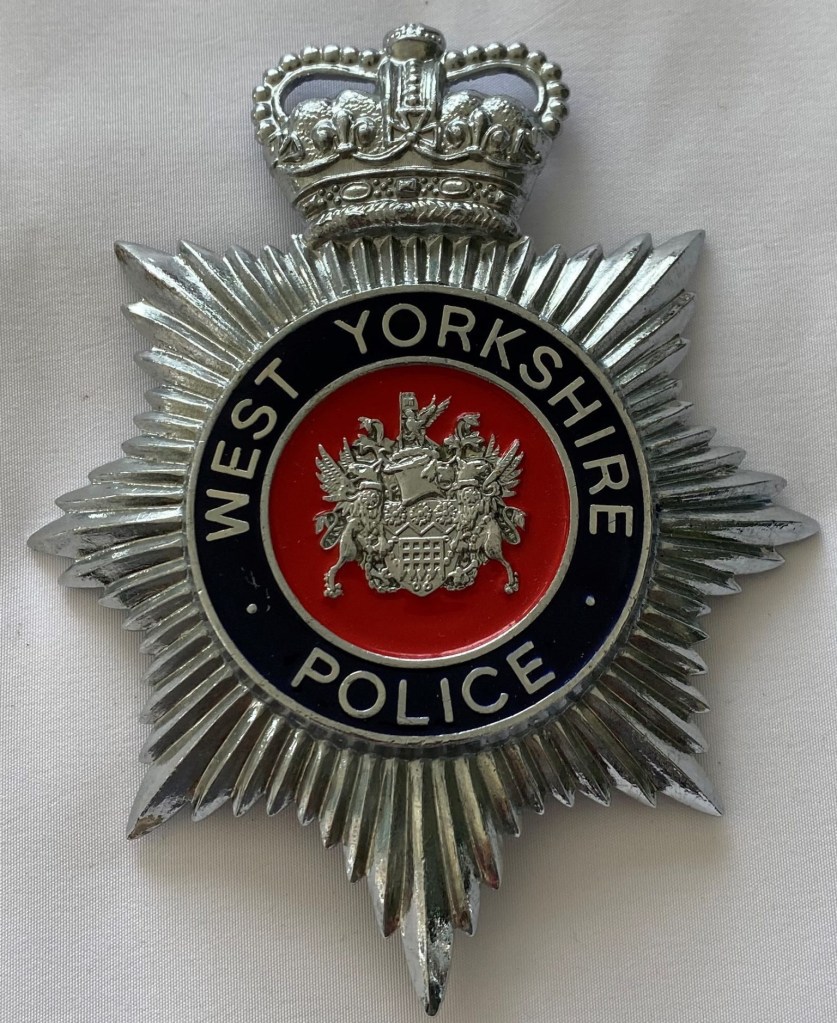
What price police reputation and integrity? Well at the moment about the same as this old badge goes for on eBay.

The 2021 independent report into the murder of journalist Daniel Morgan and the failure to solve the crime by the Metropolitan Police defined institutional corruption as:

“Concealing or denying failings, for the sake of the organisation’s public image, is dishonesty on the part of the organisation for reputational benefit and constitutes a form of institutional corruption.”

In circumstances large or small the police are prepared to manipulate cynically the complaints system in order to get officers off the hook. And in such situations the need for reasonably effective and careful supervision of police Professional Standards Departments is clear.

However staff at West Yorkshire combined authority specifically the Deputy Mayorโ€™s office, who are tasked with supervision of police complaints where the complainant seeks review, seem to be suffering an unfortunate hangover from the days of Mark Burns-Williamson.

Police failed to find in favour of the complainant. The mishandling of the complaint worked rather well for them. So the matter was referred to the Deputy Mayorโ€™s office at West Yorkshire Combined Authority. This is the next stage in the procedure of the complaints process. 

The matter was initially assessed and investigated by Karen Grey of West Yorkshire Combined Authority. 

And important fact to remember in relation to any complaint that you may refer to such as a Police and Crime Commissioner, a local authority, or The Independent Office of Police Complaints is that the matter that was originally under investigation by the policeโ€™s Professional Standards Department will not be investigated again.  

This means that police can misdirect any complaint made about their behaviour at the initial stages of that complaint and that the later appeals stages will not look for or attempt to correct those errors. The complaints system is being tactically gamed therefore to maintain the policeโ€™s professional reputation. Local authority organisations and IOPC are assisting in this.

The body tasked with review of the Police findings in respect of a complaint will conduct a tick box exercise which is essentially to review if the police have fulfilled their own tick-box exercise within their earlier complaint investigation. There will be no investigation into egregious breaches of procedure or abuse of process.

In keeping with this the investigation of the wrong person was missed by Karen Gray. The destruction of body worn video footage barely warranted a mention and the failure to interview a witness or the other officer present likewise. In short the means by which West Yorkshire Police had skewed the investigation, by dishonest means and to evade finding against one of their own officers for a breach of the College of Policing Code, were ignored by the review process.

This does not in anyway represent effective oversight of the policeโ€™s own handling of complaints. The same personnel who were present when the organisation was the Police and Crime Commissioner up until 2021 have moved to the new Combined Authority / Mayorโ€™s office. Given that the reasons PCC Mark Burns-Williamson was incapable of holding police to account are well-known Iโ€™m forced to ponder what the WYCAโ€™s excuse for the same lamentable lack of diligence is?

The suboptimal nature of the Combined Authorityโ€™s review of the police handling of a complaint, the critical facts of West Yorkshire Policeโ€™s own purposeful mishandling of the complaint in order to draw conclusions that police had handled the complaint in line with their obligations

A further review by Julie Reid, Head of Policing and Crime at West Yorkshire Combined Authority, failed to acknowledge that Karen Grey had made any errors in the handling of the complaint. So in effect then while the original complaint was subject to malfeasance from police, the complaint to WYCA about Grayโ€™s mishandling of the original matter was also covered-up.

The ultimate price of this is paid by the public of course. While police are able to cover up misdeeds with impunity and the review organisation also fails to admit it has failed to spot key errors in its own investigation the standard of policing will never improve

Design a site like this with WordPress.com
Get started